

Menu
✕
Published: August 21, 2026>Board360
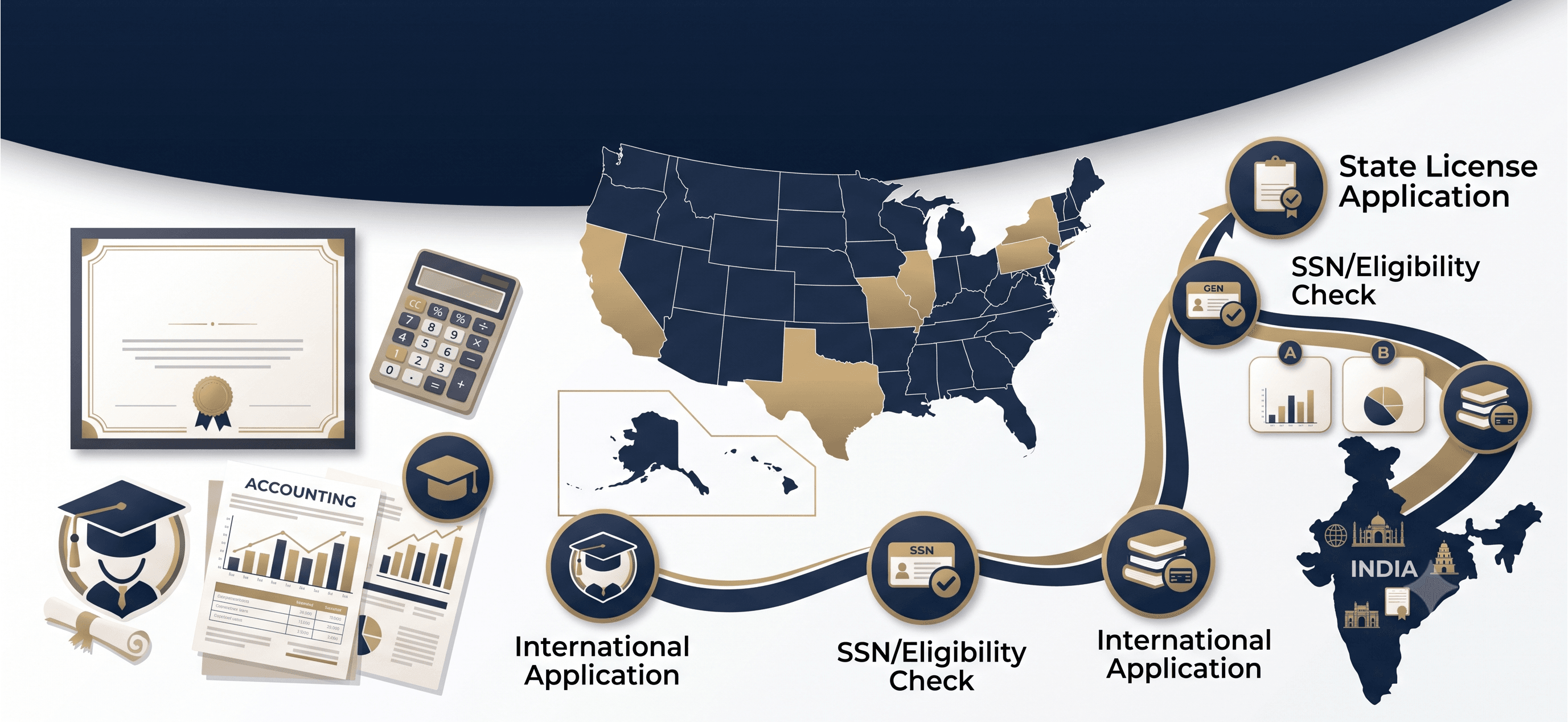
Choosing the right US state board is the first practical decision Indian candidates face after deciding to pursue the CPA. The exam is the same regardless of state. What differs is eligibility: which Indian degrees the state accepts, whether an SSN is required, what the credit-hour threshold is, and how the state handles international applicants. The stakes are real. Applying to a state whose requirements your qualifications do not meet means rejected applications and wasted fees. This post covers the states Indian candidates most commonly use, what the 2026 licensing pathway changes mean for B.Com graduates, and the one factor that does not matter when choosing a state.
The Uniform CPA Examination itself is identical across all 55 US jurisdictions. Passing AUD in Montana produces the same score as passing it in Colorado. What varies by state is the eligibility and licensure framework that surrounds the exam:
| Factor That Varies | Why It Matters for Indian Candidates |
|---|---|
| SSN Requirement | Some states require a US Social Security Number to apply. Indian residents cannot obtain an SSN. States that do not require an SSN are the practical options. |
| Credit-Hour Threshold | Most states require 150 US credit hours for licensure. A B.Com alone is typically ~120 hours. States that have adopted the 120+2 pathway may offer an alternative. |
| Accounting Coursework Requirements | States specify the number of credit hours in accounting, business, and sometimes specific subjects. Whether Indian B.Com coursework qualifies varies by state. |
| Application Fee | State board application fees range from approximately $50 to $200. A secondary consideration, not the primary one. |
| Residency Requirement | Most states have no residency requirement. A small number (Louisiana, Wyoming) impose residency or connection requirements that may eliminate them as options for Indian candidates. |
| Ethics Exam Requirement | Some states require the AICPA ethics exam; some require a state-specific exam; a few have no separate ethics requirement. |
Montana is the jurisdiction most frequently used by Indian CPA candidates. It is managed by NASBA's CPA Examination Services (CPAES), does not require an SSN, and has a straightforward application process for international candidates. Montana's credit-hour requirements follow the standard 150-hour model for licensure. A B.Com plus M.Com or MBA typically meets the 150-hour threshold after credential evaluation. Montana requires a bachelor's degree, 150 semester hours, and one year of qualifying experience for full licensure.
The work experience requirement in Montana must be verified by a licensed CPA. For Indian candidates working at Big 4 firms, GCCs, or MNCs that employ licensed CPAs, this verification is manageable. For those working at purely Indian firms without a licensed CPA supervisor, the experience verification step requires attention.
Colorado is another commonly used state for Indian candidates. It is also NASBA-managed and does not require an SSN. Colorado requires 150 semester hours for licensure, consistent with the national standard, and one year of qualifying experience.
Colorado has enacted the 120+2 alternative licensure pathway under the AICPA/NASBA Uniform Accountancy Act 9th Edition model. This means Colorado now offers two paths to licensure: the traditional 150+1 pathway (150 hours and one year of experience) and the alternative 120+2 pathway (120 hours and two years of experience). Indian B.Com graduates whose credit evaluation lands at approximately 120 hours should verify with the Colorado State Board of Accountancy whether their coursework meets the accounting concentration requirements for the 120+2 pathway.
Guam is a US territory and a participating jurisdiction in the international CPA Examination Administration program. It is NASBA-managed, does not require an SSN, and is a recognized option for Indian candidates.
Guam requires 150 semester hours for licensure and one year of qualifying experience. The application process is similar to Montana and Colorado. One practical difference: Guam is a territory rather than a state, which occasionally raises questions from employers unfamiliar with its CPA program. In practice, a Guam CPA license is a valid US CPA credential and is recognized the same way as any other state license by Big 4 firms, GCCs, and MNCs in India. CPA mobility rules allow Guam-licensed CPAs to practice in substantially equivalent US states without obtaining a separate license.
In May 2025, the AICPA and NASBA approved the 9th Edition of the Uniform Accountancy Act, which added a new alternative licensure pathway: 120 credit hours of education with an accounting concentration, plus two years of qualifying work experience, plus passing the CPA exam. States individually adopt this into law.
As of July 2026, states that have enacted this pathway include Ohio, Georgia, Minnesota, Oklahoma, Texas (effective August 1, 2026), California (effective January 1, 2027), Virginia, Tennessee, Alabama, Arizona, and others. Over 40 states are expected to adopt it by the end of 2026.
For Indian B.Com graduates who have been evaluated at approximately 120 US credit hours, this pathway is potentially significant. It removes the need to complete an M.Com or MBA before pursuing CPA licensure. However, four important caveats apply:
Accounting concentration requirement: The 120+2 pathway requires a bachelor's degree with an accounting concentration. A general B.Com may or may not meet the specific accounting coursework hours required by a given state. Verify with the state board and your credential evaluation agency before assuming your B.Com qualifies.
State-specific implementation: Each state's version of the 120+2 pathway may differ from the UAA model. Some states have adopted the exact model; others have variations. Read the specific rules of your target state, not the UAA model text.
Work experience doubles: The 120+2 pathway requires two years of qualifying experience instead of one year. For candidates who can accumulate this quickly in a qualifying role, this is manageable. For others, the timeline extends.
Mobility implications: CPA mobility allows practice across substantially equivalent states. Most states that have adopted the 120+2 pathway are treating licenses earned under it as substantially equivalent. Verify the current mobility status for any state you are considering if cross-state practice matters to your plans.
A small number of states present specific barriers for Indian candidates that make them impractical choices:
| State / Territory | Issue for Indian Candidates |
|---|---|
| Louisiana | Requires 120 days of continuous physical presence in Louisiana before sitting for the exam. Not practical for India-based candidates. |
| Wyoming | Requires a connection to the state, such as residency or employment. Not available to non-residents. |
| States Requiring SSN | Many states require a US Social Security Number on applications. Indian residents without an SSN cannot apply to these states. Check the specific state board before applying. |
No. Big 4 firms, GCCs, and MNCs in India recognize the US CPA credential, not the issuing state. A Montana CPA and a Colorado CPA are equivalent in the eyes of Deloitte's US tax team in Bengaluru or JP Morgan's GCC finance team in Mumbai. The license is a US CPA license. The state that issued it is not a factor in Indian hiring decisions.
This is a meaningful point because some Indian candidates spend time trying to identify the most prestigious state, which is not a meaningful concept in the way it might be for US-based candidates thinking about reciprocity and in-state practice. For Indian candidates working in India, the credential is what matters. Choose the state whose eligibility requirements your qualifications meet most cleanly.
Step 1: Check SSN requirement. Eliminate any state that requires a US SSN. This narrows the field immediately.
Step 2: Check credit-hour eligibility. If you have a B.Com plus M.Com or MBA and a combined evaluation of approximately 150 credit hours, Montana, Colorado, and Guam are the standard options. If your evaluation lands at approximately 120 credit hours with an accounting concentration, check which 120+2 states have enacted the pathway and whether your degree meets their accounting coursework requirements.
Step 3: Verify accounting coursework requirements. Contact the state board or NASBA CPAES directly with your credential evaluation report and ask whether your Indian degree meets the specific accounting and business credit-hour requirements for that state.
Step 4: Check work experience requirements. Most states require one year of experience under a licensed CPA for the 150+1 pathway, or two years for the 120+2 pathway. Confirm whether your employer in India has a licensed CPA who can verify your experience.
Step 5: Use NASBA's state board directory. The NASBA state board directory lists contact details for every jurisdiction. Contact your top two or three states directly to confirm current requirements before submitting any application or fees.
Board360 offers a structured US CPA program powered by UWorld, covering all four CPA sections under the CPA Evolution format. Your Board360 counselor can also help you identify the right state board for your specific Indian qualifications in your first session. Explore the Board360 CPA program and book a free demo session.