

Menu
✕
June 2, 2026>Board360

SHORT ANSWER: Yes, for finance-specific careers. MBA plus CFA is widely considered the gold standard combination for investment banking, asset management, and buy-side roles in India. The CFA deepens the technical investment expertise that an MBA builds in breadth. For non-finance roles, the uplift is marginal.
If you have finished or are finishing an MBA in India and are asking whether the CFA is worth pursuing next, the answer depends almost entirely on what career you are building. The MBA gives you breadth: strategy, leadership, networks, and business fundamentals. The CFA gives you depth: investment analysis, valuation, portfolio management, and the technical rigor that buy-side and sell-side employers specifically look for.
This post covers the salary data by role, the best time to start CFA during or after your MBA, the IIM-specific context, and how the combination changes your career options in investment banking, asset management, and beyond.
An MBA Finance, even from a top IIM, provides a wide-angle view of finance. Corporate finance, capital markets, investment banking, and valuation are covered. But at the level of breadth needed to produce general managers and functional leaders, not specialists.
The CFA is the opposite. It is three levels of increasingly deep investment analysis: equity, fixed income, derivatives, alternative investments, portfolio construction, risk management, and ethics under the IIA Standards. It is 900 or more study hours across three levels. It is a specialized investment credential that takes 3 to 5 years to complete.
The combination works because the gaps in each credential are filled by the other. The MBA builds networks, strategic thinking, and leadership credibility. The CFA builds technical depth in investment analysis, financial modelling, and asset valuation that the MBA curriculum does not cover at the required level of rigor for front-office roles.
In practice, the MBA gets you into the room. The CFA gives you the credibility to stay in the room and advance in it.
The salary impact of adding CFA to an MBA varies significantly by role. In investment-facing roles, it is substantial. In general management or non-finance roles, it is close to negligible.
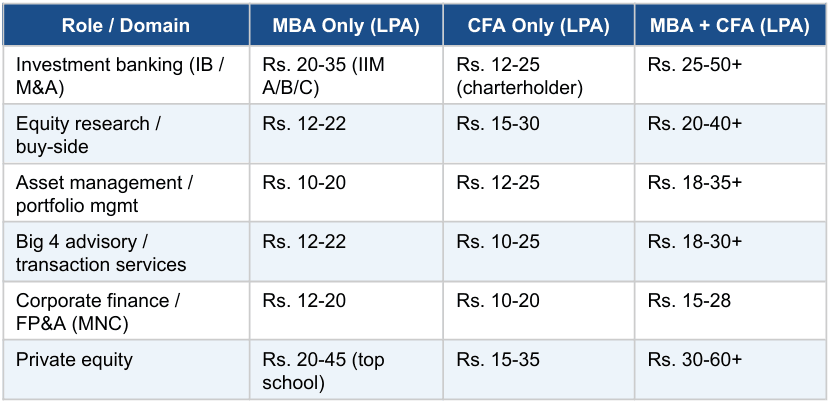
The MBA plus CFA combination commands a 20 to 30 percent premium over MBA alone in investment banking and asset management roles, according to CFA Institute and market salary surveys. The premium is driven by the specificity of the roles: employers in these teams pay for the technical credential, not just the business school brand.
One data point worth noting: IIM A, B, and C placement averages for MBA Finance graduates in 2025 ranged from Rs. 20 to 35 LPA. CFA charterholders in equivalent investment banking or asset management roles with 3 to 5 years of experience reach comparable ranges. The MBA accelerates early-career salary; the CFA accelerates mid-career trajectory.
IIM alumni already have a significant career advantage. The campus placement network, the brand equity, and the alumni base collectively accelerate early-career growth. So the question becomes: does the CFA add enough on top of that?
For IIM graduates targeting investment banking, private equity, or asset management specifically, yes, the CFA adds meaningful value. Many IIM alumni in these roles already hold or are pursuing the CFA. At bulge bracket banks (Goldman Sachs, JP Morgan, Morgan Stanley), at domestic AMCs (HDFC AMC, Mirae, ICICI Pru), and at large PE firms, the CFA is a preferred or expected credential for analysts and associates who want to advance to portfolio manager or investment director roles.
For IIM graduates in consulting, general management, operations, or marketing roles, the CFA adds very little to career advancement. Its value is specifically tied to investment analysis and capital markets work. Pursuing it without that target would be inefficient use of 3 to 5 years of part-time study effort.
The IIM network also helps with CFA networking. IIM alumni chapters at major AMCs and banks are active. CFA Institute India has active chapters in Mumbai, Bangalore, and Delhi NCR where IIM alumni are often prominent members. The combination of IIM brand and CFA credential creates a particularly strong positioning for senior investment roles.
This is the wrong question for someone who already has an MBA. The more useful question is whether the CFA adds enough to justify the time and cost.
For someone who does not yet have either: an MBA from a top school provides faster early-career salary growth due to campus placements. A CFA charterholder without an MBA may take longer to reach the same starting salary but often catches up within 5 to 7 years in specialized finance roles. The combined path is the strongest long-term option.
For someone deciding as an MBA student or recent graduate: the CFA's value compounds from the point you start building investment analysis experience. The sooner you start, the more of your career runs on the combined credential. An MBA graduate who clears CFA Level 1 in their first post-MBA year and earns the charter by year four is operating at full strength from their early career. An MBA graduate who waits until their mid-30s gets fewer compounding years of benefit.
One concrete cost comparison that matters for the decision: a full IIM MBA costs Rs. 27 to 35 lakh. The CFA costs approximately Rs. 3 to 5 lakh in total fees, including exam fees and preparation. You keep earning your salary throughout the CFA journey. The ROI calculation on adding CFA to an MBA is therefore highly favorable, assuming the role target justifies the credential.
Investment banking is the single most common reason MBA graduates in India pursue the CFA. And it is a well-founded reason.
Front-office IB roles in India, whether at global bulge brackets, domestic investment banks, or Big 4 Transaction Services practices, require deep financial modelling and valuation skills that go beyond what most MBA programs teach at sufficient depth. The CFA's Level 1 and Level 2 curriculum covers DCF valuation, comparable company analysis, fixed income pricing, and derivatives in a way that directly supports IB analyst and associate work.
MBA graduates who have cleared CFA Levels 1 and 2 are notably stronger candidates for lateral moves into IB associate roles. Recruiters at Goldman Sachs India, JP Morgan India, and large domestic investment banks have reported that CFA Level 2 or charterholder status is a differentiating factor when selecting candidates without direct IB experience.
For IB specifically, the sequence matters. If you are in your MBA and IB is the target, start CFA Level 1 in Year 1 so you enter your job with Level 1 cleared. Use your first two post-MBA years to clear Levels 2 and 3 while accumulating deal experience. By the time you are a senior associate targeting IB VP roles, the full charter combined with 3 to 4 years of deal experience is one of the strongest profiles in the market.
The timing question matters more than most candidates realize. Starting at the wrong time during your MBA can result in poor exam performance or neglected placement preparation.
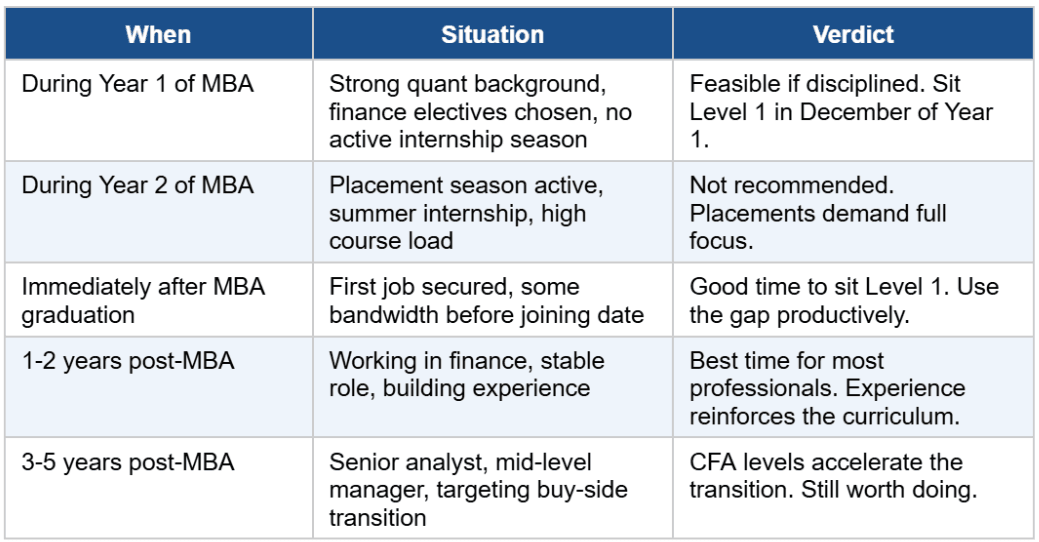
The most common and successful path is to sit CFA Level 1 in December of the first year of your MBA, while the quant skills from your undergrad and early MBA are still fresh. If you pass, you enter Year 2 with Level 1 cleared and can focus entirely on placements. After joining your first post-MBA role, you begin Level 2 preparation once you have settled into the job.
The key principle: never let CFA preparation compete with placement season. IIM placements are the primary return on your MBA investment. Missing placement opportunities because of CFA preparation is not a trade-off worth making.
Yes, but only in the right semester. CFA Level 1 requires approximately 300 hours of preparation. Across a 4 to 5-month study window, that means 2 to 2.5 hours of focused study per day.
In the first semester of most MBA programs, the course load is heavy as students adjust. Many students find Semester 2 or early Semester 3 more manageable for CFA preparation, once the MBA rhythm is established and before final-year placements dominate the schedule.
The December exam window is the most popular for MBA students in India for exactly this reason. You use the time from June to November in your first year to prepare, and the December exam falls before the January-February placement season begins in earnest at most IIMs.
Board360.ai's CFA program is powered by UWorld and is designed for professionals managing study alongside work or academic commitments. A free demo is available. Explore the CFA program at Board360.ai to understand the preparation structure before committing.
Board360.ai's CFA program is powered by UWorld. The program is structured for working professionals and MBA students who are managing study alongside significant other commitments. A free demo is available. Explore the CFA program at Board360.ai and begin building the technical foundation that the MBA plus CFA combination delivers.