

Menu
✕
June 1, 2026>Board360

QUICK ANSWER: The CFA Level 1 pass rate for February 2026 is 45% globally. First-time candidates passed at 50%; repeat candidates at 30%. CFA Institute does not publish India-specific pass rates. The 10-year historical average is 41%. You need approximately 67-69% correct answers to pass.
Pass rate data for CFA Level 1 is more useful than most candidates realize, but only when read correctly. The headline number tells you the difficulty of the exam. The breakdown by first-time versus repeat candidates tells you the most important strategic decision you can make. And the historical trend tells you whether the exam is getting harder or easier.
This post covers all of it, with sourced data from the most recent windows, an honest answer on whether India-specific pass rates exist, what score you need to pass, and how to translate the data into a preparation strategy that puts you in the 50% who pass on the first attempt.
The most recent official data: the February 2026 CFA Level 1 exam passed 45% of candidates. Among first-time candidates, the pass rate was 50%. Among candidates sitting with at least one prior deferral or failed attempt, the pass rate was 30%.
This 20-percentage-point gap between first-timers and repeaters is the single most important data point in this post. It tells you that preparing thoroughly and sitting when ready, rather than sitting early and planning to retake, is the statistically correct strategy. Repeaters are not simply unlucky candidates. They are candidates whose first attempt generated a 30% pass rate, not a 50% one. The first attempt is your best attempt, assuming preparation is adequate.
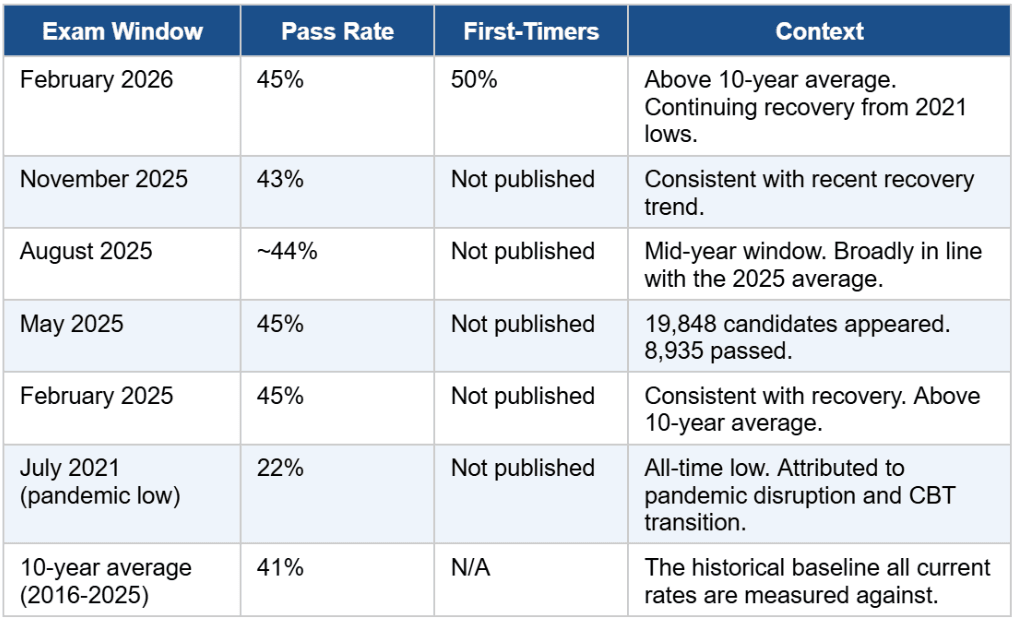
Source: CFA Institute official pass rate publications, as compiled by 300Hours and Schweser. CFA Institute publishes pass rates by exam window but does not break them down by country or region.
No. CFA Institute publishes a single global pass rate per exam window. There is no published India-specific pass rate, South Asia-specific pass rate, or any geographic breakdown of Level 1 results.
This is an important clarification because some Indian coaching providers cite India-specific pass rate figures. Those figures are not from CFA Institute. They are either proprietary data from the provider's own candidate pool, estimates from regional candidate communities, or marketing figures. Treat them as directional at best.
What we can say about Indian candidates from available data: India is one of the largest candidate pools for CFA Level 1 globally. CFA Institute's India Impact Assessment has consistently shown India as a top-three country by candidate volume. Indian candidates come from strong quantitative and analytical educational backgrounds, particularly B.Com, CA, and MBA Finance, which generally serves them well in the quantitative and financial reporting portions of Level 1. There is no data suggesting Indian candidates systematically underperform or outperform the global average.
It has been recovering. The 2021 pandemic lows were genuine outliers. The July 2021 pass rate of 22% was driven by pandemic disruption, candidates who had deferred multiple times sitting simultaneously, and the transition to computer-based testing. CFA Institute explicitly attributed those lows to pandemic conditions, not any change in exam difficulty.
Since 2022, pass rates have steadily recovered toward historical norms. The 10-year average (2016-2025) is 41%. The 2025 and February 2026 results of 43-45% are above that average, which means the exam is currently running slightly more accessible than historical norms in pass rate terms.
CFA Institute's official position is that exam difficulty does not change. The pass rate variation reflects candidate preparation quality, not exam design. The current above-average pass rates reflect a more experienced candidate pool and improved preparation resources, not an easier exam.
CFA Institute does not publish the Minimum Passing Score (MPS). The MPS is determined after each exam administration using a standard-setting process, and only a pass or did not pass result is disclosed to candidates.
Based on analysis of 20,000 or more candidate results annually, 300Hours estimates the 2025-2026 MPS at approximately 67-69% correct answers for Level 1. This estimate has been consistent for several years and is widely used as a preparation benchmark by coaching providers globally.
In practical terms: aim to consistently score 70% or above on full mock exams before sitting. A 70% mock score gives you a reasonable buffer above the estimated MPS and accounts for the natural variation between practice conditions and the actual exam. Candidates whose mock scores are consistently between 60% and 65% are operating too close to the estimated MPS threshold to sit with confidence.
The 2026 scoring system uses a scaled score. CFA Institute moved to a 1,600-point scale for Level 1 in 2025. The specific scaled score you need to pass is not disclosed. What matters for preparation purposes is the percentage correct estimate of 67-69%, which is derived from candidate data rather than from CFA Institute's methodology.
The global 45% pass rate is the average across all candidates, including those who sit with 100 hours of study and those who sit with 400 hours. Your individual pass probability is not determined by the global average. It is determined by your preparation.
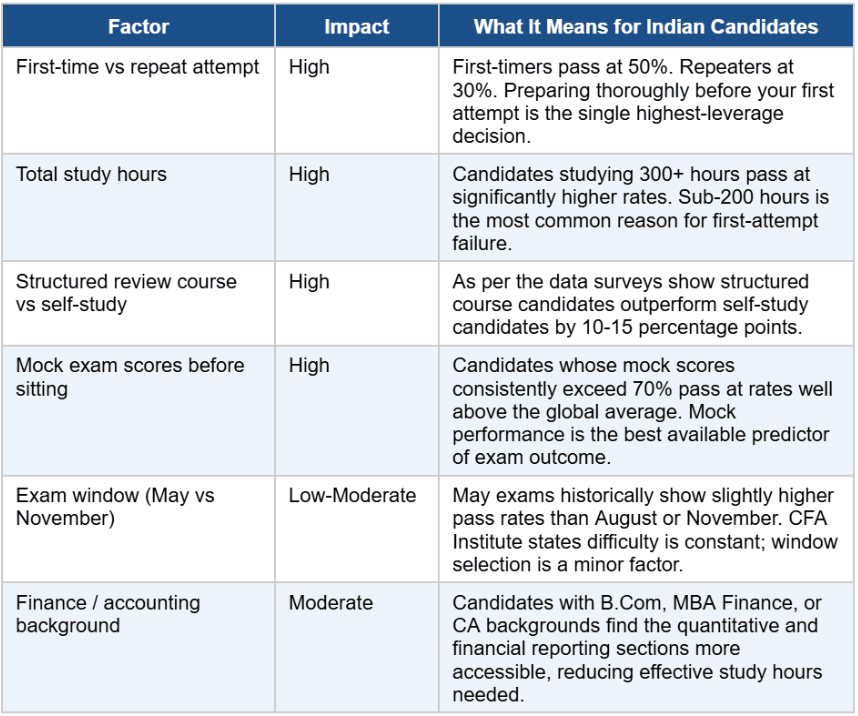
The most actionable insight from this table: the first-time vs repeat gap is 20 percentage points. No other single factor comes close to that magnitude. Delaying your sitting by 6 to 8 weeks to reach genuine readiness is almost always the right decision if your mock scores are below 68%.
The widely cited benchmark is 300 hours for Level 1. CFA Institute itself suggests 300 hours as a reference point, and most structured coaching programs are designed around this figure.
For Indian candidates specifically, the actual hours needed vary by background:
The relationship between study hours and pass rate is not linear. The returns from hours 1 to 200 are high as you build foundational coverage. Hours 200 to 300 consolidate and stress-test knowledge. Hours 300 to 400 produce diminishing returns unless specifically targeted at documented weak areas.
The highest return on study time is mock exam review, not additional content study. Candidates who complete 3 to 5 full mock exams under timed conditions and then systematically review incorrect answers learn far more per hour than candidates who reread textbooks without testing.
Board360.ai's CFA program is powered by UWorld, which has a 95% first-attempt pass rate among its CFA candidates. That figure significantly outperforms the global 50% first-timer average.
The mechanism that drives the difference is UWorld's SmartPath adaptive technology. The platform tracks your performance across all topic areas, identifies specific learning objectives where your accuracy is below threshold, and dynamically reprioritizes your study queue to address those gaps. This is fundamentally different from working through a static question bank in chapter order.
The practical implication: a candidate using UWorld for 280 hours of targeted preparation will typically outperform a candidate doing 350 hours of unstructured self-study, because the 280 hours are directed at genuine weakness rather than comfortable revision of already-mastered material.
For Indian working professionals specifically, adaptive efficiency matters. Most cannot commit 20+ hours per week to study. Explore Board360.ai's CFA program to understand how the UWorld preparation structure fits around a working schedule.
CFA Institute does not publish pass rates by employment status. What the data implies is that working professionals face a specific structural challenge: study time compression.
The 300-hour benchmark spread over a working professional's schedule typically requires 5 to 6 months of consistent 12 to 15 hours per week. Many Indian professionals manage 8 to 10 hours per week, extending the preparation window to 7 to 9 months. This is manageable but requires preserving one specific exam window rather than maintaining open-ended preparation.
Working professionals in finance, accounting, or investment-adjacent roles have an additional advantage: content familiarity. A CFA Level 1 candidate who works in equity research, FP&A, or portfolio analytics encounters the conceptual vocabulary of the Level 1 curriculum in their daily work. This reduces effective study hours by 15 to 25 percent for experienced finance professionals compared to candidates entering the CFA with no industry background.
The strategic advice for working professionals is specific: book your exam before you start studying. Candidates with a fixed exam date study differently from those with an open-ended preparation window. The deadline creates accountability that consistently translates into better study consistency and higher completion of planned preparation hours.
CFA Level 1 is available in four windows: February, May, August, and November. All are available to Indian candidates at Prometric test centers across India.
May has historically shown slightly higher pass rates than August or November, likely reflecting candidate self-selection: candidates sitting in May tend to have studied through the February-April period with fewer competing obligations. CFA Institute explicitly states exam difficulty is constant across windows.
For Indian candidates, the window selection should be driven by preparation readiness, not window pass rate trends. The difference between a May and November pass rate is 2 to 5 percentage points historically. The difference between sitting ready and sitting underprepared is 20 percentage points. Choose your window based on when you can complete 300 hours of quality preparation, not on which window appears statistically favorable.
Board360.ai's CFA program is powered by UWorld's SmartPath adaptive technology, with a 95% first-attempt pass rate across all three levels. The program is structured for working professionals managing study alongside full-time roles and covers all Level 1 topic areas with adaptive practice, full mock exams, and performance tracking. A free demo is available. Explore the CFA program at Board360.ai and start building toward the 50% of first-time candidates who pass.