

Menu
✕
June 2, 2026>Board360

CRUX: CFA is the stronger credential for investment banking, equity research, asset management, and buy-side roles. CPA is stronger for external audit, US GAAP reporting, Big 4 advisory, and tax. They serve different career paths and are not direct substitutes.
The CFA and the US CPA are both globally recognized finance credentials, and both are actively hired for in India. But they are built for completely different career tracks. Choosing between them based on which 'looks better' is the wrong frame. The right question is which one fits where you want to go.
This comparison covers every dimension that matters: exam structure, difficulty, salary by role, Big 4 recognition, investment banking scope, and what happens when you hold both. By the end, you will have a clear answer for your specific situation.
The CFA is issued by the CFA Institute and is the global standard for investment management professionals. It covers equity analysis, fixed income, derivatives, alternative investments, portfolio management, and ethics. It is the credential that asset managers, equity researchers, investment bankers, and portfolio managers pursue. In India, SEBI explicitly recognizes the CFA charter for Research Analyst registration under its regulations.
The US CPA is issued by AICPA through US state boards and is the gold standard for public accounting professionals. It covers external audit, financial reporting under US GAAP, taxation, and business environment. It is the credential that Big 4 GCC professionals, MNC controllership teams, and US-facing finance functions pursue in India.
CFA is a markets and investments credential. CPA is an accounting and reporting credential. The overlap between them is real but limited. Both can eventually lead to CFO-track roles, but through entirely different intermediate paths.
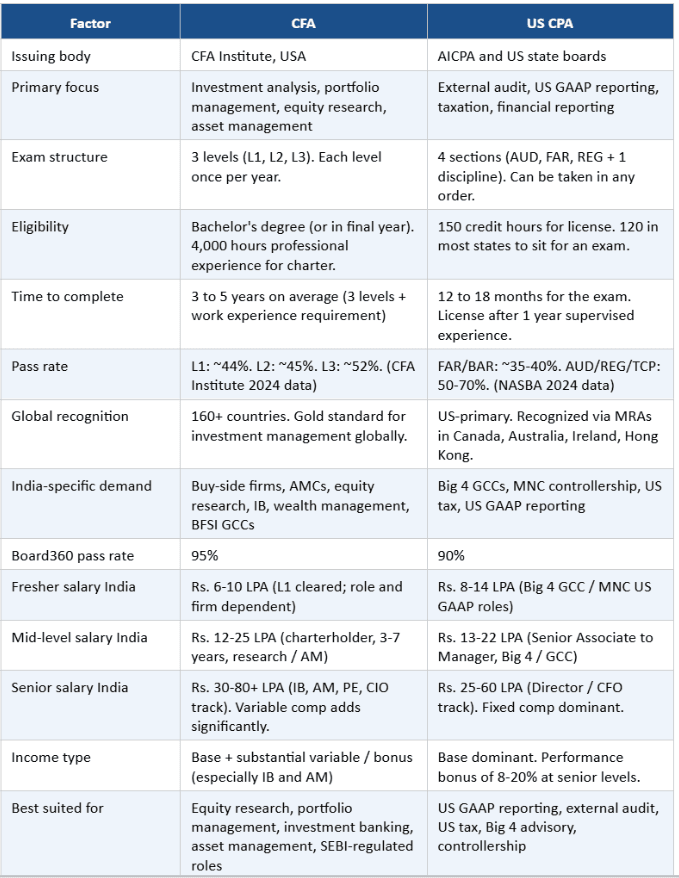
Both credentials have serious failure rates. Neither is a quick certification.
The CFA has three levels, each administered once per year. CFA Institute's 2024 exam data shows Level 1 passing approximately 44% of candidates, Level 2 around 45%, and Level 3 around 52%. The exam tests judgment and application more than memorization. Candidates must accumulate 4,000 hours of qualified professional experience before receiving the charter. Average time from starting Level 1 to earning the charter is 4 to 5 years for most working professionals.
The CPA has four sections that can be taken independently and in any order. NASBA's 2024 data shows FAR and BAR falling below 40% pass rates, with TCP the most accessible at above 70%. There is no work experience required to sit for the exam, though 1 year of supervised experience under a licensed CPA is required in most states for licensure. Most dedicated candidates complete all four sections in 12 to 18 months.
The honest comparison: the CPA is faster to complete. You can sit multiple sections per year, there are no annual exam cycles, and the total time to completion is considerably shorter. The CFA takes longer because of the annual exam schedule and the experience requirement. However, both demand serious preparation, and neither credential tolerates underestimation.
Both credentials produce strong salaries in India, but through different mechanisms. The CFA delivers a higher base in investment-facing roles and substantially higher variable compensation through bonuses and performance-linked pay. The CPA delivers more stable and predictable compensation with a reliable base salary growth track.
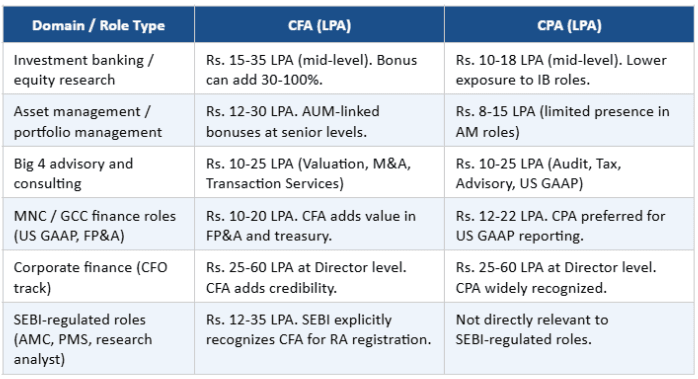
The CFA Institute's India Impact Assessment reports that charterholders with six years of experience or less average Rs. 28.6 LPA. This figure is pulled up by investment banking and portfolio management professionals where variable compensation adds significantly to base salary. CPA mid-career salaries in Big 4 GCCs and MNCs cluster more tightly around Rs. 13-22 LPA at comparable experience, with lower variable comp but more predictable income growth.
The key insight: in roles where both credentials compete directly, such as Big 4 advisory and corporate finance, salaries are broadly comparable. The CFA has higher upside in investment-specific roles due to bonus-heavy compensation structures. The CPA has a more stable and predictable income trajectory at Big 4 and MNC employers.
For investment banking specifically, the CFA is the significantly stronger credential.
Investment banking in India, whether at bulge bracket banks (Goldman Sachs, JP Morgan, Morgan Stanley) or at Big 4 Transaction Services practices, values the CFA's depth in valuation, financial modelling, and investment analysis. The CFA curriculum directly covers discounted cash flow analysis, comparable company analysis, LBO fundamentals, and fixed income pricing. These are the core technical skills of IB analyst and associate roles.
The CPA covers none of these subjects directly. CPA-qualified professionals can transition into investment banking through Big 4 Transaction Services or M&A advisory, but the CFA is the more natural fit for IB roles that require investment analysis judgment. In a direct comparison for an IB analyst role, a CFA Level 2 or 3 candidate will typically be preferred over a CPA-only candidate.
That said, the combination of CFA and CPA is particularly powerful in M&A advisory and Transaction Services roles, where accounting due diligence and investment analysis are both required. Professionals with both credentials are rare and command a meaningful premium in these teams.
Both credentials are valued at all four Big 4 firms in India. The service line determines which one takes precedence.
In Audit and Assurance, US Tax, and US GAAP reporting service lines, the CPA is the primary credential. These teams handle PCAOB audit, SOX compliance, and US financial reporting. The CPA signals direct competency for this work and is listed as preferred or required at the Senior Associate level and above.
In Transaction Services, Valuation, and Deals Advisory service lines, the CFA is actively preferred. These teams handle M&A due diligence, business valuations, fairness opinions, and financial modelling. CFA-level investment analysis skills map directly to this work.
In Risk Advisory and FP&A roles, both credentials appear. CFA holders are valued for treasury, investment risk, and strategic planning work. CPA holders are valued for financial controls, US GAAP compliance, and reporting accuracy.
A notable data point from salary research: at Big 4 India, there is a recognized salary cap of approximately Rs. 22 to 25 LPA for professionals without specialized certifications at the Senior Manager level. Both the CFA and CPA credential break through this cap in their respective service lines.
MBA graduates in India face this choice regularly, and the answer depends on what you specialized in and where you want to go.
An MBA Finance graduate targeting investment management, equity research, or wealth management should pursue the CFA. The CFA complements an MBA by adding technical investment analysis depth that MBA programs cover at a lighter level. CFA plus MBA is the strongest combination for front-office finance roles at asset management firms, investment banks, and BFSI companies in India.
An MBA Finance graduate targeting Big 4 advisory, MNC controllership, or US-facing finance functions should pursue the CPA. The CPA adds US GAAP technical competency and international accounting credibility that an MBA Finance alone does not provide. In GCC and Big 4 hiring for US-facing roles, the CPA is specifically listed in job descriptions in ways that MBA alone is not.
For MBA graduates unsure of their domain, consider your elective choices and internship direction. If you worked in consulting, banking, or research, CFA aligns better. If you worked in audit, finance operations, or MNC finance, CPA aligns better.
Yes, and a meaningful number of senior Indian finance professionals hold both.
The combination is particularly powerful in M&A advisory, Transaction Services, and CFO-track corporate finance roles where both investment analysis and accounting depth are required. A CFA-plus-CPA professional can move seamlessly between buy-side analysis, deals advisory, and controllership in ways that single-credential professionals cannot.
The recommended sequence: pursue CPA first if you are currently in an accounting, audit, or US GAAP role, as it delivers the most immediate salary and career impact for your current context. Pursue CFA first if you are in or targeting investment analysis, research, or asset management.
In terms of total timeline, completing both credentials takes approximately 3 to 5 years. The CPA is typically done first given its shorter completion path. CFA Levels 1 and 2 are then pursued after, with Level 3 following once professional experience is building. The dual-credential combination commands a premium of 15 to 25 percent over peers with either credential alone, according to industry compensation surveys.
Board360.ai offers both the CFA program (powered by UWorld, 95% pass rate) and the US CPA program (powered by UWorld SmartPath, 90% pass rate). Both programs include free demos. If you are still deciding between the two, explore both program pages and speak to the Board360.ai team to map the right credential to your specific career goals.