

Menu
✕
June 3, 2026>Board360

CRUX: For investment-specific careers, CFA wins on cost, global recognition, and technical depth. For career switching, consulting, or general management, a Tier-1 MBA wins on entry salary and network. The combination of both is the strongest setup for senior investment and strategy roles.
This is one of the most consequential decisions a finance professional in India faces. It is not a close call either way. The CFA and a Tier-1 MBA are genuinely different products that open genuinely different doors. Choosing the wrong one for your goals is expensive in both money and time.
This post gives you the data to decide: real cost numbers, salary by stage, investment banking access, how the two stack up at Big 4 firms, and whether you should do one instead of the other or both.
The MBA is a general management degree. The top IIMs and ISB produce graduates who go into consulting at McKinsey and BCG, investment banking at Goldman Sachs, strategy at MNCs, general management at consumer companies, and everything in between. The MBA is a career accelerator and a career switcher. Its power comes from the institution's brand and placement network, not from technical specialization.
The CFA is a specialized investment credential. It produces professionals who are technically excellent in investment analysis, portfolio management, equity research, and financial valuation. Its power comes from demonstrated technical competence and global institutional recognition across 160+ countries. It does not switch your career or provide an alumni network in the MBA sense. It deepens and validates expertise you are already building.
The most common mistake: treating these as equivalent qualifications competing for the same role. They are not. A better frame is: the MBA buys you access to a broader set of doors at the entry level, particularly through campus placements. The CFA deepens your credibility in investment roles over the mid and long term.
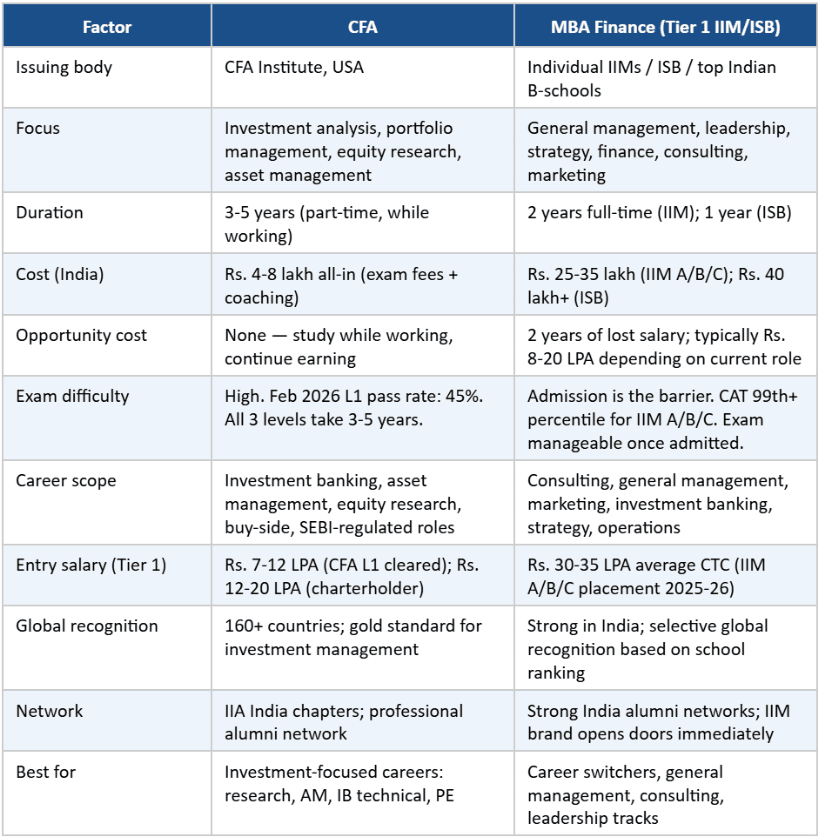
Entry-level salary is where the MBA advantage is most dramatic. Top IIM and ISB placement reports for 2025-26 show average CTCs of Rs. 30-35 LPA for IIM A/B/C graduates. CFA Level 1 cleared candidates typically start at Rs. 7-12 LPA in analyst roles. The gap at entry is Rs. 20-25 LPA in favor of the Tier-1 MBA.
By mid-career, the gap narrows significantly in finance-specific functions. A CFA charterholder with 5 years of investment experience in equity research or asset management typically earns Rs. 18-28 LPA. An MBA Finance graduate with 5 years in a comparable investment role earns in a similar range. The MBA's early-career advantage compresses as technical competence and track record become the dominant salary drivers.
At the senior level, CFA holders in portfolio management, private equity, and asset management can reach Rs. 40-60 LPA, with variable compensation pushing total packages significantly higher in fund management roles. MBA Finance graduates at equivalent seniority in consulting or general management earn comparably. Both converge in the Rs. 30-60 LPA range at 10 years, with the specific role and employer mattering more than the credential.
The true cost comparison is where the CFA wins decisively on ROI. A CFA costs Rs. 4-8 lakh all-in including coaching and exam fees, with no opportunity cost because you continue working. A Tier-1 IIM MBA costs Rs. 25-35 lakh in tuition plus Rs. 16-40 lakh in lost salary across two years, bringing the true economic cost to Rs. 50-70 lakh or more. For professionals targeting specialized investment careers, the CFA delivers a comparable or superior outcome at a fraction of the investment.
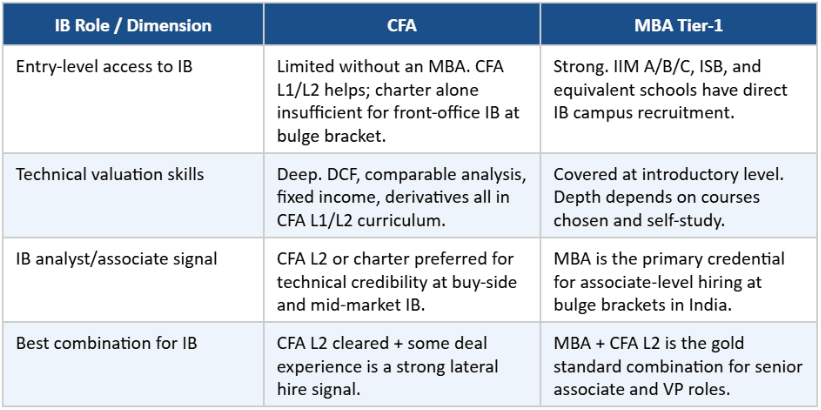
The honest answer for investment banking in India: a Tier-1 MBA is the more reliable entry route at the associate level at bulge bracket banks. Goldman Sachs India, JP Morgan India, and Morgan Stanley India predominantly hire IB associates from IIM A/B/C and ISB campuses.
However, the CFA is increasingly relevant for two IB scenarios: lateral hire access to mid-market and domestic investment banks where campus hiring is limited, and technical credibility at the senior associate and VP level where CFA charterholder status is listed as preferred. A CFA Level 2 candidate with 2-3 years of relevant deal or research experience is a strong lateral candidate for associate roles at mid-market IB and Big 4 Transaction Services practices.
Big 4 firms in India value both credentials, but in very different service lines.
For Audit, Tax, and US GAAP service lines: neither CFA nor MBA is the primary credential. CA and CPA are more relevant.
For Transaction Services and Deals Advisory: MBA Finance from a Tier-1 school is the primary credential for associate-level hiring. CFA provides additional technical credibility for senior roles involving valuation and deal structuring.
For FP&A and Performance Management Advisory: CMA or MBA Finance with relevant analytics experience is the stronger fit. CFA is less directly applicable here.
For Strategy and M&A Advisory: MBA is the primary credential. CFA adds technical depth for investment-heavy mandates.
The bottom line: at Big 4 India, neither the CFA nor the MBA alone drives access to the highest-fee work. The combination of MBA for entry and CFA for technical credibility is the strongest positioning for senior roles in Deals and Advisory.
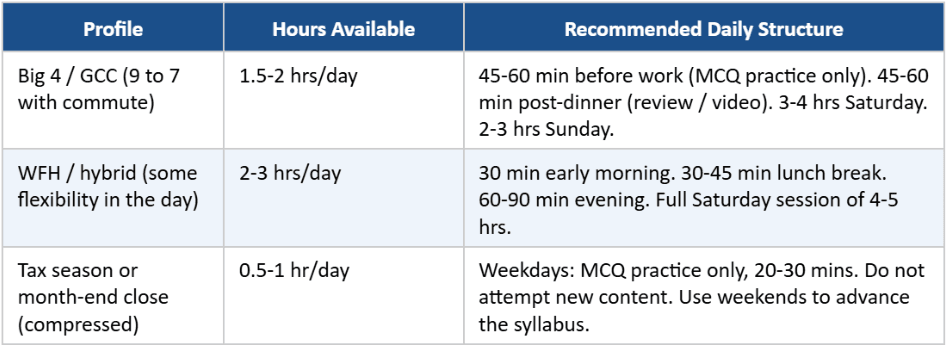
This dimension heavily favors the CFA for working professionals who do not want to pause their careers.
The MBA requires you to stop working for one to two years. Even ISB's one-year program requires full-time commitment. During that period, you are paying tuition, living expenses, and forgoing your salary. For someone earning Rs. 10-15 LPA before the MBA, the true two-year cost of an IIM A program is closer to Rs. 55-65 lakh when opportunity cost is included.
The CFA requires no career break. You study alongside your job, typically 10-15 hours per week across 3-5 years. Total fees across all three levels range from USD 3,500 to USD 4,500 (approximately Rs. 3.4 to 4.4 lakh at current rates). Add coaching costs of Rs. 1-3 lakh and the total is Rs. 4-8 lakh, with no lost salary.
For a working professional at age 27-30 who already has a finance job and is building investment expertise, the CFA's ROI is almost always stronger than a Tier-2 or Tier-3 MBA. The only case where an MBA beats CFA on ROI is a Tier-1 admission (IIM A/B/C or ISB) for someone who wants to switch careers or enter consulting.
Yes, but with one important qualification: it depends entirely on your career target.
If you want to enter investment banking through campus placements at bulge bracket banks, or switch from a non-finance background into consulting or general management, the MBA provides access the CFA does not. The MBA's campus placement system is a structured entry mechanism that the CFA has no equivalent to.
If you are already in finance, targeting investment analysis, asset management, equity research, or buy-side roles, and want to deepen your technical credibility while continuing to earn, the CFA is the more efficient path. The CFA does not require you to leave your job, costs significantly less, and signals exactly the technical specialization that investment-focused employers value.
The CFA also does not close the MBA door. Many professionals complete the CFA first, build 3-5 years of investment experience, and then pursue an MBA later with a much stronger profile for Tier-1 admission. The reverse, MBA first then CFA, is equally common and produces the strongest combination for senior investment roles.
In terms of brand recognition in India, an IIM A/B/C or ISB MBA has higher immediate brand value than a CFA for most employers. The IIM brand opens doors in consulting, FMCG, banking, strategy, and general management through placement networks that simply do not exist for CFA candidates.
In terms of investment-specific credibility, the CFA has higher technical recognition in the investment management community globally. Asset managers, hedge funds, and research teams globally treat the CFA as the gold standard for investment analysis. An IIM MBA alone does not carry that specific technical signal.
For the Indian market in 2026, the most useful frame is domain-specific:
Board360.ai's CFA program is powered by UWorld, with a 95% first-attempt pass rate across all three levels. The program is designed for working professionals who want to build investment expertise without pausing their careers. A free demo is available. Explore the CFA program at Board360.ai and see where the CFA fits in your 2026 career plan.