

Menu
✕
June 2, 2026>Board360

CRUX: CIA opens more doors in internal audit, GRC, and risk management. CPA opens more doors in external audit, US GAAP reporting, and broad finance. CPA has a higher entry-level salary. CIA has a higher long-term ceiling in dedicated audit leadership. The best combination is both.
Both the CIA and the US CPA are globally recognized, actively valued in India's Big 4 and GCC market, and capable of building strong finance careers. But they are built for different functions and serve different career destinations.
This comparison cuts through the noise on every dimension that matters: exam structure, difficulty, salary, Big 4 recognition, global reach, and how the two credentials interact when combined. By the end, you will know clearly which one fits your career path in 2026.
The CIA is issued by the Institute of Internal Auditors and is the only globally recognized credential specifically for internal auditors. It covers internal audit methodology, risk-based audit planning, governance frameworks, internal controls, and the Global Internal Audit Standards (GIAS). It is relevant wherever an organization needs someone who can assess and improve its internal assurance function.
The US CPA is issued by AICPA through US state boards. It covers external audit, financial reporting under US GAAP, taxation, and advisory. It is the standard credential for public accounting in the US and is widely recognized by MNCs and Big 4 GCCs in India for US-facing work.
One is a specialization credential for internal audit. The other is a broad public accounting credential. They do not compete for the same jobs. They compete for the same candidate pool, which is why so many Indian finance professionals end up comparing them.
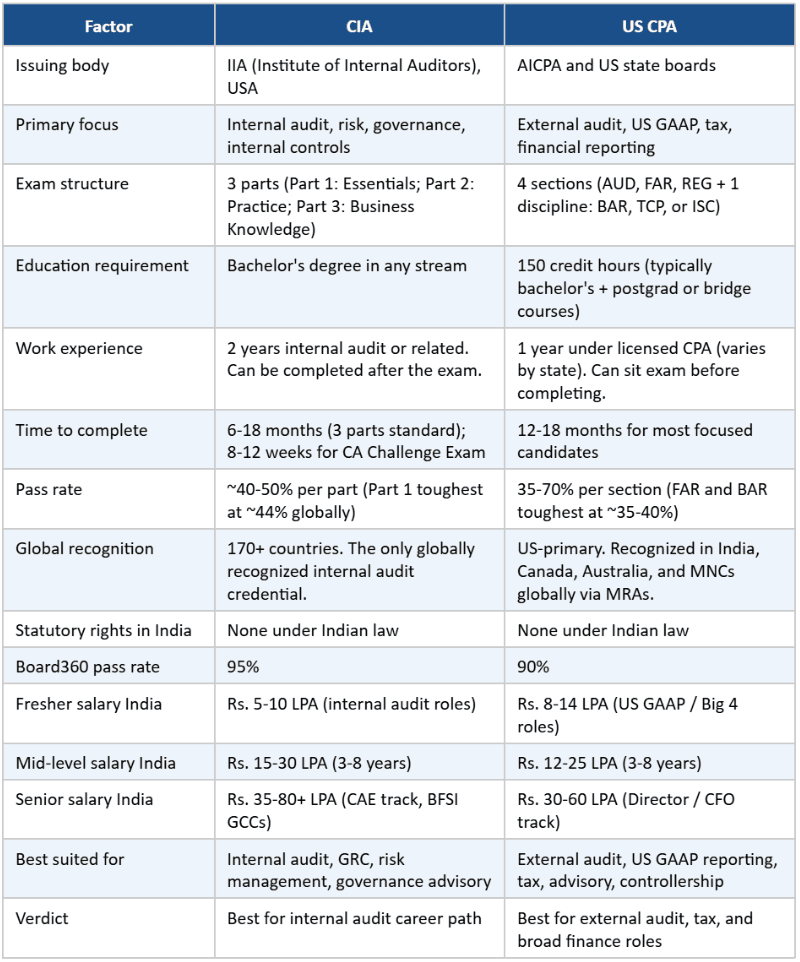
Both exams are genuinely difficult. Neither is a shortcut. But the difficulty is structured differently.
The CIA has three parts. Part 1 globally passes around 44% of candidates, making it statistically the hardest individual paper of the two credentials. Part 2 runs around 50-55% and Part 3 is the most accessible. The challenge with CIA is that Part 1 requires deep understanding of the GIAS framework which was updated in 2025, meaning pre-2025 materials are not adequate for current exam sitters.
The CPA has four sections, two of which, FAR and BAR, pass fewer than 40% of candidates per attempt. NASBA's 2024 data shows TCP at the highest pass rate of the four sections and BAR at the lowest. The total study volume for the CPA is significantly higher than for the CIA because the breadth of content is wider.
In terms of total time to complete: the CIA is faster on average. Three parts with a combined study burden of 300 to 400 hours versus four CPA sections requiring 300 to 400 hours per section. Most dedicated CIA candidates finish in 6 to 12 months. Most CPA candidates take 12 to 18 months.
One important fast-track for Indian candidates: qualified Indian CAs can take the CIA Challenge Exam, a single 150-question paper that replaces all three parts. For CAs, preparation typically takes 8 to 12 weeks.
At the fresher level, the CPA has a higher starting salary in India. This is because CPA-qualified freshers enter Big 4 GCCs and MNCs in US GAAP roles that command Rs. 8 to 14 LPA, while CIA freshers entering internal audit roles typically start at Rs. 5 to 10 LPA.
The picture changes at mid and senior levels. CIA holders on the Chief Audit Executive track in BFSI GCCs can reach Rs. 80 to 100+ LPA. CPA holders on the CFO and controllership track typically reach Rs. 50 to 80 LPA at equivalent seniority. The IIA's global salary data shows CIA-certified professionals earning 37 to 51 percent more than non-certified internal auditors, a premium that holds broadly in the Indian market.
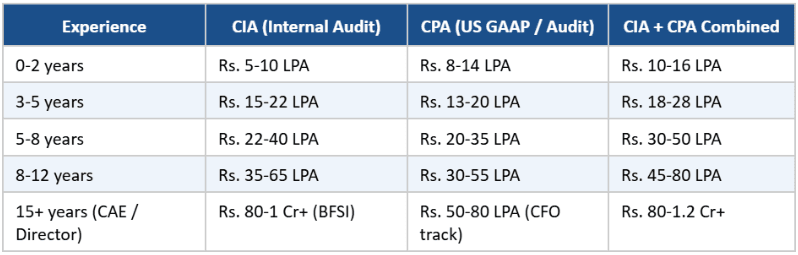
The combined CIA and CPA salary band is the highest at every level. Professionals who hold both certifications command a 15 to 25 percent premium over single-certification peers in roles that value both internal and external audit expertise.
Both credentials are present and valued at all four Big 4 firms in India. But they appear in different service lines.
The CPA is the primary credential in Audit and Assurance, US Tax, and Transaction Services service lines. At Deloitte, EY, PwC, and KPMG India, the US GAAP and PCAOB audit teams that service US-listed clients specifically prefer CPA holders at the Senior Associate level and above. The CPA signals the technical competency needed for those mandates.
The CIA is the primary credential in Advisory and Risk service lines. Big 4 advisory teams handling internal audit outsourcing mandates, SOX and ICFR advisory, enterprise risk management, and governance reviews for large Indian and multinational clients actively recruit and prefer CIA holders at the same level. In these teams, the CIA credential directly maps to what the client is paying for.
A Big 4 salary report from 2025 notes explicitly that there is a salary cap of approximately Rs. 22 to 25 LPA for professionals without additional certifications at the Senior Manager level. Beyond that, international certifications like the CPA or CIA become essential for further progression. Neither credential dominates at Big 4. They operate in parallel service lines that occasionally converge in advisory and risk work, where holding both is the most powerful combination.
The CIA is recognized in over 170 countries. As the IIA's only certification for internal auditors, it has consistent recognition across every major market: the US, UK, UAE, Singapore, Australia, and emerging markets in Southeast Asia and Africa. An Indian CIA holder can step into an internal audit role at a multinational in any of those markets without the credential being questioned.
The CPA is primarily a US credential. It is recognized in the US, and through Mutual Recognition Agreements (MRAs), it is directly recognized in Canada, Australia, Ireland, Hong Kong, New Zealand, and Mexico for certain roles. In other markets, particularly the Middle East and Southeast Asia, the CPA is valued but not formally recognized in the same way. For Indian professionals targeting the US market specifically, the CPA is stronger. For those targeting a broader international career across multiple geographies, the CIA has wider standardized recognition.
This one is clear. For a dedicated internal audit career, the CIA is the stronger primary credential.
The CIA is the only internationally recognized certification that signals internal audit specialization. A CPA can work in internal audit, but the CPA does not directly signal internal audit competency the way the CIA does. Hiring managers for senior internal audit roles, particularly in MNCs and BFSI GCCs, list CIA as preferred or required and CPA as complementary. That preference pattern is consistent across Big 4 Advisory, GCC internal audit functions, and standalone corporate internal audit departments.
For the specific question of which certification is best for internal auditors in India, the answer is CIA first, with CPA as the secondary qualification that broadens your reach into accounting and advisory when you are ready for it.
Yes. And the combination is widely recognized as the most powerful credential pairing for senior finance careers in India.
The recommended sequence depends on your current role. If you are in internal audit or a corporate finance role, pursue the CIA first. It is faster, directly applicable to your current work, and opens the salary premium immediately. Add the CPA afterwards for breadth and credibility in external audit and advisory contexts.
If you are in external audit at a Big 4 or planning to enter a US GAAP role at a GCC, pursue the CPA first. It is the more directly applicable credential for that context. The CIA adds strategic depth in governance and risk once your accounting foundation is established.
Combined CIA and CPA holders in India consistently access the broadest range of senior roles and the highest salary bands. The dual-credential path takes longer, typically 2 to 3 years for both, but the career ceiling it creates justifies the investment for those with long-term ambitions in audit, advisory, or finance leadership.
Board360.ai offers both credentials under one platform. The CIA program is powered by HOCK International with a 95% pass rate and covers the GIAS 2025-aligned syllabus, including the Challenge Exam fast-track for qualified CAs. The CPA program is powered by UWorld SmartPath with a 90% pass rate and covers all four sections. Free demos are available for both programs.