

Menu
✕
June 8, 2026>Board360

QUICK ANSWER: Passing all 4 CPA exam sections makes you an exam passer, not a licensed CPA. The license requires 3 more steps: 150 credit hours confirmed, work experience (1 year minimum under a licensed CPA), and a state board application. Many states also require an ethics exam. Total time from last exam pass to license: 3-6 months if documentation is in order.
This is the part that surprises many Indian CPA candidates. You pass FAR. You pass AUD. You pass REG. You pass your discipline section. You expect to be a CPA. Then you discover there are several more steps before that title is officially yours.
Passing the exam sections makes you a CPA exam passer. The CPA license is a separate credential issued by your state board, and it requires education confirmation, verified work experience, and in most states an ethics examination. This post walks through every step in detail, specifically for candidates based in India.
This distinction matters practically. An exam passer has demonstrated technical competency by clearing the four exam sections. They cannot, however, legally describe themselves as a CPA or perform public accounting services under that title. Only a licensed CPA can use the CPA designation, sign audit reports, and practice public accounting in regulated contexts.
For most Indian CPA holders working at Big 4 GCCs, MNCs, or non-public-accounting roles, the license itself may not be a day-one operational requirement. Your employer may not distinguish between an exam passer and a licensed CPA for internal finance or advisory roles. But the license is the full credential. It is what every job description means when it says CPA. Pursuing the license after passing the exams is the logical completion of the journey you started.
The AICPA describes the licensing requirements as the 4 Es: Education, Examination, Ethics, and Experience. You have completed your Examination. The remaining three are what this post covers.
Most US state boards require 150 US credit hours of education for the CPA license. You may already have met this requirement if you used an M.Com, MBA, or bridge courses to reach the 120-credit exam eligibility threshold. But the 150-credit license threshold is separate from the 120-credit exam threshold.
A standard three-year Indian B.Com evaluates to approximately 90 US credits via NIES or WES. To reach 150, you typically need:
If you are not yet at 150 credits, you can still apply for the license once you have accumulated the remaining credits. The credit confirmation process involves submitting updated transcripts from all institutions to your state board. NIES remains the most widely accepted evaluation agency.
One critical timing point: do not wait until after passing all four exam sections to begin your credit planning. The fastest path to licensure is to have your 150 credits confirmed before or concurrently with your last exam sitting.
Approximately 35 of the 55 US state boards require candidates to pass an ethics examination before issuing the CPA license. According to AICPA's state requirements page, states popular with Indian candidates including Montana, Guam, Alaska, and Washington all require the ethics exam. Illinois does not.
The most commonly required version is the AICPA Professional Ethics: The Comprehensive Course. It is a self-study course covering the AICPA Code of Professional Conduct, independence rules, integrity standards, and the ethical responsibilities of CPAs. The exam is open-book.
To pass, you need a score of 90% or above. This sounds high, but the open-book format means it is achievable with focused study of the course material. Most candidates complete the self-study and exam in 10 to 20 hours over one to three weeks.
The ethics exam is typically taken after passing all four CPA sections and before submitting the license application. It is state-board-specific in how it is submitted, so confirm your state board's process. Some states accept the AICPA course directly; others have their own ethics requirement.
Board360.ai provides state-specific guidance on the ethics exam requirement as part of its CPA licensing pathway support, including which course to take and how to submit results to your chosen state board.
Most US state boards require 1 year of supervised accounting experience (approximately 2,000 hours) under a licensed CPA before the license is issued. Some states require 2 years. The experience requirement does not have to be completed before you take the exam — it can be accumulated before or after, as long as it is verified before you apply for the license.
The most common question from Indian candidates: does Big 4 India experience count?
The answer is yes, in most cases. What matters is not where the work is done, but who supervises it and whether the work falls within the qualifying experience categories (accounting, attest, compilation, management advisory, financial advisory, tax, consulting).
At Big 4 GCCs in India, many managers and senior managers hold active US CPA licenses. If your direct supervisor is a licensed CPA, they can verify your experience hours. The key is to identify and confirm this early, not at the end of the year when you are ready to apply. Ask your supervisor about their CPA license status at the beginning of your experience accumulation, not at the end.
If your supervisor is not a licensed CPA, check your state board's rules carefully. Some states, including Illinois and Montana, allow experience verification by someone other than a licensed CPA in certain circumstances. Most states require the verifier to be a licensed CPA, but the specific rules vary.
You applied to a state board to sit for the exam. That same state board typically issues your license. However, once you hold a license, you can apply for endorsement or reciprocity to other states if you move or need licensure in a different jurisdiction. For most Indian candidates, the question is which state is most practical for the initial license.
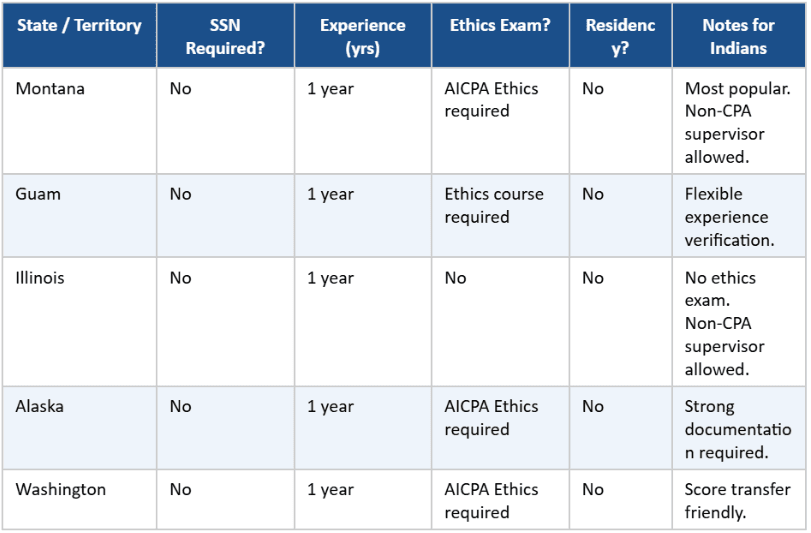
Montana is the most popular starting state for Indian candidates for several reasons: no SSN requirement, non-CPA supervisor experience verification in some circumstances, and a clean application process for international candidates. NASBA's state requirements page is the authoritative source for verifying current rules before you apply.
One important nuance: if you passed your exam sections through Montana but want your license issued there, your 150 credits and experience must meet Montana's specific requirements. Always verify the license requirements separately from the exam eligibility requirements. They are not always the same.
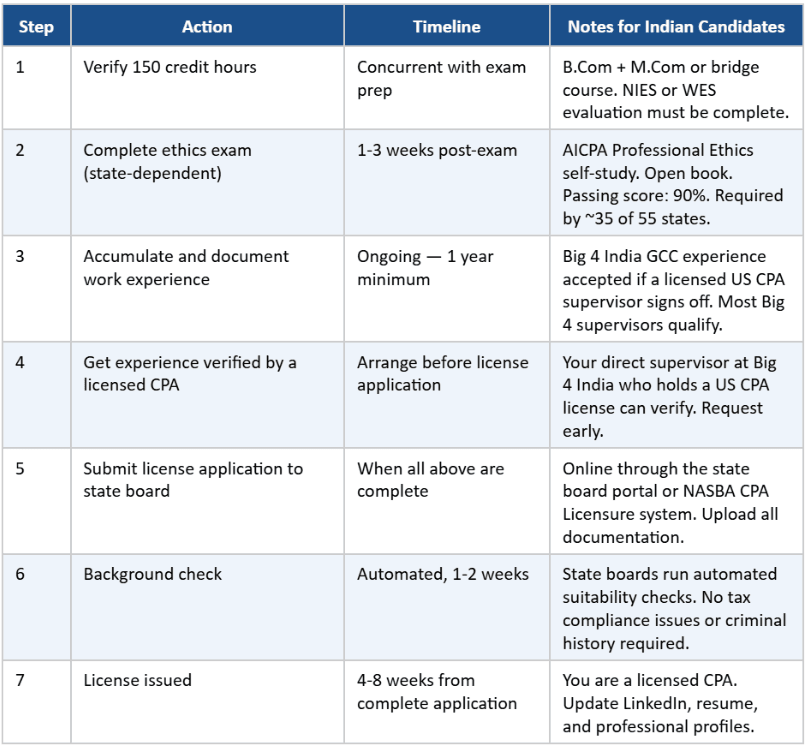
The total elapsed time from passing your last exam section to receiving your CPA license is typically 3 to 6 months for candidates who have their 150 credits in order and a licensed CPA supervisor available to verify their experience. Candidates who still need to accumulate work experience will have a longer gap.
Some state boards issue a formal score report or certificate showing that you have passed all four exam sections. This is documentation of your exam passes, not your license. It does not authorize you to use the CPA title.
The CPA license is issued after you complete all post-exam requirements: 150 credits, experience, ethics, and state board application. It is the license number issued by the state board that gives you the legal right to call yourself a CPA and perform regulated public accounting services.
For Indian candidates working at Big 4 GCCs or MNCs in non-public-accounting roles, the practical working difference is limited. Your employer will recognize both your exam passes and your license as strong credentials. But the license is the complete credential and the one that matters for any future role requiring public accounting authorization, particularly if you ever relocate to the US or work directly with US clients in regulated capacities.
Once you receive your CPA license, it requires ongoing maintenance to remain active. Continuing Professional Education (CPE) is required annually by all state boards. The standard is 40 CPE hours per year, with a typical requirement of at least 4 hours in ethics annually.
CPE can be completed through webinars, online courses, conferences, or self-study programs. AICPA, IMA, and several accredited platforms offer CPE content. Your state board specifies which providers are acceptable. Most state boards also require annual license renewal fees, typically USD 50 to USD 150 per year.
Non-compliance with CPE requirements causes your license to lapse. A lapsed license can typically be reinstated but requires catching up on missed CPE hours. Keeping a log of your CPE activities from day one avoids administrative headaches at renewal time.
Board360.ai's CPA program is powered by UWorld's SmartPath technology with a 90% first-attempt pass rate. Beyond the exam sections, the team provides state-specific licensing guidance including ethics exam requirements, experience documentation advice, and state board application support for Indian candidates. A free demo is available. Explore the CPA program at Board360.ai and get end-to-end support from exam preparation through to license issuance.