

Menu
✕
June 2, 2026>Board360

QUICK ANSWER: 10-15 focused hours per week is the realistic CPA study target for Indian working professionals. At this pace, the exam phase takes 15-18 months. The key is consistency over intensity: short daily sessions plus a longer weekend block outperform cramming.
Most Indian CPA candidates are working professionals. They are not full-time students. They are managing 9-hour days, client deliverables, audit seasons, month-end closes, and commutes, and then trying to find time to study for one of the most demanding professional exams in the world.
This post is written specifically for that situation. Not for someone with eight free hours a day. For someone with two. It covers realistic weekly targets, daily schedules that actually work around Indian work patterns, which sections to sit first, how to protect your study time during peak work periods, and what a 12-month plan looks like in practice.
The total recommended study time for all four CPA sections is 300 to 400 hours. At 10 hours per week, that spreads across 30 to 40 weeks, or 8 to 10 months of pure study time. Adding buffer weeks and exam scheduling gaps, the realistic total timeline is 15 to 18 months for a working professional studying 10 to 15 hours per week.
The minimum viable study load is around 8 hours per week. Below that, knowledge decay between sessions becomes a real problem. If more than 3 or 4 days pass without studying a topic, you spend the next session re-learning rather than advancing. Eight hours per week is manageable but leaves no buffer for work pressure periods. Most professionals who successfully complete the CPA while working average 10 to 12 hours per week over the full journey.
Twenty hours per week is achievable for short bursts of 4 to 6 weeks before a specific exam sitting. It is not sustainable for 15 months. Candidates who try to maintain 20-hour weeks across the full journey typically burn out between sections 2 and 3.
The honest target: plan for 12 hours per week, budget for dropping to 8 during intense work periods, and push to 18 in the 3 weeks before each exam sitting.
The structure of your study week matters more than the total hours. Indian working professionals who pass the CPA consistently report one pattern: short weekday sessions for active practice, longer weekend sessions for new content.
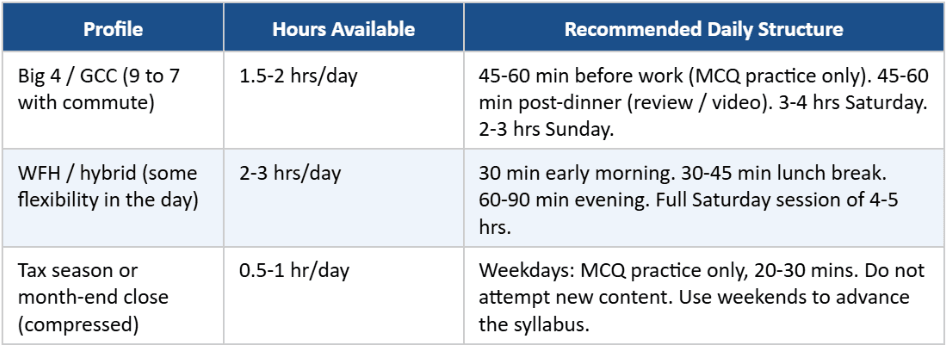
The morning session is the highest leverage slot of the day. Your brain has not yet been depleted by work decisions, meetings, or context-switching. Even 45 minutes of MCQ practice before work, done consistently, compounds significantly over a 15-month journey.
Do not try to study new content on weekday evenings if you finish work after 8 PM. Your retention of new material after a cognitively exhausting day is low. Use those evenings for MCQ practice, which is lower cognitive load and still productive.
The Saturday deep session is your primary content advancement slot. This is when you watch lecture videos, read technical content, and work through difficult topics for the first time. Protect it. Do not schedule social commitments that compromise Saturday study during exam preparation months.
Yes. Many Board360.ai CPA students are Big 4 professionals. It is harder than preparing from a non-Big 4 role, but it has one significant advantage: content overlap.
If you work in US GAAP reporting, SOX advisory, or audit at a Big 4 GCC, you are encountering FAR and AUD content in your daily work. Lease accounting, revenue recognition, consolidation, and audit procedure documentation are not abstract concepts. You see them every week. This reduces the effective study hours needed for FAR and AUD by 20 to 30 percent compared to candidates working in unrelated roles.
The Big 4 challenge is time. Audit busy season (October to January) and tax season (January to April) compress available study time severely. The practical approach: plan your exam sittings to avoid busy season. Target FAR for May or August, when your workload is most predictable. Do not book an exam sitting in November or January unless you have exceptional time discipline.
Big 4 firms in India also commonly offer CPA support programs: exam fee reimbursement, study leave of 10 to 15 days per section, and internal study groups. Check your firm's HR policy. If study leave is available, use it for the 2-week intensive sprint before each exam sitting.
The Q1 2026 section pass rates from AICPA's latest published data confirm what working professionals have known for years: FAR and BAR are the hardest, TCP is the most accessible.
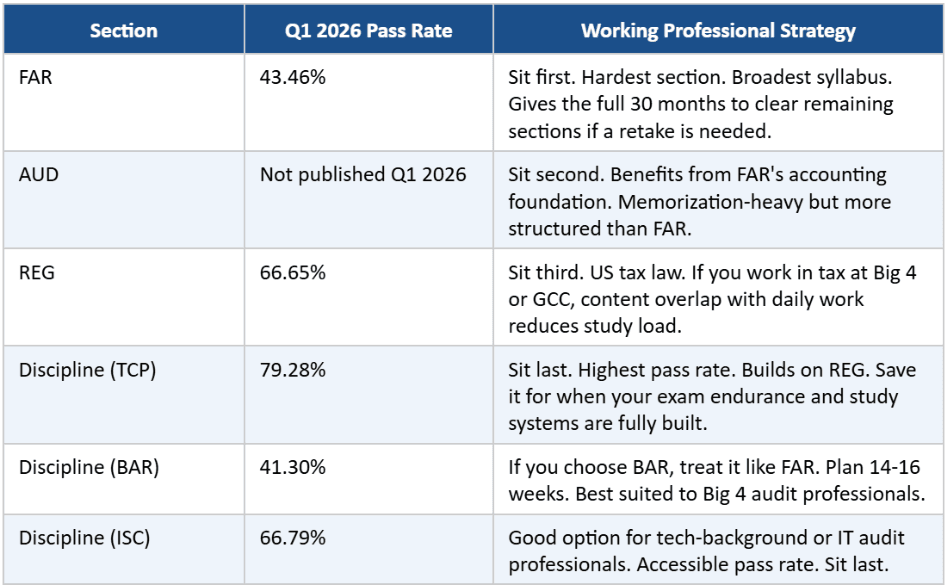
The sequencing logic for working professionals is slightly different from full-time students. As a working professional, your first exam sitting is also your first real experience with CPA exam conditions. Starting with FAR serves two purposes: it forces you to build your strongest study system early, and it opens the full 30-month rolling window with your hardest section cleared, giving you maximum flexibility for the remaining three.
Every working professional faces a recurring problem: work expands to fill available time, and study time is the first casualty. The candidates who consistently pass are the ones who treat study time as a fixed commitment rather than a flexible one.
Specific tactics that work in the Indian working professional context:
The plan below assumes 10 to 12 hours per week at a working professional pace. FAR is given the most time as the hardest section. Each section ends with a 2 to 3-week sprint at 15 to 18 hours per week just before the exam sitting.
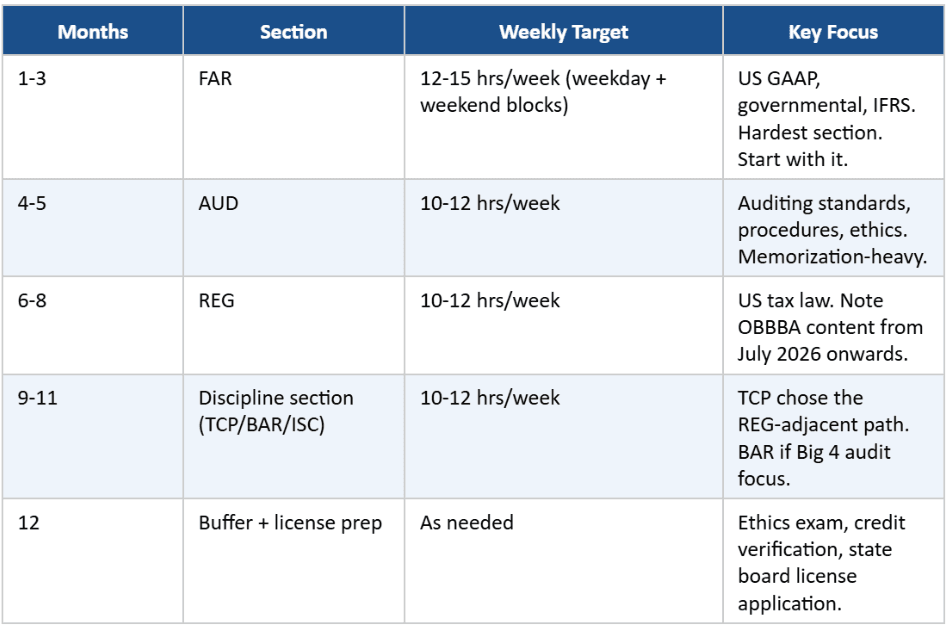
This 12-month plan is aggressive but achievable. The critical success factors are: no major study gaps between sections, protecting the Saturday deep-study sessions, and not sitting an exam before mock scores consistently exceed 70%.
Yes. It requires specific conditions but it is achievable, not exceptional.
The candidates who complete the CPA in 12 months while working typically share these characteristics: they work in US-facing accounting or audit roles where daily work overlaps with FAR and AUD content, they study 12 to 15 hours per week with high consistency, they first-attempt pass all four sections, and they have partners or household support that protects their weekend study time.
The 12-month target is not for everyone, and that is fine. A 16-month timeline completed at a sustainable pace produces better outcomes than a 12-month sprint that results in section failures and retakes. The best schedule is the one you can execute for months without burning out.
Board360.ai's CPA program is powered by UWorld's SmartPath adaptive technology. The program is designed around the specific constraints of working professional preparation.
SmartPath identifies which specific Learning Objectives within each section you are weakest on and re-prioritizes your practice queue accordingly. This means every study session is targeted at genuine gaps rather than covering material you already know. For a working professional with 90 minutes available each day, this efficiency difference is significant.
The mobile-accessible platform means MCQ practice is possible during commutes, lunch breaks, and gaps in the workday. The program does not require long uninterrupted sessions to make progress. Short, focused, adaptive practice accumulates.
Board360.ai's 90% first-attempt pass rate reflects candidates who are predominantly working professionals, not full-time students. The program is calibrated to this reality.
Board360.ai's CPA program is powered by UWorld's SmartPath technology with a 90% first attempt pass rate. The program is built for working professionals: self-paced, mobile-accessible, and adaptive so every study session targets your specific weak areas. A free demo is available. Explore the CPA program at Board360.ai and see how the program fits around a full-time job.