

Menu
✕
June 2, 2026>Board360

SHORT ANSWER: The CA gets you into finance. The EA gets you into US tax specifically. At Big 4 GCCs and BFSI GCCs, the EA is increasingly the preferred credential for US tax roles at Senior Associate level and above. Most CAs clear all three SEE parts in 10-16 weeks. No exemptions, but the overlap is significant.
There is a quiet but consistent pattern playing out across Deloitte USI, EY GDS, PwC SDC, and KPMG GBS. Experienced Indian CAs who add the Enrolled Agent designation are moving into US tax roles, getting promoted faster within US tax teams, and commanding salary premiums of 20 to 40 percent over CA-only peers doing comparable work.
This is not a niche trend. The Big 4 collectively employ 4,000 to 6,000 CPA and EA-qualified professionals in India, with US tax headcount growing steadily as offshore delivery of US tax work expands. The EA is increasingly the standard credential signal for US tax competency in these teams. This post explains exactly why, what the career and salary case looks like, and how a qualified CA makes the transition.
The CA is a comprehensive Indian accounting qualification. It covers Indian GAAP, direct and indirect taxation under Indian law, statutory audit, and corporate compliance. These are exactly the skills Big 4 audit and Indian tax practices need.
US tax is a different discipline governed by a different legal framework. A US tax team at a Big 4 GCC prepares Forms 1040 and 1120, handles transfer pricing documentation, responds to IRS notices, and advises US clients on cross-border tax exposure. None of this is covered in the CA curriculum. The CA gives a professional analytical and accounting foundations. It does not signal US tax law competency.
The EA does exactly that. The EA is issued by the IRS itself and is the highest IRS credential available. Holding an EA signals to a US tax team that the professional has demonstrated knowledge of US individual tax law, US business tax law, and IRS representation procedures. No other credential available to Indian candidates signals US tax competency as directly.
The practical consequence: according to Big 4 India hiring data compiled through 2026, the Big 4 collectively employ 4,000 to 6,000 CPA and EA-designated professionals in India, with US tax as one of the fastest-growing service lines. When hiring managers at Deloitte USI or EY GDS compare two CA-qualified candidates for a US tax role, the one with an EA wins the conversation.
Indian CAs do not get formal exemptions from any of the three SEE parts. The IRS does not have an MoU with ICAI that waives parts of the exam. You sit all three parts.
But this does not mean the CA background is irrelevant. The overlap is real and meaningful, even without formal exemption.
Part 2 (Businesses) is where CAs have the strongest head start. Corporate income tax structures, entity classification, basis concepts, and profit and loss allocation share conceptual DNA with the Indian corporate taxation and accounting framework CAs know from articleship. The specifics are different, but the analytical framework is familiar. Most CAs find Part 2 the most natural of the three parts.
Part 3 (Representation, Practices and Procedures) covers IRS procedures, Circular 230, and EA representation rights. It is entirely new content for a CA, but it is also the most straightforward part of the exam. It is conceptual and procedural rather than computational. CAs with strong analytical reading habits absorb this material faster than the study hour estimates suggest.
Part 1 (Individuals) is the steepest climb for most CAs. US individual tax law, with its passive activity loss rules, alternative minimum tax, credit phase-outs, and new OBBBA provisions, has no close Indian equivalent. This is where preparation time is highest and where structured study matters most.
The net result: most qualified CAs who study with a structured program clear all three SEE parts in 10 to 16 weeks, roughly half the time it takes a candidate without an accounting background. That speed advantage is meaningful when career momentum is at stake.
The salary impact of adding an EA to a CA qualification in US tax roles is consistent and documented across Big 4 GCC hiring data.
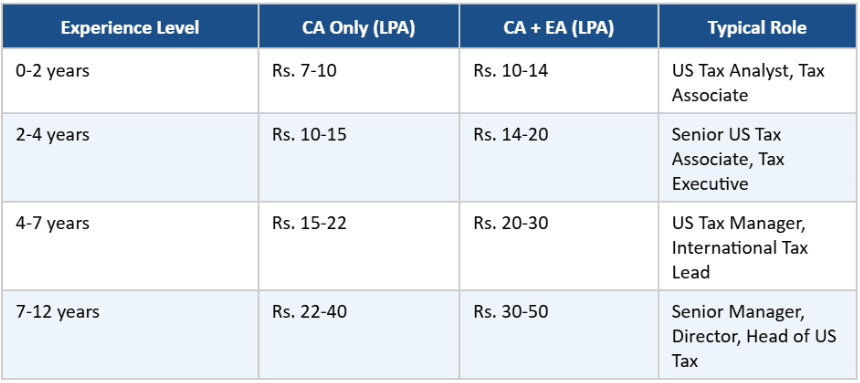
The premium between CA-only and CA-plus-EA is most visible at the 2 to 7 year experience mark. This is the range where IRS representation rights, which only an EA holds, become directly relevant to the work. A CA without an EA can prepare and review US tax work. Only an EA can formally represent clients before the IRS, respond to audit notices on behalf of clients, and sign off on certain IRS correspondence. Big 4 GCC teams value this capability and pay for it.
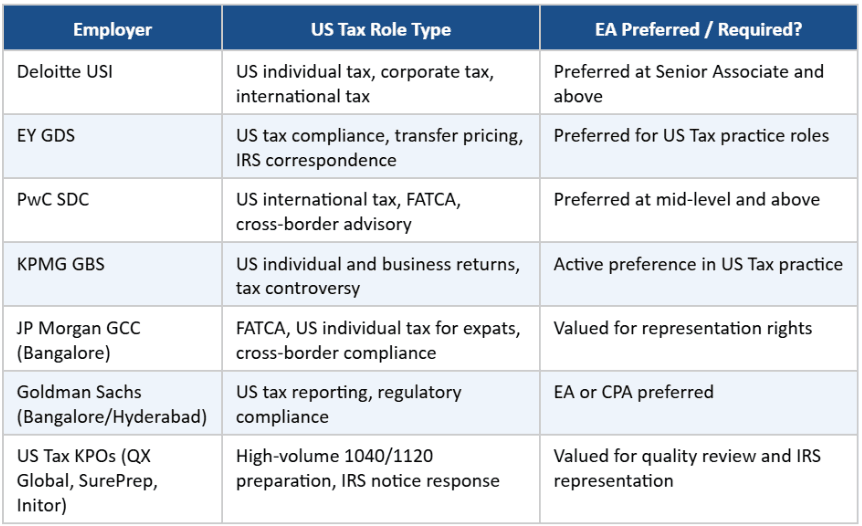
The common thread across all these employers is US tax delivery. Any GCC or firm that handles US individual or corporate tax compliance, IRS correspondence, or transfer pricing documentation values the EA credential. The CA provides the accounting foundation. The EA provides the US tax authority.
There is no complex eligibility process. Any Indian CA who holds an active ICAI membership can sit the SEE. The process is straightforward.
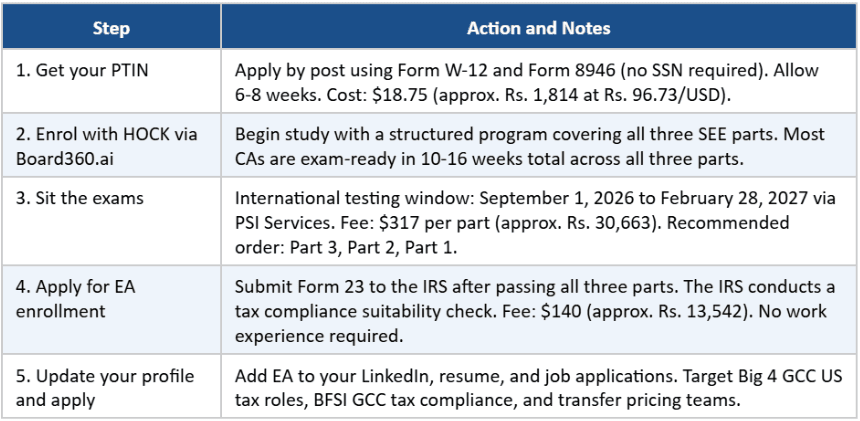
The total elapsed time from beginning PTIN registration to EA enrollment is typically 5 to 7 months for a CA who studies consistently. This includes the PTIN processing wait, preparation time, the international testing window (September to February), and Form 23 processing by the IRS.
The question is really: what is your target career domain?
If you are in or targeting US tax at a Big 4 GCC, BFSI GCC, or US tax outsourcing firm, yes, unambiguously. The EA is the fastest and most direct way to signal US tax competency, command a salary premium, and access IRS representation rights that peers without the credential cannot hold. The investment is 10 to 16 weeks of study and approximately Rs. 1.07 lakh in IRS fees at current rates.
If you are in Indian statutory audit, domestic tax practice, or Indian regulatory advisory, the EA adds limited incremental value. Your CA is the stronger and more relevant credential in those domains.
For CAs in US-facing roles who are already doing the work, the EA is the credential that formalizes what you already know and unlocks the pay and role access that the CA alone does not provide in a US tax context.
Board360.ai's Enrolled Agent program is powered by HOCK International, with a 95% first-attempt pass rate. The program is designed around exactly the CA-to-EA transition described in this post, with structured coverage of all three SEE parts and preparation designed around the content gaps that matter most for Indian CA candidates. A free demo is available. Explore the EA program at Board360.ai and start building the credential that opens Big 4 GCC US tax roles.