

Menu
✕
June 2, 2026>Board360

If you are a finance professional in India weighing a global credential, the Enrolled Agent (EA) and the US CPA are probably the two names you keep coming back to. Both are recognized across Big 4 firms, GCCs, and MNCs with US operations. But they serve different career paths, take different amounts of time, and open different doors. This comparison breaks down EA vs CPA across every factor that actually matters, so you can make the call that fits your situation.
The Enrolled Agent is a federal tax credential issued directly by the US Internal Revenue Service (IRS). It is the highest tax credential the US government recognizes, giving holders unlimited rights to represent US taxpayers before the IRS. In India, EAs are in growing demand at Big 4 firms, transfer pricing teams, and GCCs managing cross-border tax compliance for US parent entities. The US Certified Public Accountant (CPA) is issued by state boards of accountancy under AICPA oversight. It is the gold standard for audit, assurance, and financial reporting in the US. Indian CPA holders are sought after at Deloitte, EY, PwC, KPMG, and any firm that handles US GAAP reporting or SEC filings. One important clarification: the EA is purely a tax credential. The CPA covers accounting, audit, tax, and advisory. This single difference drives almost every other distinction in this comparison.
This is where the EA has a clear structural advantage for Indian professionals. The EA has no educational requirement. A B.Com graduate, a working professional without a degree, or someone who never studied accounting can appear for the Special Enrollment Examination (SEE). The IRS only asks that you register with a valid email and a Preparer Tax Identification Number (PTIN). There is no work experience requirement either.
The US CPA, by contrast, requires 150 credit hours of education, which most Indian candidates interpret as a postgraduate degree (M.Com, MBA, or a master's abroad) combined with a bachelor's. Many states also require 1-2 years of public accounting experience under a licensed CPA before you can get your license. This is not a barrier if you already have the academic background, but it is something to plan for.
For Indian Chartered Accountants, the ICAI-AICPA MOU provides credit exemptions that reduce the US CPA exam requirement from 4 sections to just 3 under certain state board rules. Check the current state-by-state requirements directly, as these rules change periodically.
The EA covers three parts of the Special Enrollment Examination: Individuals (Part 1), Businesses (Part 2), and Representation, Practices, and Procedures (Part 3). Each part has 100 multiple-choice questions and a 3.5-hour time limit. The content is entirely US tax law, so if you already work in US taxation at a Big 4 or GCC, Parts 1 and 2 will feel familiar.
Board360.ai's EA program, powered by HOCK International, is designed around exactly this syllabus structure, with adaptive practice questions and full mock exams for each part.
The CPA exam now consists of four sections under the updated CPA Evolution model: Business Analysis and Reporting (BAR), Auditing and Attestation (AUD), Financial Accounting and Reporting (FAR), and one discipline section (Tax Compliance and Planning, Information Systems and Controls, or Business Environment and Concepts). Each section is 4 hours long. FAR is consistently rated the hardest of the four by candidates globally.
According to NASBA candidate performance data, CPA section pass rates vary significantly: FAR and BAR are the toughest, with pass rates falling below 40% in 2024, while TCP is the most accessible at above 70%. The EA, by contrast, carries an overall pass rate of around 66% across all three parts for the 2024-2025 testing window. In raw difficulty, the EA is the more accessible credential.
Most dedicated candidates clear all three EA parts in 6 to 12 months. Some working professionals in US tax roles finish faster because their day job covers a significant portion of the syllabus. There is no waiting period between parts.
The CPA typically takes 12 to 18 months for candidates who are well-prepared and consistent. NASBA allows 18 months to pass all four sections once you start, so the time pressure is real. For Indian candidates balancing full-time jobs, most take 15-18 months on average.
If speed to certification is important, the EA wins. If you have the runway and want the broader credential, the CPA's extra time investment pays off in career scope.
Salary ranges for both credentials in India depend heavily on the type of firm (Big 4 vs mid-tier vs GCC vs boutique), years of experience, and the role you are stepping into.
For Enrolled Agents in India, entry-level roles at US tax firms or GCCs typically start at Rs. 5-8 LPA. Mid-level professionals with 3-5 years of experience and an EA credential can expect Rs. 10-15 LPA. Senior US tax managers in Big 4 or large GCCs with EA designation can reach Rs. 18-25 LPA. US international tax specialists consistently command a significant premium over domestic tax roles at equivalent experience levels, given the specialist nature of the credential.
For US CPAs in India, entry-level positions in audit or US GAAP roles begin at Rs. 7-10 LPA. Mid-career professionals at Big 4 firms typically earn Rs. 15-22 LPA. At the senior manager and director level, Rs. 25-40 LPA is achievable, particularly in firms like Deloitte and PwC where US GAAP and PCAOB audit skills are in consistent demand.
The CPA has a higher salary ceiling in India. But the EA's salary-to-time-invested ratio is strong, particularly for professionals already in US taxation who want to formalize their expertise quickly.
The EA is purpose-built for US tax. In India, that means roles in Big 4 transfer pricing and international tax teams, US tax compliance centers, GCC tax departments, and boutique US tax advisory firms. The market for EA holders has grown significantly since 2020, driven by the expansion of GCCs in cities like Bangalore, Hyderabad, Pune, and Chennai.
According to the NASSCOM-Zinnov India GCC Landscape Report 2024, India now hosts over 1,700 GCCs employing more than 1.9 million professionals, contributing USD 64.6 billion in revenue. A growing share of these centers handle US tax compliance, making EA holders increasingly relevant in this ecosystem.
The CPA opens a wider set of doors: external audit, internal audit, US GAAP reporting, financial advisory, risk management, and M&A. For professionals who want a career that can move between tax, audit, and finance, the CPA provides that flexibility. A CPA at a Big 4 in India can rotate between service lines in a way that an EA-only credential does not support.
One practical consideration: if your current role is in US tax and you plan to stay in that domain, the EA is the more targeted and valuable signal. If you are building toward a CFO, controller, or finance director role, the CPA has broader recognition.
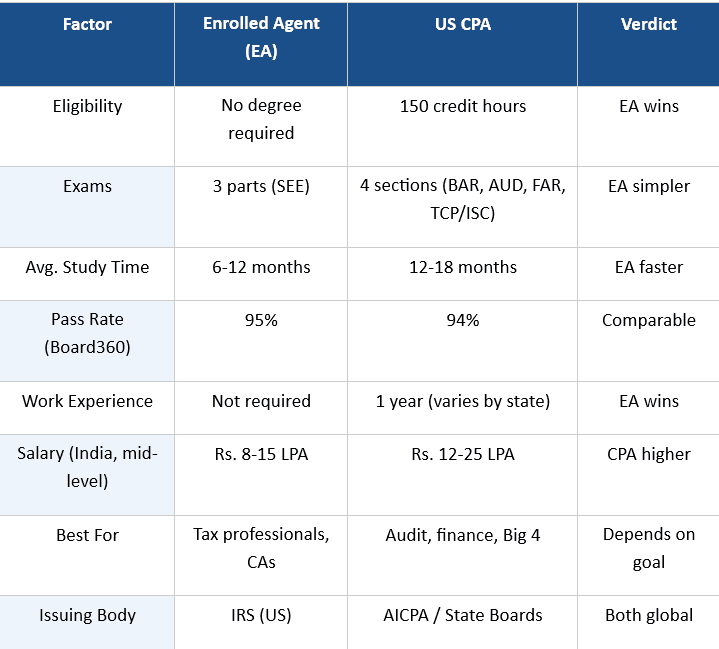
The answer comes down to where you want to go, not which credential looks better on paper.
If you are already in US taxation, planning to move into US tax at a GCC or Big 4 firm, or want a globally recognized credential without an education or experience barrier, the EA is the more direct and efficient path. You can clear it in 6-12 months and start applying the credential in your current role immediately.
If you want a credential that covers audit, US GAAP, and advisory alongside tax, and you have the academic background to meet the 150-credit requirement, the US CPA provides broader career flexibility and a higher long-term earnings ceiling in India.
Many Indian finance professionals pursue the EA first, get into the US tax market, and then evaluate the CPA later from a position of financial stability. That is a legitimate and increasingly common path in the Big 4 and GCC space.
Board360.ai's Enrolled Agent program is powered by HOCK International, one of the most respected EA prep providers globally, with a 95% pass rate. The program covers all three SEE parts with adaptive practice, full mock exams, and expert support. A free demo is available so you can experience the platform before committing. Start your EA journey at Board360.ai and explore the program that fits your 2026 career goals.