

Menu
✕
June 2, 2026>Board360
QUICK ANSWER: 12 to 18 months for the CPA exam, depending on your pace and background. Add 3 to 6 months for the state board application and license processing. Total time from starting your application to holding a CPA license: 15 to 24 months for most Indian candidates.
The 8-month CPA timeline exists. So does the 24-month one. Both are real, and neither is dishonest. The difference comes down to your background, how many hours per week you can study, and whether you pass each section on the first attempt.
This post gives you the realistic breakdown: study hours by section, timelines by candidate profile, what the 30-month rule actually means, and how long the bridge course and license process adds to the total. No aspirational numbers, no worst-case scenarios. Just what most Indian candidates actually experience.
The CPA journey has three distinct phases, each with its own timeline. Most candidates underestimate the first and third phases and focus entirely on the second.
Phase 1: Eligibility and state board application
Before you sit for a single exam section, your Indian degree must be evaluated by a NASBA-approved credential evaluation agency, you must apply to a US state board, and you must receive your Notice to Schedule (NTS). This phase takes 6 to 10 weeks from submitting your application. It cannot be compressed. Factor it in from Day 1.
Phase 2: Passing all four exam sections
This is where most of your time goes. The study and exam phase typically takes 10 to 18 months depending on your pace and profile. The 30-month rolling window starts when you pass your first section, so planning your exam sequence matters.
Phase 3: License application and issuance
After passing all four sections, you apply for the CPA license with your state board. This requires confirming your 150 credit hours and meeting the work experience requirement for your state. License processing typically takes 4 to 8 weeks after a complete application is submitted.
There is no single CPA timeline. Your starting point changes everything.
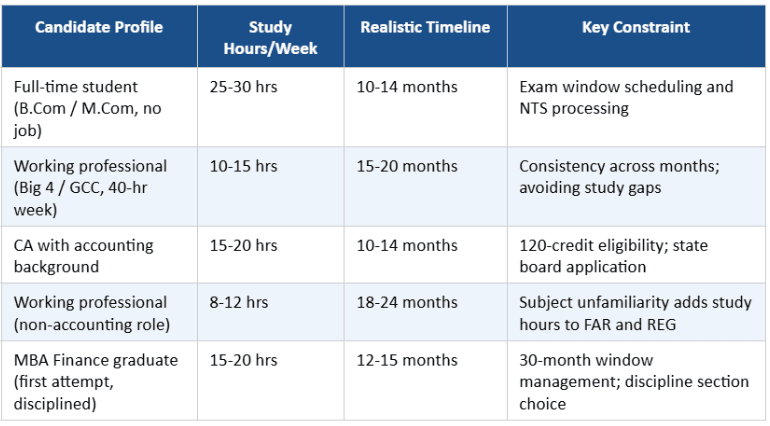
The most common scenario for Indian candidates is the working professional path at 15 to 20 months. Most people beginning the CPA in India are already employed in finance or audit roles and cannot dedicate 25 hours per week to study alongside a full-time job. Ten to fifteen hours per week is a realistic and sustainable commitment that delivers results without burnout.
According to UWorld's CPA exam study hours research, candidates should expect 300 to 600 total study hours across all four sections, depending on their background and discipline section choice. Here is how that breaks down per section:
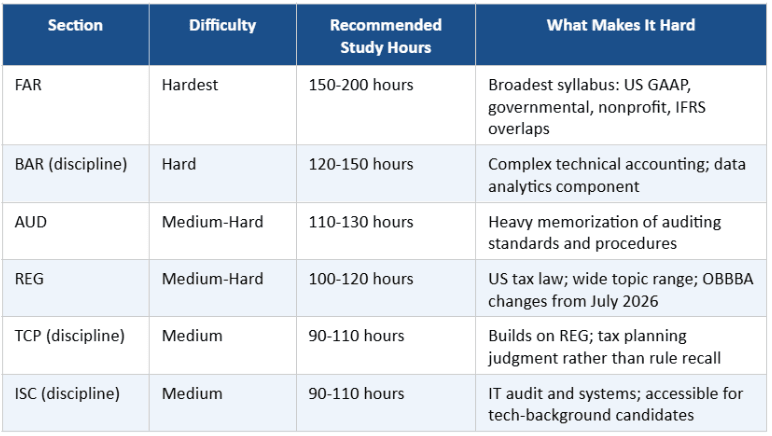
FAR is consistently the section that surprises candidates. Its syllabus is the broadest of all four sections, covering US GAAP, governmental accounting, nonprofit accounting, and international financial reporting. Indian candidates who studied accounting under IGAAP or IFRS find FAR the biggest adjustment. Budget generously for it.
REG has an additional consideration in 2026: the One Big Beautiful Bill Act (OBBBA) becomes testable from July 1, 2026, bringing changes to individual tax rates, bonus depreciation, and new deductions. Candidates sitting REG from July 2026 onwards need updated materials that reflect the new law. Board360.ai's CPA program, powered by UWorld, is updated to reflect these changes for the relevant exam windows.
Yes. It is not common, but it is achievable under specific conditions.
An 8-month timeline requires: study starting immediately after your NTS is issued, 25 or more hours of study per week, one exam section every 6 to 8 weeks, first-attempt passes on all four sections, and no significant delays from exam scheduling or score release.
Most candidates who achieve this are either full-time students with no competing work commitments, or working professionals in US GAAP roles where daily work overlaps significantly with AUD and FAR content, reducing the effective study hours needed.
For the majority of Indian candidates working full-time in non-accounting roles, 8 months is not realistic. Pursuing an 8-month timeline with 8 to 10 hours of study per week typically results in underprepared exam attempts, failed sections, and a total timeline that ends up longer than a steady 15-month pace would have been.
Once you pass your first CPA exam section, a 30-month rolling window starts. You must pass all remaining sections within that window. If you do not, the first section you passed expires and you must retake it.
This rule makes sequencing important. The two strategic approaches most Indian candidates use:
Avoid sitting the discipline section first. The discipline sections (BAR, TCP, ISC) test more advanced content that builds on the core sections. Sitting AUD, FAR, and REG first provides the conceptual foundation that makes the discipline section significantly more manageable.
Indian B.Com graduates typically need additional credits to meet the 120-credit exam eligibility threshold, since a standard three-year B.Com evaluates to approximately 90 US credits.
A NAAC-accredited bridge course designed to close this gap typically takes 6 to 12 months to complete. Most bridge programs run concurrently with CPA exam preparation. You can study for your first exam section while completing bridge coursework, provided the bridge course institution issues official transcripts that NIES or WES can evaluate before your state board application is finalized.
If you are pursuing the 150-credit threshold for the license rather than just the 120-credit exam threshold, an M.Com or MBA typically takes 1 to 2 years on a full-time basis. Many working professionals complete M.Com through distance learning programs simultaneously with CPA preparation.
The timeline below assumes a working professional sitting two sections every four to five months with first-attempt passes.
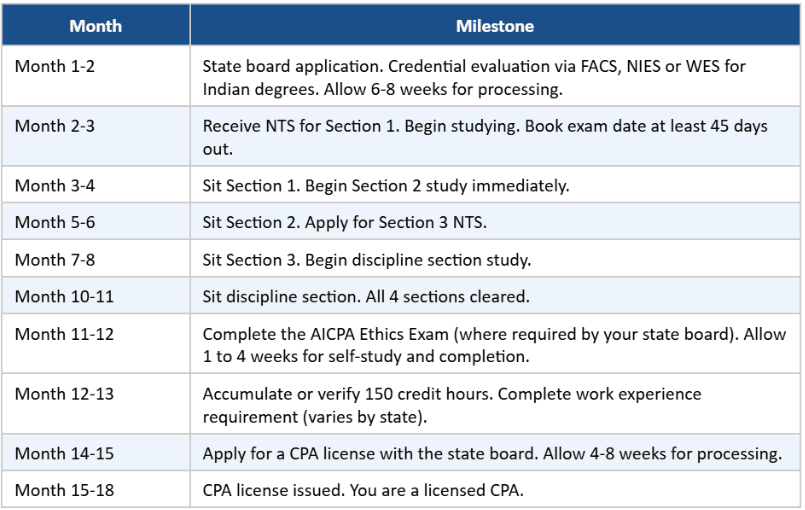
This produces a total timeline of 15 to 18 months from starting your state board application to receiving your CPA license. Candidates who spread sections out to one per quarter will land closer to 20 to 24 months.
Many Indian CPA candidates discover this requirement only after passing all four exam sections. It catches people off guard at the licensing stage and can add unexpected weeks to the process.
Most US state boards require candidates to pass an ethics examination before issuing the CPA license. The most widely accepted version is the AICPA's own course and examination, formally titled the AICPA Professional Ethics: The Comprehensive Course.
Here is what you need to know about it.
The course is self-study. It covers the AICPA Code of Professional Conduct, independence rules, integrity requirements, and the ethical obligations of CPAs in practice. The material is not difficult conceptually, but it requires genuine engagement with the rules rather than rote memorization.
The exam at the end of the course is open-book. You need to score 90% or above to pass. Most candidates who study the course material properly pass on their first attempt.
The time commitment is modest. Most candidates complete the self-study course and exam within 10 to 20 hours, spread across one to three weeks. It is typically completed after all four CPA exam sections are passed and before the state board license application is submitted.
Not every state requires the AICPA Ethics Exam specifically. Some states accept alternatives. Montana and Guam, two of the most popular state boards for Indian candidates, both require an ethics component. Confirm your state board's specific requirement before assuming you can skip this step.
Board360.ai provides guidance on the AICPA Ethics Exam as part of the CPA licensing pathway support. The team walks candidates through the specific ethics requirement for their chosen state board, recommends the right preparation approach, and ensures the ethics step does not create a last-minute delay at the licensing stage.
The CA takes an average of 4 to 6 years to qualify in India, including articleship. Some candidates complete it in 3.5 years; others take 7 or more. The pass rates at CA Final are consistently below 15% for both-group combined attempts.
The CPA takes 15 to 20 months for most Indian working professionals. First-attempt pass rates for individual CPA sections range from 35% to 70% depending on the section, which is structurally more forgiving than the CA's combined-group pass rate model.
The time difference is not a quality difference. The CA is a broader credential covering Indian law and practice in depth. The CPA is a more focused credential covering US accounting standards and tax law. They serve different career goals. But if speed to qualification matters, the CPA is the faster path by 2 to 4 years for most candidates.
Passing all four sections does not make you a licensed CPA. The license requires three additional steps that add time after your last exam pass.
From passing your final exam section to holding a CPA license, the process typically takes 3 to 6 months for candidates who have their 150 credits in order and their work experience documented. Candidates who still need to complete credits or accumulate work experience will have a longer gap.
Board360.ai's US CPA program is powered by UWorld's SmartPath adaptive technology with a 90% first-attempt pass rate. The program is structured to fit working professional schedules and covers all four exam sections including updated content for OBBBA changes in REG and TCP from July 2026. A free demo is available. Explore the CPA program at Board360.ai and start building your CPA timeline today.