

Menu
✕
June 2, 2026>Board360

SHORT ANSWER: Yes. The EA is a US federal credential issued by the IRS. It carries no statutory recognition under Indian law, but it is actively hired for by Big 4 GCCs, BFSI GCCs, MNCs, and US tax outsourcing firms in India. In those specific environments, it is one of the most valued credentials available
The Enrolled Agent credential confuses a lot of Indian finance professionals for one reason: it is a US federal credential operating in an Indian job market. So the question of whether it is 'valid in India' needs a precise answer, not a vague one.
This post gives you that precise answer. It explains what EA recognition actually means in India, which companies actively hire EA-qualified professionals, what specific roles are available, and what you can realistically earn in 2026.
The Enrolled Agent designation is issued by the Internal Revenue Service (IRS), the US federal tax authority. It is the highest tax credential the IRS awards and grants unlimited representation rights before the IRS for any US taxpayer, on any tax matter, in any US state.
The EA is not recognized under any Indian statute. It carries no legal rights under the Income Tax Act, the Companies Act, or any other Indian law. An EA cannot sign Indian tax returns, appear before Indian tax authorities, or conduct statutory work in India in their capacity as an EA.
That is the full extent of what the EA cannot do in India. And it matters very little in practice for the roles where EAs actually work.
The EA's value in India is market-based, not statutory. Every Big 4 GCC, BFSI GCC, and US tax outsourcing firm in India is delivering US tax services. They work under US tax law. They prepare US returns. They interact with the IRS. For all of that work, the EA is precisely the credential that signals competence. The IRS issues it. It is recognized by every US employer and every US client these firms serve.
Indian government bodies do not recognize the EA. The Government of India has no formal MoU or recognition agreement with the IRS for the EA designation. But the Indian government is not the employer. The MNCs, GCCs, and US-facing firms are. And they recognize it fully.
India's Global Capability Center ecosystem is the primary driver of EA demand. According to the NASSCOM-Zinnov GCC India Landscape Report 2024, India hosts over 1,700 GCCs employing more than 1.9 million professionals. A large and growing share of these centers handle US tax compliance, transfer pricing, and international tax reporting for US parent entities.
This is the structural source of EA demand in India. US parent companies have Indian GCCs that manage their tax obligations. Those GCCs need professionals who understand US tax law at a deep level. The EA, as the highest IRS-issued credential for US taxation, is the clearest market signal of that knowledge.
Beyond GCCs, the Big 4 run large US tax practice groups out of their India operations. Deloitte's US Tax group, EY's Global Tax Desk, PwC's International Tax Advisory, and KPMG's US Tax practice all operate out of Hyderabad, Bangalore, Gurgaon, and Mumbai. These teams service US clients directly. EA designation is listed in job descriptions for these practices at the Senior Associate level and above.
The US tax outsourcing sector is the third major employer. Firms like QX Global, SurePrep, and Initor process tens of thousands of US individual and business returns each tax season out of India. They actively recruit EA holders for quality review, IRS correspondence, and senior preparation roles because EAs can represent the firm's clients before the IRS if needed.
The roles available to EA holders in India fall into three broad categories: compliance, advisory, and representation. Here is a detailed breakdown with employer types and salary ranges.
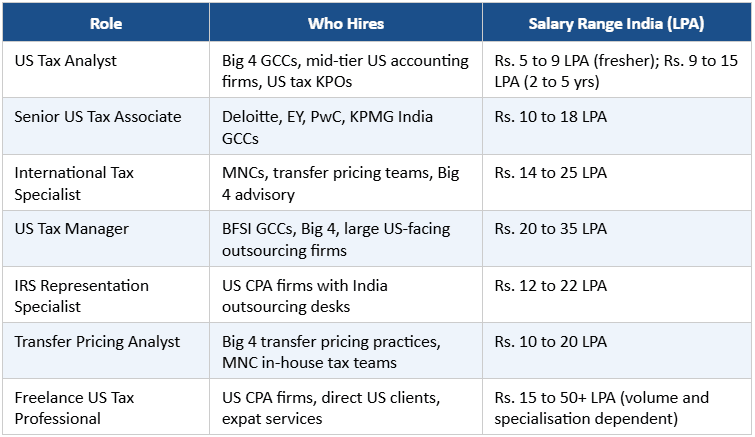
The salary ranges above reflect 2026 hiring market data. The fresher range applies to candidates who have cleared all three SEE parts but have minimal work experience. The higher ranges require 3 to 7 years of active US tax work combined with the EA designation.
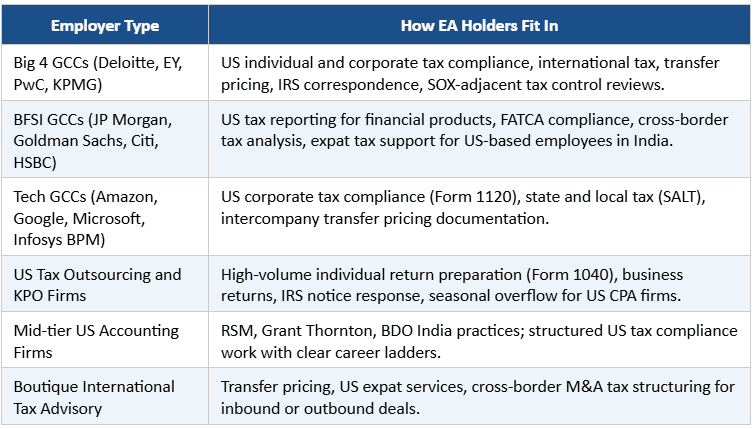
The common thread across all these employer types is US tax exposure. If a firm or GCC delivers work to US clients, handles US parent entity tax obligations, or processes US individual and corporate returns, the EA designation is directly relevant and actively valued.
Yes, and they do in significant numbers.
All four Big 4 firms run structured US tax practices in India. The work spans US individual tax compliance (Form 1040 and related schedules), US corporate tax (Form 1120), partnership returns (Form 1065), international tax planning, and transfer pricing documentation. EA holders are hired at every level from analyst to manager in these practices.
At the analyst and senior analyst levels, the EA is not always a mandatory requirement, but it creates a measurable advantage. Big 4 firms in India pay a premium for EA designation relative to non-certified peers doing the same work. At the assistant manager level and above, EA is frequently listed as preferred in internal job postings for US tax roles.
The most important thing the EA does for Big 4 career progression is IRS representation rights. A Big 4 US tax team servicing clients who receive IRS notices or face audits needs professionals who can formally respond and represent. An EA can do this without needing a US CPA license. A non-EA colleague cannot, regardless of their experience level.
This is the EA career path with the highest income potential in India, and one of the most underutilized.
US CPA firms have been actively offshoring work to India since 2020. A combination of US talent shortages in accounting and the expansion of remote work infrastructure has made India-based tax professionals a primary resource for US tax season overflow. EA-qualified professionals in India can work directly with US CPA firms as independent contractors, preparing US returns, handling IRS correspondence, and providing advisory support.
US CPA firms pay India-based EAs on a per-return basis or monthly retainer. Depending on complexity and volume, an experienced EA can earn US-equivalent rates that convert to Rs. 20 to 50 LPA at productive output levels. Complex returns, FBAR filings, expat cases, and IRS audit representation work command the highest per-case fees.
The EA's IRS representation rights are the key enabler here. A non-credentialed Indian tax professional preparing US returns can prepare and file but cannot formally represent a client before the IRS. An EA can. That distinction matters to US CPA firms choosing who to partner with, and it drives premium pricing for EA-credentialed contractors over non-credentialed ones.
Building a freelance client base takes 2 to 3 years of salaried experience first. But for EAs who have worked in Big 4 or GCC US tax roles and built a network, the transition to direct client work is a well-trodden and financially rewarding path.
No. The EA has no formal recognition under Indian law or by Indian regulatory bodies. The Government of India does not have a recognition agreement with the IRS for the EA designation.
This means EA holders cannot use their credential for any purpose governed by Indian law. You cannot sign Indian tax returns as an EA, appear as an EA before Indian income tax authorities, or use the EA designation in any Indian statutory context.
For the market where EAs actually work in India, this statutory distinction is largely irrelevant. The work is US tax work, governed by US law, for US clients or US parent entities. Indian government recognition of the EA credential simply does not factor into any of those employment relationships.
If you are weighing the EA specifically for Indian statutory practice or domestic tax advisory, it is not the right credential for that purpose. The CA or the ICAI's dedicated qualifications serve those functions. The EA is the right credential specifically for US tax work done in India.
Board360.ai's EA program is powered by HOCK International, with a 95% first-attempt pass rate and full coverage of all three SEE parts. Whether you are a fresher targeting a Big 4 GCC role or an experienced tax professional building toward freelance US client work, the program is structured around the career paths described in this post. A free demo is available. Explore the EA program at Board360.ai and start preparing for one of the strongest US tax credentials available to Indian professionals.