

Menu
✕
June 2, 2026>Board360
**QUICK ANSWER: ** The CA qualification satisfies IMA's education requirement, so CA students do not need a separate degree to register. However, there are no exam part exemptions. You must pass both CMA parts. The combination is genuinely powerful for MNC and global finance careers.
Many CA students and qualified CAs ask whether the US CMA is worth pursuing alongside or after their Indian qualification. The short answer is yes, for the right career goals. But there is a lot of confusion about what the US CMA actually offers CA students, particularly around exemptions, fees, articleship, and timing.
This post clears up every major question. What exemptions exist. What does not get waived. Whether you can study during articleship. What the salary uplift looks like after CA. And whether the dual qualification is genuinely worth the additional time and money.
This is the most misunderstood part of the US CMA for Indian CA students. Let's be direct.
The CA qualification is accepted by IMA as meeting the education requirement for the US CMA. This means CA students do not need to provide a separate bachelor's degree certificate. The ICAI qualification is treated as equivalent to an accredited degree for the purposes of IMA registration.
That is where the exemptions end.
There are no exemptions from either CMA exam part. IMA does not waive Part 1 or Part 2 on the basis of CA or any other qualification. Every candidate, including qualified CAs, must pass both parts of the Uniform CMA Examination to earn the credential. There is no reciprocal agreement between ICAI and IMA that eliminates exam requirements.
What CA training does give you is a significant preparation advantage. Part 1 of the US CMA covers financial planning, performance, and analytics. Part 2 covers strategic financial management. CA students who have covered financial reporting, costing, and management accounting in their ICAI curriculum will find material overlap in both parts. This typically reduces study hours needed, not eliminates them.
Expect to spend 200 to 300 hours total preparing for both parts if you are a CA student with strong management accounting exposure. A non-commerce candidate starting from scratch typically needs 300 to 400 hours.
Yes. And it is actually one of the better times to pursue it.
The US CMA has no articleship or mandatory training requirement of its own. IMA requires two years of professional experience in management accounting or financial management, but this can be completed before or within seven years of passing the exam. It does not need to run concurrently with your exam preparation.
Under ICAI's current scheme, CA articleship runs for two years (reduced from three under the new 2024 scheme). During this period, most CA students are gaining hands-on exposure to financial statements, audit procedures, costing, and tax. Depending on the firm you are articled under, a substantial portion of this work involves financial analysis, budgeting support, and internal controls work.
IMA can accept CA articleship as qualifying work experience for the US CMA, provided it meets their criteria: the work must be full-time or at least 20 hours per week, involve relevant financial or management accounting tasks, and run for a continuous two-year period. Articleship that involves financial planning, cost analysis, internal auditing, or decision support work typically qualifies. You will need to document your responsibilities clearly when submitting the experience confirmation form to IMA.
The practical implication: if you begin your CMA exam preparation during your second year of articleship, you can potentially sit for both parts before you qualify as a CA, and have your IMA work experience requirement met through articleship by the time you finish CA Final. This is an efficient path that many Indian CA students have followed.
For most Indian students, CA first, US CMA second is the stronger sequence. Here is the logic.
CA is significantly harder to complete and has strict sequential requirements including Foundation, Intermediate, articleship, and Final. Starting CA and abandoning it midway is common, and it is a waste of time. Completing CA gives you the credentialing, the statutory audit rights, and the domestic market credibility that no international qualification can replicate in India.
Once you have your CA, adding the US CMA becomes a focused, efficient exercise. You are studying just two exam parts. Your management accounting background gives you a head start on both. Your articleship experience is potentially already qualifying for IMA's work experience requirement. The marginal cost of the US CMA relative to a qualified CA is low.
For B.Com students who have decided they do not want to pursue CA and are targeting MNC or GCC finance careers from the start, pursuing the US CMA directly after graduation is also a valid and increasingly popular path. The US CMA can be completed in 6 to 18 months, giving them a global credential much faster than CA would allow.
The CA plus US CMA combination is one of the most respected dual qualifications in Indian finance. Here is what each credential contributes to the overall profile.
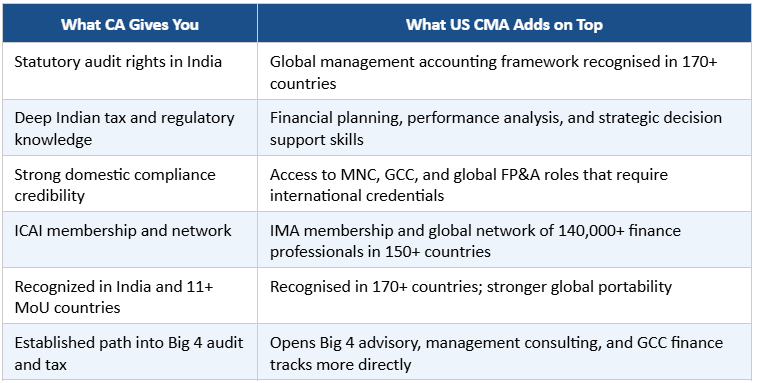
In practical terms, the dual qualification opens doors that neither credential fully unlocks alone. A CA has unlimited domain coverage within India but limited global portability. A US CMA alone lacks the statutory standing and domestic depth. Together, they create a finance professional who can operate across Indian regulatory contexts and global management accounting roles.
At Big 4 India, CAs with the US CMA frequently move between service lines with more flexibility. A CA in statutory audit can transition into advisory, management consulting, or US GAAP reporting practices more easily when they hold the CMA. GCCs actively seek this combination for controllership and FP&A leadership roles.
The salary impact of adding a US CMA to a CA qualification is significant and measurable, particularly in global-facing roles.
A qualified CA at Big 4 India in audit or tax typically earns Rs. 9 to 14 LPA at the associate level. The same profile with a US CMA in a management consulting or US GAAP advisory service line typically earns Rs. 12 to 18 LPA at equivalent experience. The credential premium is roughly 15 to 30 percent in the first role change.
The bigger salary impact comes at the first lateral move, typically at the 3 to 5 year mark. A CA with US CMA moving from Big 4 audit to an in-house GCC finance or FP&A manager role typically receives a 40 to 60 percent salary increase. According to IMA's global salary surveys, CMA-certified professionals earn 58% more than their non-certified peers globally. In India, the premium is most visible in GCC and MNC environments.
For CA students still in articleship, the US CMA investment starts generating returns even before the salary bump. Having both qualifications on a CV when applying for a first job after CA qualification results in access to a broader set of roles and higher starting offers than CA alone in global-facing firms.
All four Big 4 firms in India actively value the US CMA for certain service lines. In standard audit and statutory tax practices, CA is the primary credential. But in advisory, transaction services, US GAAP reporting, and management consulting tracks, the US CMA is increasingly noted as a preferred or valued secondary qualification.
Several Big 4 firms sponsor or partially reimburse CMA exam costs for employees showing strong performance. Study leave of 10 to 15 days per exam part is available in most cases. If you are a CA articleship student at a Big 4 firm and considering the CMA, it is worth discussing sponsorship early.
For CA students looking to enter Big 4 India in service lines beyond audit, holding or being close to the US CMA is a meaningful differentiator. In interviews for advisory and consulting roles, the combination signals that you are not just India-centric in your finance understanding, and that you are investing in global competencies proactively.
IMA membership is mandatory before you can register for the CMA exam. The membership type determines your cost significantly.
If you are a full-time student enrolled in at least six credit hours at a recognized institution, you qualify for student membership at $49 per year, compared to the professional rate of $295 per year. CA articleship students who are simultaneously enrolled in a degree program typically qualify for student rates.
If you have already qualified as a CA and are no longer in full-time education, you will pay the professional membership rate. The difference across the full certification process is substantial, as the table below shows.
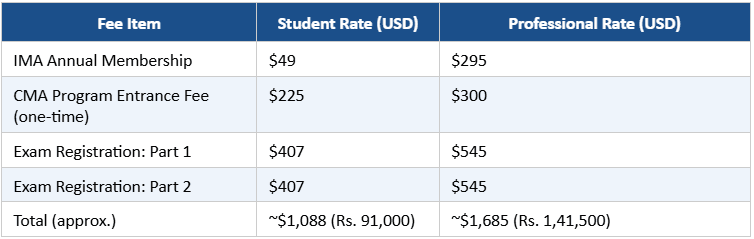
The total cost for a CA student qualifying at student rates is approximately Rs. 91,000, excluding coaching. This is a one-time cost for the full certification. The work experience and CPE obligations carry ongoing costs thereafter, but the initial certification investment is comparable to a single semester of postgraduate study.
One practical note: IMA periodically offers promotional discounts of 40 to 50 percent on membership and entrance fees. These promotions typically run between November and January. Timing your registration to coincide with a promotional window can meaningfully reduce total costs.
Board360.ai's US CMA program is powered by UWorld, with a 94% first-attempt pass rate and full coverage of both exam parts. The program is built for working professionals and CA students who want to add a globally recognized management accounting credential efficiently. A free demo is available. Explore the US CMA program at Board360.ai and see how the dual qualification fits your 2026 career plan.