

Menu
✕
July 10, 2026>Board360
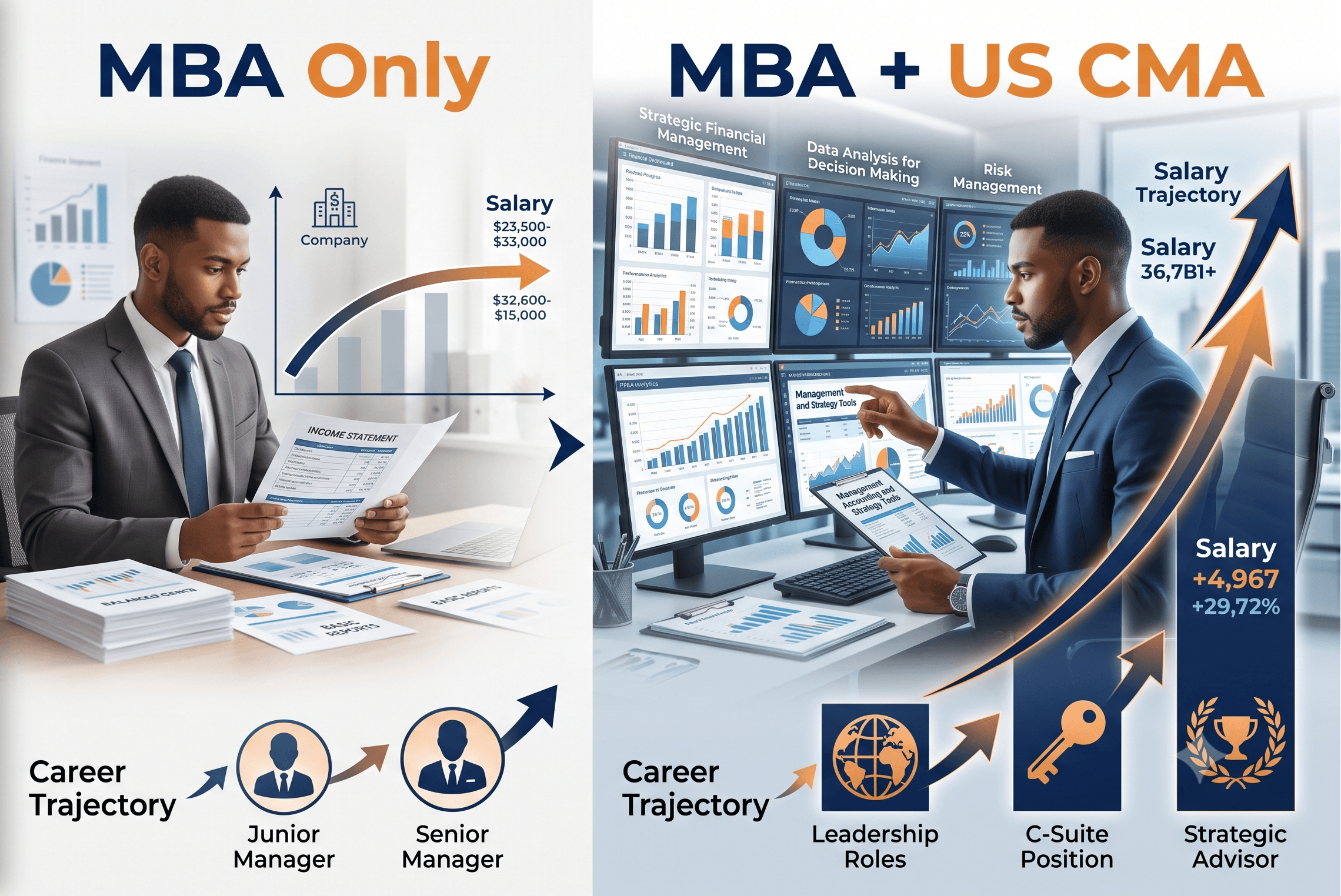
MBA Finance graduates in India often reach the same crossroads a year or two into their career: the degree opened the door, but the corporate finance roles they are targeting now ask for something more specific. The US CMA is one of the most commonly considered additions to an MBA profile, and for good reason. It covers financial planning, analysis, performance management, and strategic decision support, exactly the skills that GCCs, MNCs, and Big 4 advisory teams pay a premium for. This post looks at whether the US CMA is worth it for MBA graduates in India, what the salary data shows, when to pursue it, and which profiles benefit most.
An MBA Finance provides a broad business education. It covers financial management, corporate strategy, marketing, operations, and organizational behavior. It is deliberately wide because its purpose is to develop general management capability.
The US CMA, awarded by the Institute of Management Accountants (IMA), is a practitioner-level credential focused on one domain: management accounting and financial management. Part 1 covers external financial reporting, planning, budgeting, forecasting, performance management, cost management, and internal controls. Part 2 covers financial statement analysis, corporate finance, risk management, investment decisions, and professional ethics.
The MBA teaches you to read and interpret a budget. The CMA teaches you to build, defend, and stress-test it. For MBA graduates targeting FP&A, finance controller, or business finance partner roles, that distinction is what makes the CMA a genuine credential addition rather than a qualification overlap.
The IMA's 2023 Global Salary Survey found that CMAs earn 21% more than non-certified peers globally. In the Middle East, Africa, and India region, the premium is 39%. The premium is highest for early-career professionals: Gen Z CMA holders reported a median salary premium of 32% over their non-certified peers.
For MBA Finance graduates specifically, the CMA premium compounds on an already above-average salary base. An MBA from a Tier-1 institution in India may command ₹12 to ₹18 LPA in a corporate finance role. Adding the CMA qualification in the first two to three years typically positions the candidate for FP&A manager and finance business partner roles that pay ₹18 to ₹28 LPA at GCCs and MNCs, based on Naukri and AmbitionBox salary data for management accounting roles in Bengaluru, Gurugram, and Mumbai.
The salary premium is most visible in roles where the hiring manager is evaluating whether the candidate can independently own a planning cycle, build a variance analysis, or present to a CFO. The CMA curriculum is built around those exact competencies. An MBA without a professional finance credential is more often mapped to generalist roles; an MBA with CMA is more often shortlisted for specialist finance roles.
| Experience Level | MBA Finance Only (Approx.) | MBA + US CMA (Approx.) |
|---|---|---|
| 0–2 Years (Entry Level) | ₹8–14 LPA | ₹10–16 LPA |
| 3–5 Years (Mid-Level) | ₹14–20 LPA | ₹18–28 LPA |
| 6–10 Years (Senior Level) | ₹20–35 LPA | ₹28–45 LPA+ |
All figures are indicative ranges based on AmbitionBox and Naukri data for FP&A, finance controller, and management accounting roles at GCCs and MNCs in India. Actual compensation varies by employer, city, and the candidate's specific experience and skills.
Not every MBA specialization benefits equally from adding the US CMA. The credential adds the most value where the MBA's generalist training leaves a technical gap that employers in finance roles specifically look for.
| MBA Specialization | How US CMA Adds Value |
|---|---|
| MBA Finance | Strongest pairing. US CMA transforms finance theory into practical expertise for FP&A, budgeting, financial planning, management accounting, and financial reporting roles. |
| MBA Operations | High value for professionals pursuing finance controller, cost accounting, cost management, and business finance roles in manufacturing, FMCG, logistics, and supply chain organizations. |
| MBA Strategy | Excellent fit for candidates targeting CFO-track, corporate strategy, business finance, and financial planning roles where strategic decision-making and financial analysis intersect. |
| MBA General Management | Moderate to high value. US CMA provides specialized finance and management accounting skills that complement a general management background, enabling transitions into finance leadership roles. |
| MBA HR or Marketing | Lower relevance. US CMA focuses on accounting, finance, cost management, and business performance, making it less aligned with HR or marketing career paths unless transitioning into finance. |
Yes. The IMA allows candidates to sit for the CMA exam before completing all eligibility requirements, including the two-year work experience requirement. This means MBA students can begin and potentially complete both parts of the CMA exam during their second year or immediately after graduation, before accumulating the qualifying work experience needed for certification.
This approach works well in practice. Many MBA Finance students use the summer between their first and second year, or the months immediately after placement, to prepare for Part 1 of the CMA. Finishing both parts before or shortly after starting your first post-MBA job means you arrive in the workforce with the CMA exam complete. The two-year experience requirement then runs concurrently with your employment, and you receive the full certification without any additional time away from work.
The IMA requires that the two-year experience requirement consist of work in management accounting or financial management functions. Roles in FP&A, financial analysis, budgeting, cost management, internal controls, or corporate finance all typically qualify. Confirm the eligibility of your specific role with the IMA's work experience guidelines before submitting your experience documentation.
The combination is most valued by employers who run finance functions at the intersection of US accounting standards and strategic business support. Three employer categories hire this profile consistently.
Global Capability Centers (GCCs): India-based GCCs of US and European MNCs, including those of companies like Amazon, Microsoft, Google, JP Morgan, and EY, run large finance and FP&A teams that handle global budgeting, variance analysis, and management reporting. These teams explicitly look for candidates with both an understanding of business context (MBA) and technical finance credentials (CMA) for mid-level and senior roles.
Big 4 advisory and transactions teams: Deloitte, EY, PwC, and KPMG run advisory practices in India that serve MNC clients. Roles in financial due diligence, performance improvement, and FP&A advisory prefer candidates with a dual MBA-plus-credential profile because the work requires both client-facing communication and deep financial modeling skills.
Listed Indian companies with US GAAP or IFRS reporting requirements: Indian subsidiaries of foreign-listed companies, companies with US-listed ADRs, and IFRS-reporting conglomerates increasingly value the CMA's grounding in US GAAP and IFRS-aligned financial reporting alongside the strategic communication skills an MBA provides.
This is a comparison that does not have a clean answer because the two credentials are not substitutes. The MBA is a degree. The CMA is a professional certification. Employers do not choose between them; they evaluate both as complements.
In hiring contexts, the MBA signals business acumen and leadership potential. The CMA signals depth in financial planning and management accounting. In GCCs and MNCs that hire for FP&A manager and finance business partner roles, the MBA plus CMA combination is consistently preferred over either credential alone at the mid-career level.
The CMA alone, without an MBA or CA, competes directly against graduates with stronger academic profiles for many mid-senior roles. The MBA alone, without a professional finance credential, often competes at a disadvantage against CMA or CPA holders for specialist finance roles. Together, they remove both gaps.
For MBA Finance graduates targeting FP&A, finance controller, or CFO-track roles at MNCs and GCCs in India, yes. The CMA adds practitioner-level credentialing to a management-level degree, closes the technical gap that prevents many MBA graduates from being shortlisted for specialist finance roles, and carries a documented salary premium in the 30% to 39% range for early-career professionals in the India region based on IMA survey data.
It is worth doing during or immediately after your MBA, not years later. The earlier you complete both parts, the sooner the credential starts working for your career rather than sitting on a future to-do list.
Board360 offers a structured US CMA program powered by UWorld, the IMA's recommended study partner. The program covers both CMA parts with a study plan designed for working professionals and MBA graduates who need to balance preparation with full-time commitments. Explore the Board360 CMA program and book a free demo session.