

Menu
✕
June 2, 2026>Board360

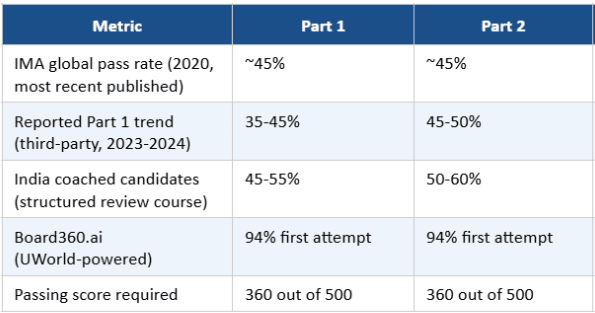
QUICK ANSWER: The IMA's most recently published global CMA pass rate is 45% across both Part 1 and Part 2. Part 1 tends to run slightly lower than Part 2. Indian candidates using structured review courses consistently pass at 50-60%. Board360.ai's pass rate is 94%. The passing score is 360 out of 500.
Pass rate data for the US CMA exam requires careful reading. The IMA last published a detailed breakdown in 2020. Since then, the official position has been a general figure of 45% across both parts. Third-party sources, coaching providers, and regional data fill in the rest of the picture. This post consolidates what is known, what is estimated, and what that means for your preparation strategy.
The most recent IMA-published global pass rate for the US CMA exam is 45% across both Part 1 and Part 2, based on January and February 2020 data covering more than 5,000 candidates. IMA has not released a more granular breakdown since 2016, when it changed how it reports pass rate information.
This 45% figure is the authoritative baseline. Third-party providers and coaching networks have reported that Part 1 has historically trended slightly lower than Part 2 in more recent windows, with Part 1 estimated at 35-45% and Part 2 at 45-50% based on candidate outcome data. These are estimates, not official IMA statistics, but they are widely cited across the professional CMA preparation community.
One important framing: a 45% global pass rate is not low for a professional certification of this level. The US CPA pass rates run below 40% for the hardest sections. The CA Final both-groups combined is under 23%. The CMA's 45% reflects a rigorous exam that rewards structured preparation, not an exam designed to fail the majority.
Part 1 covers financial planning, performance, and analytics. Part 2 covers strategic financial management.
The general consensus among CMA candidates and coaching providers globally is that Part 1 is harder for most candidates. The reason is syllabus breadth. Part 1 covers budgeting, forecasting, cost management, performance measurement, internal controls, technology, and analytics across a wide content range. It demands both conceptual understanding and quantitative application.
Part 2 is more focused. It concentrates on financial statement analysis, capital budgeting, risk management, and professional ethics. Candidates who have worked in finance or who hold an accounting background find Part 2's content more familiar and more directly tied to their professional experience.
Many Indian coaching providers, including Board360.ai, recommend sitting Part 2 first for candidates with an Indian accounting or finance background. The content overlap with standard Indian finance education tends to be higher in Part 2, producing stronger first-attempt outcomes. You then sit Part 1 with the momentum of a passed section behind you.
The passing score for both Part 1 and Part 2 is 360 out of 500. This is a scaled score, not a raw percentage. IMA uses scaled scoring to account for differences in exam difficulty across versions. Two candidates sitting different exam forms in the same window may answer a different number of questions correctly and both score 360, because the scaling adjusts for the relative difficulty of each form.
A common misunderstanding: scoring 72% of questions correctly does not guarantee a pass. Because of scaled scoring, the relationship between raw percentage correct and scaled score varies by exam version. Focus on demonstrated mastery of the content rather than targeting a specific percentage of questions.
One structural prerequisite before the essay or CBQ section is even graded: you must correctly answer at least 50 of the 100 MCQs. Candidates who answer fewer than 50 MCQs correctly have their written section ungraded and receive a failing score regardless of essay or CBQ quality. This threshold is the first gate, and preparing specifically to clear it is a distinct part of exam strategy.
The global 45% pass rate is an average. Your individual pass rate is not determined by the global average. It is determined by your preparation quality, study hours, and exam strategy.
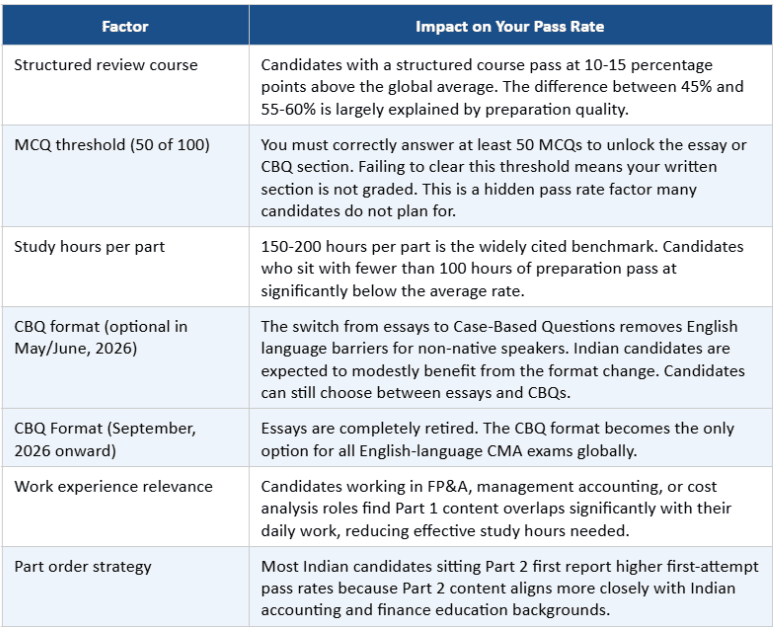
The single biggest differentiator between the 45% global average and the 55-60% rate observed among structured, coached Indian candidates is consistent adaptive practice. Candidates who work through large question banks with performance tracking, identify weak topic areas, and return to those areas before sitting the exam outperform candidates who primarily read textbooks or watch lectures without active practice testing.
From the May/June 2026 testing window, essays are replaced by Case-Based Questions (CBQs) for the written section of both Part 1 and Part 2. CBQs use structured response formats, drag-and-drop, fill-in-blank, and select-from-list rather than open-ended written answers.
For Indian candidates, this is a modestly positive development for pass rates. The essay section required fluent, concise written English under time pressure. Some non-native English speakers who fully understood the content lost marks on essay phrasing and structure. CBQs test the same analytical content without that language barrier.
The written section carries 25% of the total exam score. Removing the language-dependent component of that 25% is expected to produce a small improvement in pass rates for candidates whose content knowledge was strong but whose English writing precision was limiting their essay scores. The effect will be visible in IMA's next published pass rate data, which candidates and coaching providers will be monitoring through 2026.
A common question from Indian candidates is how the US CMA's pass rates compare to the Indian CMA (ICMAI). They are very different credentials tested very differently.
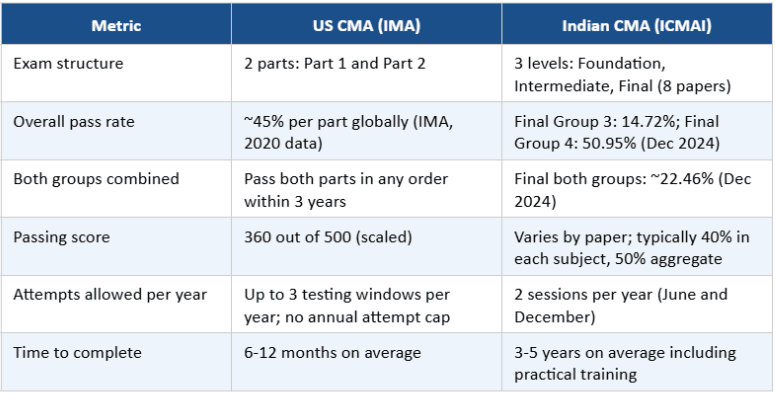
The US CMA's 45% global pass rate is significantly higher than the Indian CMA Final both-groups pass rate of approximately 22% (December 2024 data). This does not mean the US CMA is easier in absolute terms. The Indian CMA covers a much broader syllabus across eight papers over three levels. The comparison is between a two-part focused management accounting exam and a multi-level broad Indian accounting qualification. They are not structurally equivalent.
There is no IMA-published data on average attempts per candidate. What the 45% global pass rate implies is that fewer than half of all attempts result in a pass on that sitting. Many candidates take two or more attempts at Part 1 before passing.
Among Indian candidates using structured coaching programs, first-attempt pass rates are consistently reported at 50-60%.
For candidates sitting without a structured review course or with limited study hours, multiple attempts are common. The three-year window to pass both parts means candidates have time for retakes, but each retake costs the full exam fee and extends the timeline. Investing in quality preparation from the first attempt is more time and cost-efficient than planning for retakes.
Based on pass rate data and candidate outcome patterns, these are the preparation factors with the strongest documented impact on first-attempt pass rates:
Board360.ai's US CMA program is powered by UWorld, IMA's strategic partner. The program covers both Part 1 and Part 2 with SmartPath adaptive technology, full mock exams, and CBQ-ready practice for the May 2026 onwards format change. A free demo is available. Explore the CMA program at Board360.ai and start preparing with materials built to put you in the 50-60% of Indian candidates who pass on the first attempt.