

Menu
✕
June 2, 2026>Board360

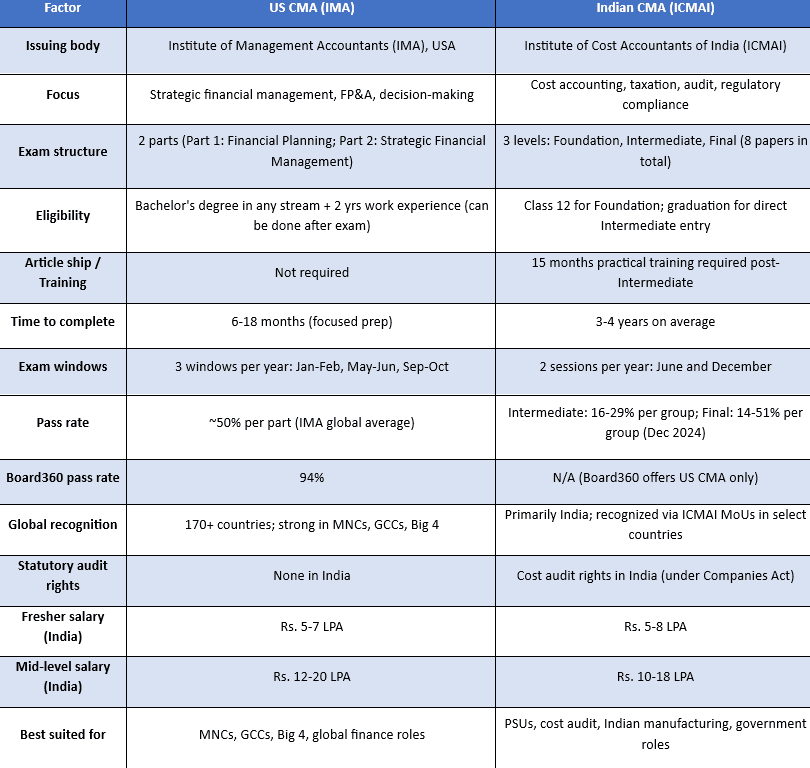
The short answer: they are not the same qualification and do not compete for the same roles.
The US CMA is issued by the Institute of Management Accountants (IMA), USA. It is a two-part global credential focused on strategic financial management, FP&A, and decision-making. It is recognized in 170+ countries.
The Indian CMA is issued by the Institute of Cost Accountants of India (ICMAI). It is a three-level qualification covering cost accounting, taxation, audit, and Indian regulatory compliance. It holds legal recognition for cost audits under Indian law.
If you want to work at MNCs, GCCs, or Big 4 globally, the US CMA is the stronger signal. If you want to build a career in Indian manufacturing, PSUs, or cost audit, the Indian CMA is the more relevant credential. Many Indian professionals hold both. But choosing wisely starts with understanding the differences.
The US CMA is built around two exam parts. Part 1 covers financial planning, performance, and analytics. Part 2 covers strategic financial management. The syllabus emphasizes budgeting, forecasting, variance analysis, internal controls, risk management, and business decision-making.
This makes the US CMA the credential of choice for FP&A roles, management accounting in MNCs, and senior finance positions that require both technical skill and strategic thinking. It is not an audit or compliance credential.
The Indian CMA covers a much broader scope across three levels. Foundation covers basics of accounting, economics, and law. Intermediate adds cost accounting, taxation, and financial management. Final covers strategic management, financial reporting, and indirect taxation in depth. It also includes mandatory practical training.
The Indian CMA gives you cost audit rights under the Indian Companies Act. This is an exclusive statutory function. No other credential in India grants this authority. If cost audit is part of your career plan, the Indian CMA is non-negotiable.
The US CMA has a simple, flexible entry bar. You need a bachelor's degree in any stream from a recognized university. Engineering, arts, science, commerce — all qualify. You also need two years of relevant work experience in management accounting or financial management. Crucially, this experience can be completed after you pass the exams, giving you up to seven years post-exam to fulfill it.
There is no articleship and no mandatory training period. Working professionals can pursue it entirely while in their current jobs.
The Indian CMA has a tiered entry structure. Students can join after Class 12 via CMA Foundation. Graduates can skip Foundation and enter directly at the Intermediate level. After clearing Intermediate, candidates must complete 15 months of practical training before attempting CMA Final. This training requirement adds time to the overall timeline.
For working professionals in India, the US CMA's flexibility is a significant practical advantage. The Indian CMA's structure suits students who start early and can accommodate the training requirement.
Both are genuinely difficult. But the structure of difficulty is very different.
The US CMA exam averages a 50% pass rate for both Part 1 and Part 2, according to IMA's global data. Each part has 100 multiple-choice questions and two essay-based questions within a four-hour window. The pass mark is 360 out of 500. The exam is entirely objective and case-based. There are no descriptive papers or open-ended written assessments.
The Indian CMA has significantly lower pass rates at the group level. ICMAI's December 2024 results showed Intermediate Group 1 at 16.10% and Final Group 3 at 14.72% for both-group combined attempts. Across recent sessions, Indian CMA Intermediate pass rates have ranged from 14% to 29% per group. These figures reflect a structured exam demanding deep subject knowledge across a broad syllabus.
The US CMA is narrower in scope. You study two topics very well. The Indian CMA is broader. You study eight papers across three levels. Each has its own form of difficulty.
In terms of time investment, the US CMA typically takes 6 to 18 months with focused preparation. The Indian CMA takes 3 to 4 years on average, including practical training. Faster completions exist but are uncommon without prior full-time study.
This is the dimension that matters most for career planning.
The US CMA is issued by IMA, which has over 140,000 members across 150+ countries. The credential is recognized by MNCs, Big 4 GCCs, and global financial services firms. In India, the US CMA has seen significant uptake in GCC hiring for FP&A, cost management, and financial analysis roles. It does not, however, carry any statutory recognition under Indian law.
The Indian CMA holds statutory legal recognition in India. ICMAI is established by an Act of Parliament. Indian CMAs have the exclusive right to conduct cost audits under the Companies Act, 2013. This is mandatory for certain categories of companies and is a significant source of work for Indian CMA practitioners.
For roles at Indian PSUs, government-facing companies, or manufacturing firms requiring cost audit, the Indian CMA's statutory standing matters. For roles at MNCs, GCCs, or global firms, the US CMA's international recognition carries more weight.
A useful frame: the Indian CMA travels well within India's regulatory ecosystem. The US CMA travels well beyond it.
At the fresher level, both credentials produce similar starting packages in India. Fresh Indian CMA holders typically start at Rs. 5-8 LPA. Fresh US CMA holders start at Rs. 5-7 LPA. The entry-level gap is small.
The difference widens at mid and senior levels. According to IMA's global salary surveys, CMA-certified professionals earn 58% more than their non-certified peers globally. In India, mid-career US CMA holders typically earn Rs. 12-20 LPA. Indian CMA mid-career professionals typically earn Rs. 10-18 LPA. The US CMA premium is most visible in MNC and GCC roles, where the credential's global framing is directly valued.
Indian CMAs in specialized roles, particularly cost audit, manufacturing finance, or PSU leadership positions, can also reach Rs. 20-30 LPA at senior levels. The ceiling depends on domain and employer type, not just the credential.
Board360.ai's US CMA program is powered by UWorld, with a 94% first-attempt pass rate. If you are targeting MNC or GCC roles, the program is built around exactly the career path where the US CMA pays its highest returns.
The US CMA opens doors in FP&A, management accounting, business analysis, and corporate finance at MNCs, GCCs, and global firms. In India, companies like Amazon, Accenture, Wipro, L&T, and JP Morgan actively recruit US CMA holders for finance roles. The credential is increasingly common in shared services centers and Big 4 advisory teams that support global clients.
The Indian CMA covers a broader range of Indian-specific roles. Cost audit, indirect taxation, government contracting, manufacturing finance, and SEBI-regulated entities all have active demand for ICMAI members. PSUs like BHEL, ONGC, and Indian Railways hire Indian CMAs for cost accounting and budgeting roles.
There is meaningful overlap in private sector corporate finance. Both credential holders appear in financial analysis, budgeting, and controllership roles at mid-size Indian companies. In these roles, the US CMA's strategic and global framing often gives it a marginal edge in MNC environments.
One important nuance: the US CMA does not grant you the right to conduct cost audits in India. That right belongs exclusively to ICMAI members. If statutory cost audit work is part of your plan, the Indian CMA is essential.
Yes. And many Indian finance professionals do exactly this.
The two credentials are complementary, not competing. The US CMA gives you global recognition and strategic finance credibility. The Indian CMA gives you statutory rights and deep domain knowledge in Indian costing and taxation. Together, they position you for the broadest possible range of finance roles in India.
For working professionals, the US CMA is typically pursued first, given its shorter timeline and greater flexibility. The Indian CMA is then layered in, often taken in parallel or after initial career establishment.
For students starting fresh, the sequence depends on your target domain. If your primary goal is domestic Indian practice, start with the Indian CMA. If you are targeting MNC or GCC roles early, the US CMA is the more direct path.
Board360.ai's US CMA program is powered by UWorld, with a 94% first-attempt pass rate and full coverage of both exam parts. The program is designed for working professionals and can be completed in 6 to 18 months. A free demo is available. Explore the CMA program at Board360.ai and see if it fits your 2026 career goals.