

Menu
✕
June 2, 2026>Board360

Here is the short answer. If you want to build a career in India, particularly in audit, practice, or domestic finance, CA is the better foundation. If you want to work at a Big 4 GCC, MNC, or in a role that handles US GAAP or global reporting, the US CPA gives you a direct edge. Many Indian professionals ultimately pursue both. But the order and timing depend on your starting point.
This post breaks down every key dimension, so you can make the decision clearly.
The US CPA is issued by American state boards of accountancy under AICPA oversight. It is the standard qualification for accounting professionals working with US GAAP, SEC reporting, and international audit. In India, CPA holders are primarily hired by Big 4 GCCs, MNCs with US parent entities, and global financial services firms.
The CA is issued by the Institute of Chartered Accountants of India (ICAI). It is the highest accounting credential in India and covers audit, taxation, financial reporting, and advisory under Indian law and standards. CA is the only qualification in India that grants the legal right to sign statutory audits.
They are not direct substitutes. They are designed for different regulatory environments and career contexts. Comparing them head-to-head only makes sense when you are clear on what market you are trying to enter.
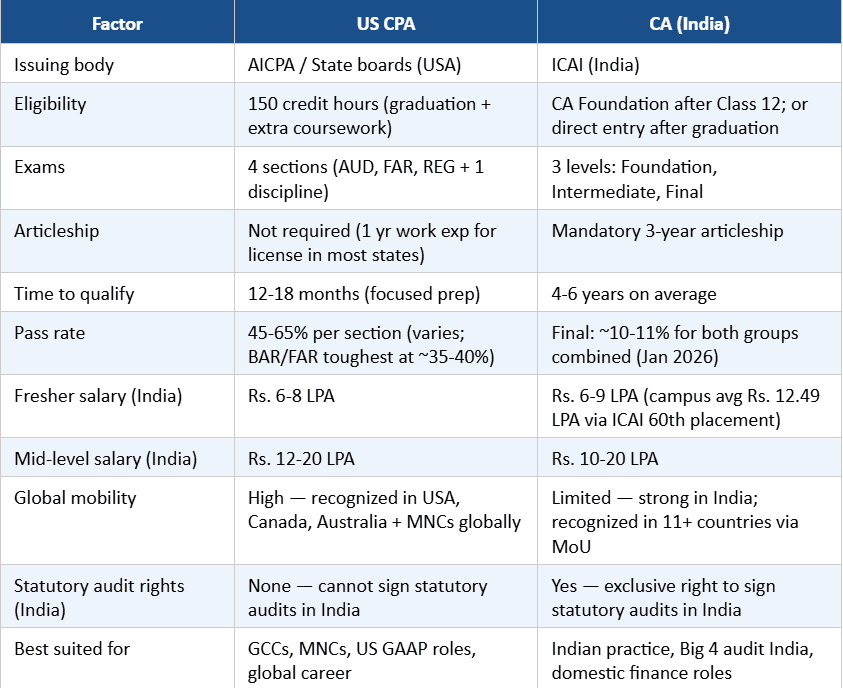
For the US CPA, most US state boards require 150 credit hours of education. For Indian candidates, this typically means a bachelor's degree plus additional coursework, an M.Com, or a postgraduate program. Some states have agreements that allow Indian CAs to fulfill this requirement through their CA qualification.
For the CA, students can enter through two routes. After Class 12, they appear for CA Foundation, then Intermediate, then Final. Graduates and postgraduates can skip Foundation and enter directly at the Intermediate level. Either path leads into a mandatory three-year articleship.
For B.Com students wondering which to choose: CA is the natural starting point if you want a comprehensive Indian credential. The CPA becomes relevant once you have your degree and want to add a global certification. Many B.Com and M.Com graduates pursue the CPA after completing their degree, without doing CA at all, and build careers in MNCs or GCCs.
Both credentials are genuinely difficult. But they are difficult in different ways.
The CA has one of the lowest completion rates of any professional qualification in India. ICAI's January 2026 results show a combined pass rate of just 10.97% for candidates attempting both groups of CA Final together. The CA Intermediate combined pass rate in the same session was 9.39%. These are not outliers. CA pass rates have consistently ranged between 8% and 27% across levels and sessions. The exam demands years of study, a three-year articleship under a practicing CA, and deep command of Indian law.
The US CPA is challenging, but more structured. Candidates take four sections independently. According to NASBA data, pass rates vary by section. FAR and BAR are the toughest, with rates falling below 40% in 2024. REG and TCP are more accessible, with TCP consistently above 70%. The CPA's pass rates are low in absolute terms, but the pass-on-attempt basis is significantly more forgiving than the CA's combined group model. Board360.ai's CPA program, powered by UWorld’s CPA Review Course, has produced a 90% pass rate among its students.
Bottom line: CA is harder to complete. The CPA is harder to dismiss. Both require serious preparation.
This is where the CPA has a clear structural advantage for working professionals.
The average time to qualify as a CA in India is 4 to 6 years. This includes CA Foundation (6-12 months), CA Intermediate (12-18 months), three years of articleship running concurrently with exam preparation, and CA Final (12-24 months). Multiple attempts at the same level are common, which extends the timeline further.
The CPA typically takes 12 to 18 months for a focused candidate who is working full-time. You can study while employed. There is no mandatory articleship. NASBA gives you 18 months from passing your first section to pass the remaining three. Most Indian candidates who are consistent finish within 15 months.
For someone already in the workforce, this difference is significant. A CPA credential earned in 18 months can change your employer, role, and salary band while you are still in your 20s. The CA route, taken after graduation, often puts candidates in their late 20s or early 30s before they qualify.
Salary comparisons between CA and CPA in India depend heavily on the type of employer, city, and role. Here is an honest breakdown.
For freshers: CPA holders typically start at Rs. 6-8 LPA in US-facing roles at GCCs or Big 4 India. CA freshers through campus placements averaged Rs. 12.49 LPA in ICAI's 60th placement drive (2024), though this reflects a curated campus pool. Outside campus, most CA freshers start at Rs. 6-9 LPA in general industry roles.
At mid-level (3-7 years): US CPAs in Big 4 GCCs or MNCs typically earn Rs. 12-20 LPA. CAs in Big 4 India audit and advisory earn in a comparable range. The gap depends on specialization. A CA with international tax expertise can match or exceed a CPA's earnings in a domestic context. A CPA handling US GAAP reporting at a large GCC often earns more than a CA in a general accounts role.
At senior level (8+ years): Both credentials can reach Rs. 30-50 LPA and above at director, VP, or CFO level. The CA has stronger reach into traditional Indian corporate and practice roles. The CPA has stronger pull in global reporting, MNC controllership, and roles that interface directly with US headquarters.
The honest conclusion: at comparable experience and employer type, salaries are broadly similar. The CPA gives you a salary premium specifically in global, US-facing roles. The CA has a stronger claim in domestic practice, statutory audit, and Indian regulatory work.
The CA opens more doors within India's regulatory framework. Statutory audits, tax practice, SEBI compliance, RBI-regulated entities, and government assignments all require the CA. If you want to run your own practice, train articles, or build a firm in India, the CA is the only path.
The CPA is built for global accounting. The Big 4's combined GCC headcount in India stood at 140,000-160,000 as of 2024, with a large share working on US GAAP, PCAOB audit, and international tax. Mid-sized US firms like RSM are also scaling India teams rapidly. The CPA credential is the preferred qualification for these roles. MNCs and GCCs hiring for US-facing finance functions specify CPA more often than CA in job descriptions for senior roles.
There is also a global mobility dimension. The CPA is recognized in the US, Canada, Australia, and through mutual recognition agreements in several other countries. The CA is recognized in India and through ICAI's MoU agreements with bodies in 11+ countries. If working in the US or switching to a US-based employer is part of your 10-year plan, the CPA is the more direct route.
This is one of the most common questions, and the answer is: it depends on your situation, but the combination is genuinely powerful.
Indian CAs who pursue the CPA bring a deep understanding of Indian tax and audit law, strong exam discipline, and a credential that employers respect. The transition is also more efficient: ICAI's MoU with AICPA allows qualified CAs to meet the education requirements for many US state boards without needing additional coursework. Many CAs clear all four CPA sections in 10-14 months.
The salary impact of adding a CPA to a CA is significant in global roles. A CA with a Big 4 audit background who adds the CPA can transition into US GAAP or IFRS advisory roles and often sees a 40-60% salary increase in the move. This is not a guaranteed outcome, but it is a commonly observed pattern in the Big 4 and GCC hiring market.
For someone still deciding between the two at the start of their career: if you are already a CA or mid-way through the CA program, completing it first and then pursuing the CPA makes strategic sense. If you have a bachelor's degree, have not started CA, and are drawn to global or MNC roles, the CPA alone is a viable path without CA.
Board360.ai's US CPA program is powered by UWorld. UWorld is the global leader in CPA & CMA prep, combining the expertise of Roger Philipp, Wiley Efficient Learning, and the legendary Peter Olinto to deliver 100% blueprint-aligned courses and a 90% CPA exam pass rate. Whether you are a fresh graduate targeting a Big 4 GCC role or a qualified CA looking to add a global credential, the program is designed around your schedule. A free demo is available. Explore the CPA program at Board360.ai and see if it fits where you want to go in 2026.