

Menu
✕
June 2, 2026>Board360

SHORT ANSWER: A US CMA works in management accounting: budgeting, forecasting, cost analysis, and business decision support. The most common role in India is FP&A Analyst or Finance Manager at GCCs and MNCs. The work is forward-looking, analytical, and internally focused — very different from a statutory accountant's compliance work.
Most people have a vague sense that the US CMA is a finance credential. But if you ask what a CMA professional actually does on a Tuesday afternoon in Bangalore, the answer is less obvious. This post makes it concrete.
We cover what management accounting actually involves, what a CMA's day looks like across different seniority levels, which industries and employers hire CMAs in India, how the role differs from a traditional accountant, and what the career path toward CFO looks like from an FP&A starting point.
Before the job roles make sense, this distinction does.
A financial accountant records what has already happened. They produce the balance sheet, profit and loss statement, and trial balance. Their audience is external: auditors, tax authorities, banks, and regulators. Their output is historical and compliance-focused.
A management accountant, which is what a CMA is trained to be, focuses on what is going to happen. They build the budget. They produce the monthly forecast. They analyze why actual results deviated from the plan. Their audience is internal: the CFO, the business head, the operations team, and the CEO. Their output informs decisions.
This distinction drives every other difference in job description, daily workflow, employer type, and career trajectory. A CMA does not primarily maintain ledgers. A CMA primarily answers the question: what should we do next, and why?
The daily work of a CMA in India varies by seniority and employer type. But the building blocks are consistent across roles.
For a CMA Analyst (0-3 years) at a GCC or MNC:
For a CMA Senior Analyst or Manager (4-8 years):
The work involves spreadsheets, yes. But the output is analytical judgment. You are not entering data. You are explaining it and recommending what to do about it.
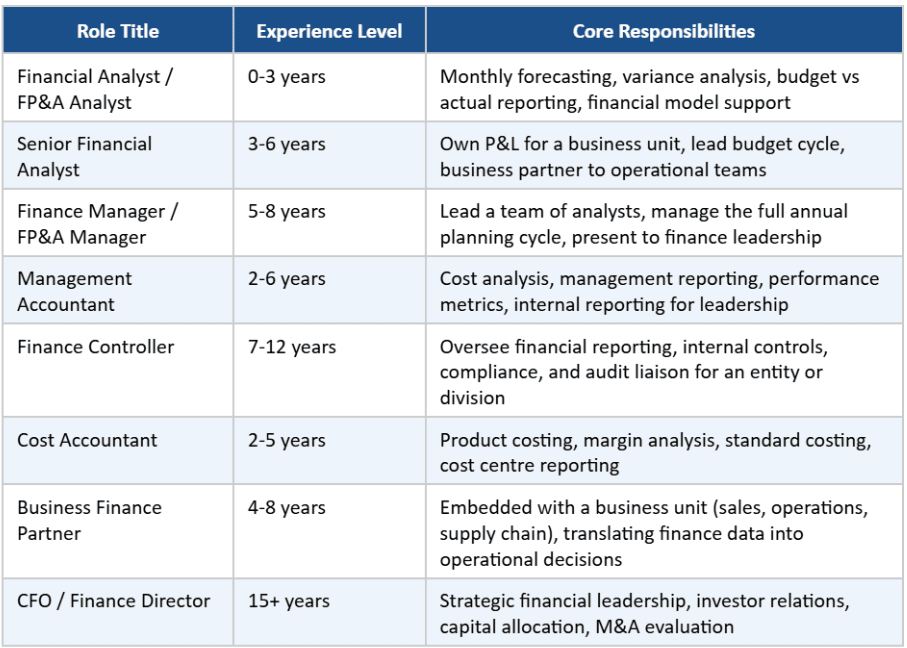
FP&A is the most common entry point for US CMA graduates in India, particularly at GCCs and MNCs. According to IMA's global salary survey, CMA-certified professionals earn 21% more than non-certified peers globally. In India, mid-level CMA holders in GCC or MNC FP&A roles typically earn Rs. 12 to 20 LPA, compared to Rs. 8 to 13 LPA for comparable experience without the credential.
Financial Planning and Analysis is the function inside a company responsible for budgeting, forecasting, and management reporting. It sits between raw financial data and strategic business decisions.
FP&A teams at GCCs and MNCs typically run three core cycles: the Annual Operating Plan (AOP) in Q3 and Q4, the monthly forecast update, and the monthly or quarterly business review. A CMA's skills map almost exactly onto these cycles: the CMA Part 1 syllabus covers budgeting, forecasting, variance analysis, performance measurement, and internal controls. Part 2 covers financial analysis, capital investment decisions, and risk management. These are the technical tools of FP&A work.
This is why CMAs are not simply well-suited to FP&A. They are specifically trained for it. The CMA curriculum is built around the competencies that FP&A job descriptions list. A B.Com or M.Com graduate studying general accounting is not.
FP&A roles in India are growing rapidly. NASSCOM's GCC India Landscape Report 2024 identified India as the global hub for GCC finance and analytics work, with over 1,700 GCCs now operating in India. A large proportion of the finance headcount in these centers is in FP&A, management reporting, and business partnering roles, all of which are core CMA territory.
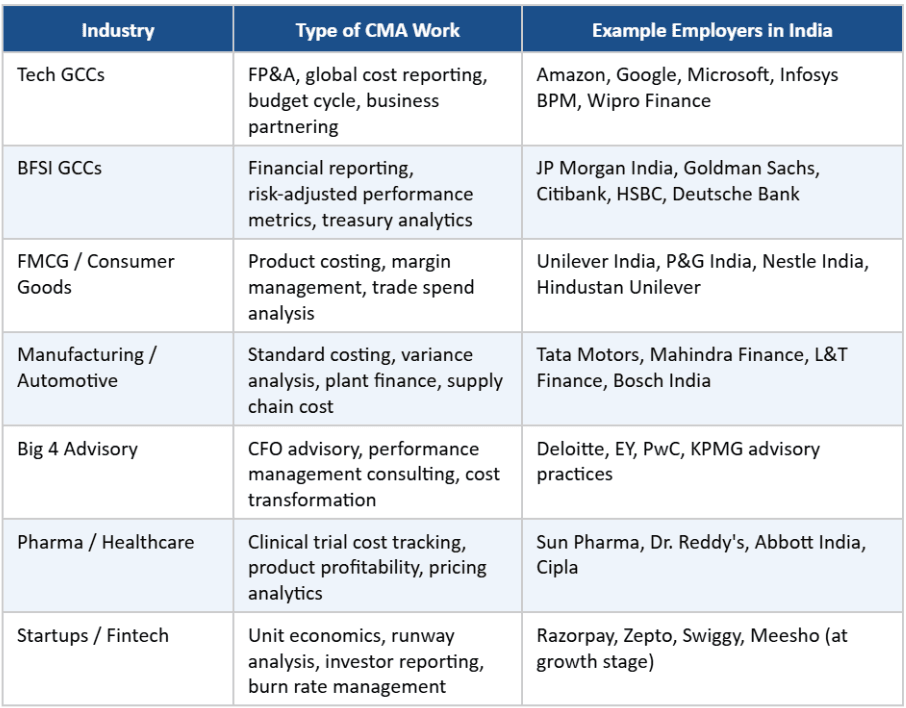
Technology GCCs and BFSI GCCs are the highest-volume CMA employers in India and offer the strongest salary packages. FMCG and manufacturing employ large management accounting teams focused on cost control and margin analysis. Big 4 advisory teams use CMAs for CFO advisory and performance improvement engagements.
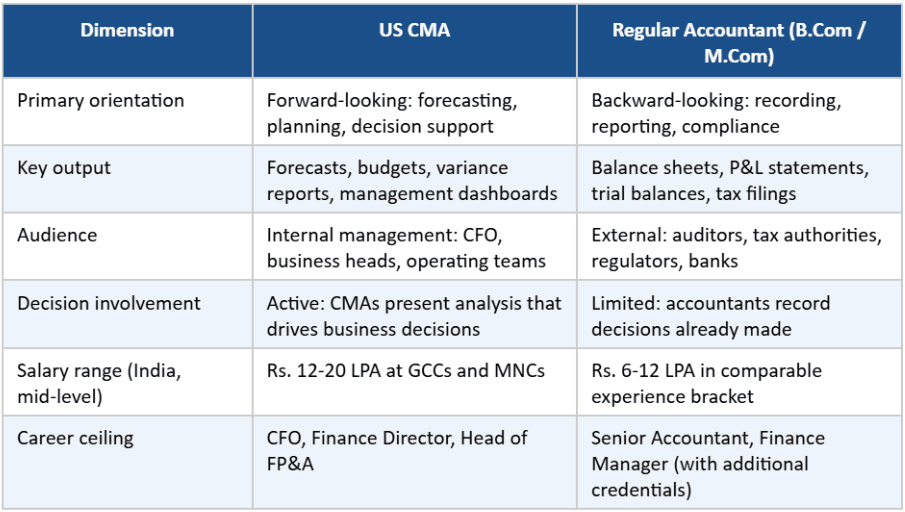
The simplest way to frame this: a regular accountant tells you what happened. A CMA tells you why it happened and what to do about it. Both functions are necessary. But the CMA's analytical and forward-looking role typically commands higher compensation and faster career progression in MNC and GCC environments.
Yes, but in a specific context. Big 4 firms in India employ CMAs primarily in their Advisory and Consulting service lines, not in audit or tax. The work is typically:
At Deloitte, EY, PwC, and KPMG India, the Advisory practices that handle these mandates actively value or prefer the US CMA credential alongside an MBA or CA. The CMA signals the management accounting and business performance competencies that are central to advisory engagements, in a way that a pure audit or tax credential does not.
The tools a CMA uses depend on the seniority level and employer size. Here is the realistic picture by stage:
At the analyst level at most Indian GCCs and MNCs:
At the senior analyst and manager level at larger MNCs:
The CMA curriculum does not teach specific software. It teaches the analytical framework and financial thinking that the software supports. An analyst who understands variance analysis and cost behavior will use any FP&A tool effectively. An analyst who only knows the software but not the concepts will produce outputs without understanding them.
The CFO is the most common long-term destination cited by CMA professionals globally, and in India the path is well-trodden in MNC and GCC environments.
The typical career arc: FP&A Analyst (0-3 years) to Senior Analyst (3-6 years) to Finance Manager (5-8 years) to Finance Controller or Finance Director (8-12 years) to CFO or Head of Finance (12-20 years). Each step adds more scope, more stakeholders, and more strategic involvement.
The CMA credential supports this trajectory because it is specifically designed around the competencies that finance leaders need: strategic planning, risk management, capital allocation, performance measurement, and business decision analytics. These are not compliance skills. They are leadership skills in a financial context.
In India's GCC market, the path from FP&A Analyst to Finance Director at a multinational subsidiary is genuinely achievable in 12 to 15 years with the right combination of CMA credentials, progressive employer experience, and business partnering track record. Several India-based CFOs of large GCCs hold the US CMA alongside an MBA or CA.
At GCCs and MNCs, the US CMA role is primarily an internal finance function. You serve internal business stakeholders: the CFO, business unit heads, and operating teams. There is typically no external client relationship in the way a Big 4 auditor or consultant would have one.
The work involves significant stakeholder interaction. A Senior FP&A Analyst will present to regional VPs, challenge operational teams on their cost assumptions, and defend financial forecasts in executive business reviews. The role is analytical and communicative, not siloed.
At Big 4 advisory practices, CMA-qualified professionals do have external client relationships. They are brought in to advise CFOs and finance teams at client organizations on performance management and finance transformation. This is a more externally facing variant of the CMA career, closer to consulting than to in-house finance.
Board360.ai's US CMA program is powered by UWorld, IMA's strategic partner. The program covers both Part 1 and Part 2, including the CBQ format change from May 2026. A free demo is available. Explore the CMA program at Board360.ai and start building the analytical and strategic finance skills that GCCs, MNCs, and Big 4 advisory teams hire for.