

Menu
✕
Published: October 23, 2026>Board360
Your CPA Discipline choice should match the work you want to do after qualification. The right choice also fits your accounting strengths and the material you can study consistently.
If you work in financial reporting, analysis, or corporate finance, BAR may be the natural fit. If you work in US taxation, TCP deserves serious consideration.
If your experience involves technology controls, information security, or IT audit, ISC may suit you better. You do not need to pick the section with the highest reported pass rate.
The American Institute of Certified Public Accountants provides the official CPA Exam blueprints and section outlines. Use that document to verify the content for your exam date before buying study material.
The Uniform CPA Examination has three required Core sections: AUD, FAR, and REG. You must also pass one Discipline section from BAR, ISC, or TCP.
Your Discipline choice does not create a different CPA license. The AICPA explains that candidates qualify for the same license regardless of their selected Discipline.
The sections still test different technical skills. Your choice determines which advanced subject area you study and demonstrate in the exam.
BAR develops technical accounting, financial analysis, and reporting skills. ISC focuses on information systems, security, data management, and controls.
TCP extends federal tax knowledge into advanced compliance and planning for individuals and entities. It also covers personal financial planning and property transactions.
You should choose based on career direction, subject comfort, and practice results. The AICPA discussion of the Discipline model explains why pass rates alone can mislead candidates.
Use this table as a first filter. Read the detailed sections below before making your final decision.
| Factor | BAR | ISC | TCP |
|---|---|---|---|
| Main Focus | Business analysis, technical accounting, financial reporting, state and local government | Information systems, data, security, privacy, and SOC engagements | Advanced individual and entity tax compliance and planning |
| Best-Fit Roles in India | Financial reporting, assurance, advisory, FP&A, controllership | IT audit, technology risk, systems assurance, cybersecurity controls | US tax, tax compliance, tax planning, private-client or entity tax support |
| Core Section Overlap | FAR | AUD | REG |
| MCQs | 50 | 82 | 68 |
| Task-Based Simulations | 7 | 6 | 7 |
| Score Weighting | 50% MCQ, 50% TBS | 60% MCQ, 40% TBS | 50% MCQ, 50% TBS |
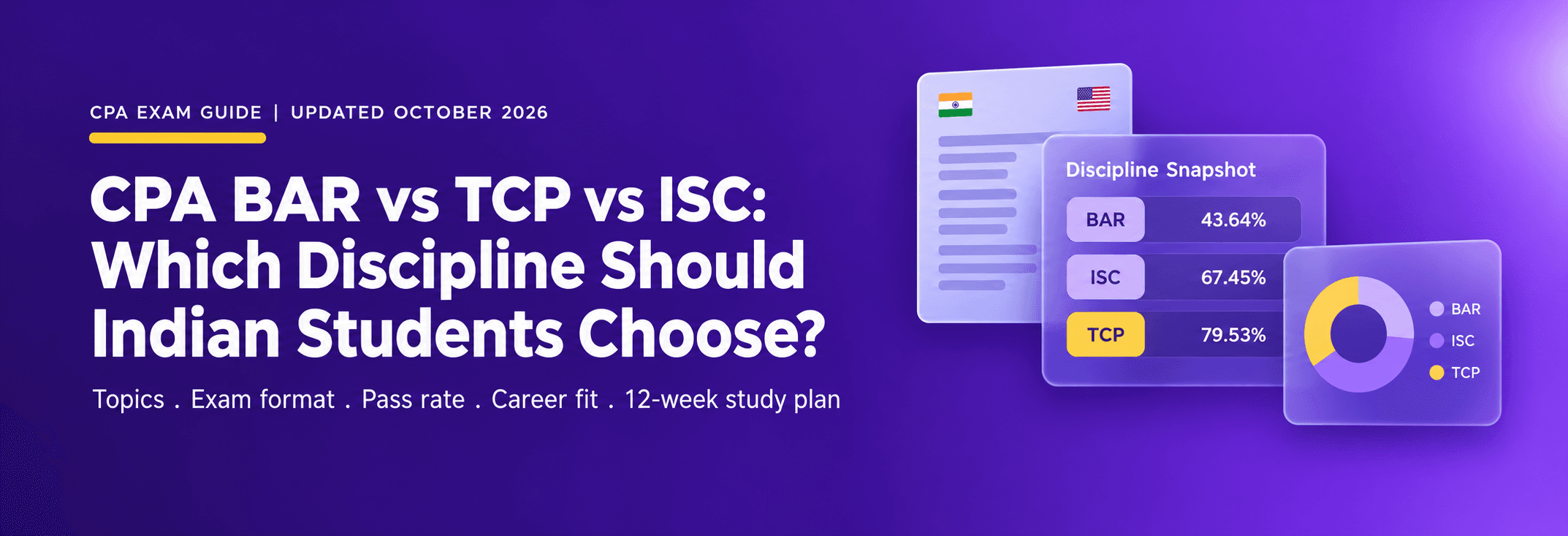
| AICPA Cumulative Pass Rate, Q1-Q2 2026 | 43.64% | 67.45% | 79.53% |
| Strongest Advantage | Builds on accounting and analytical ability | Has a more MCQ-heavy exam structure | Builds naturally on federal tax concepts from REG |
| Potential Challenge | Technical and calculation-heavy analysis | New technology terms and control frameworks | Detailed tax rules, exceptions, and planning scenarios |
The published pass rates are historical results across the exam population. They do not predict your individual chance of passing.
Choose BAR when your strongest professional foundation is financial accounting, reporting, analytical review, or business decision support. It builds most naturally on FAR.
What BAR Covers
The 2026 blueprint divides BAR into three content areas. Business Analysis carries 40% to 50% of the section. Technical Accounting and Reporting carries 35% to 45%. State and Local Governments carries 10% to 20%. Business Analysis includes financial statement analysis, cost and managerial accounting, budgeting, forecasting, and valuation decisions. You may also work with financial and non-financial performance measures.
Technical Accounting and Reporting covers selected advanced accounting matters. These can include business combinations, derivatives, hedge accounting, share-based payments, and other topics beyond FAR fundamentals.
The government reporting area tests financial reporting concepts for state and local government entities. If your background is limited to Indian corporate reporting, you should plan time for this material.
Your Background That Fits BAR
BAR may suit you if you want a technical accounting or finance story on your resume. It can support work in assurance, corporate finance, advisory, and controllership.
Why BAR Can Feel Difficult
BAR has calculation-heavy content and requires you to interpret data rather than memorize isolated facts. You may need to connect accounting rules with business analysis.
Its cumulative pass rate was 43.64% through Q2 2026. This was lower than the reported rates for ISC and TCP during the same period. That difference does not prove BAR is objectively harder for every candidate. Candidates select sections based on different backgrounds, and preparation levels vary.
If you choose BAR, study it with FAR concepts fresh in your memory. Review financial statement analysis and managerial accounting early, then devote planned sessions to government accounting and advanced technical topics.
Choose ISC if information systems, technology risk, IT controls, cybersecurity, or systems assurance fits your current work or career target. It builds most naturally on AUD concepts.
What ISC Covers
The 2026 blueprint has three content areas. Information Systems and Data Management carries 35% to 45% of the section. Security, Confidentiality and Privacy also carries 35% to 45%. Considerations for System and Organization Controls engagements carries 15% to 25%.
You should understand how business processes use systems and data. You also need to know how access, change management, operations, and data handling affect risk. Security topics include confidentiality, privacy, and protection of information. The SOC area focuses on the assurance work associated with system and organization controls engagements.
ISC is not a general programming test. You should expect assurance, governance, system, and control concepts rather than software development exercises.
Your Background That Fits ISC
ISC can also be a sensible option if you are moving into technology assurance from an accounting role. You must still be willing to learn the terminology and frameworks.
Why ISC May Fit Some Candidates Better
ISC has 82 MCQs and six task-based simulations. MCQs contribute 60% of the score, while simulations contribute 40%. That structure differs from BAR and TCP, which use equal MCQ and TBS score weighting. It may appeal to candidates who prefer a more MCQ-heavy format.
However, you still need simulation practice. Do not assume the larger MCQ count makes ISC easy or requires only memorization. The AICPA reported a 67.45% cumulative ISC pass rate through Q2 2026. Use it as context, not as a reason to choose ISC without subject interest.
Choose TCP if you want to work in US tax compliance, tax planning, or advanced individual and entity taxation. It builds directly on REG and is usually the clearest fit for tax-focused candidates.
What TCP Covers
The 2026 blueprint gives 30% to 40% to individual tax compliance, tax planning, and personal financial planning. Entity Tax Compliance carries another 30% to 40%.
Entity Tax Planning carries 10% to 20%. Property Transactions carries 10% to 20%. The complete outline and score weightings appear in the official AICPA CPA Exam blueprint resource.
Individual topics include gross income, adjusted gross income, taxable income, estimated taxes, and loss limitations. The blueprint also includes gift taxation and personal financial planning concepts.
Entity topics include tax compliance for corporations, partnerships, and other covered entity types. You also need to understand planning decisions and the tax effects of property dispositions.
Your Background That Fits TCP
TCP is especially relevant if you already prepare US tax returns. Your job experience can make examples easier to understand, though exam tasks may require different reasoning.
Why TCP Can Still Be Challenging
TCP uses 68 MCQs and seven task-based simulations. MCQs and TBSs each contribute 50% of your score. You need to apply rules to complex fact patterns. These can involve individuals, entities, property transactions, and planning choices.
Its cumulative pass rate was 79.53% through Q2 2026. This is the highest among the three Discipline sections for that reporting period. The AICPA cautions that candidate self-selection affects Discipline pass rates. Tax practitioners may select TCP because their work already overlaps with its content.
If you have no US tax background, TCP is still available to you. You should allow time to build federal tax fundamentals and complete REG before advanced tax practice.
There is no single Discipline section that is hardest for every Indian candidate. Difficulty depends on what you already know and how well you apply the tested material.
| If You Find This Difficult | You May Need More Preparation For | Why |
|---|---|---|
| Advanced accounting, statement analysis, calculations | BAR | BAR requires applied accounting, reporting, analysis, and government concepts. |
| IT terminology, controls, security, data processes | ISC | ISC tests systems, data, information security, privacy, and SOC engagements. |
| US federal tax rules, tax planning, exception handling | TCP | TCP builds on REG and applies tax rules to advanced compliance and planning. |
Use practice results to validate your impression. Complete a small diagnostic set for each Discipline before choosing, if your study provider offers sample questions.
Compare the explanations as well as your raw scores. A topic may feel unfamiliar at first but become manageable after structured review. Do not interpret a pass rate as a direct difficulty ranking. The AICPA explains how exam scoring works and publishes section rates on its official pass-rate page.
BAR and TCP are common options for Indian CAs and finance professionals. Both use 50% MCQ and 50% TBS weighting, but their knowledge bases differ.
BAR is generally more relevant when your strongest skills involve financial reporting, accounting analysis, and business decisions. TCP is better aligned with advanced tax compliance and planning. If your job is in a US tax outsourcing team, TCP may reinforce practical work. If your job is in audit, reporting, controllership, or FP&A, BAR may be more relevant.
A CA qualification does not automatically make BAR easier. Your day-to-day work matters more than your qualification title alone. Likewise, a tax associate is not automatically ready for TCP. You should understand US federal tax concepts and prepare for the exam’s more advanced scenarios. Choose the content you can study with sustained focus. Career fit is useful only when you can build enough knowledge to pass the assessment.
| Your Current Background or Target Role | First Discipline to Consider | Reason to Shortlist It |
|---|---|---|
| Indian CA in financial reporting or technical accounting | BAR | It extends accounting and reporting skills beyond FAR. |
| CA or commerce graduate targeting FP&A or controllership | BAR | It covers analysis, budgeting, forecasting, and technical reporting. |
| US tax associate, EA candidate, or NRI tax support professional | TCP | It builds advanced federal tax compliance and planning capability. |
| Indian professional in entity tax or personal tax support | TCP | The content fits advanced individual and entity tax workflows. |
| IT auditor, SOC associate, technology risk analyst | ISC | It covers information systems, security, data, and controls. |
| Internal auditor focused on IT general controls | ISC | The content aligns with systems assurance and technology controls. |
| B.Com or M.Com graduate with no clear specialization | Choose from work target and diagnostic practice | Review all three outlines and sample questions before committing. |
Your choice does not restrict the work permitted under the CPA license. It can still help employers understand your interests and specialist knowledge. If your employer has a preferred Discipline, ask about that before committing. Some teams may value tax, reporting, or IT assurance experience more than a particular exam label.
Step 1: Start With Your Desired Role
Write down two or three roles you want within the next three years. Examples include US tax senior, financial reporting analyst, IT audit associate, and FP&A analyst. Map the daily tasks of those roles to the Discipline content. This gives you a better basis than advice from a friend who has different career goals.
Step 2: Review the Official Blueprint
Read the current blueprint for every shortlisted section. Review its content areas, task statements, skill levels, and question structure. The AICPA blueprint page is the source of truth for tested content. Use the version that applies to your scheduled exam date.
Step 3: Take a Diagnostic Set
Complete a representative sample from BAR, ISC, and TCP. Keep the same time limits and review conditions for each section. Track your accuracy, time per item, confidence, and review effort. The section with the highest initial score is not always the best long-term fit.
Step 4: Check Your Core Knowledge
BAR builds most naturally on FAR, ISC on AUD, and TCP on REG. Think about which Core subject you understood most deeply. You do not need perfect Core scores to choose a Discipline. You should, however, be comfortable revisiting its related concepts.
Step 5: Match the Decision to Your Calendar
Estimate how many hours you can study each week. Select a section whose content you can revisit consistently alongside work and family commitments. Review the exam windows and scheduling requirements through your jurisdiction and NASBA. Check the official NASBA international exam information if you plan to test in India.
This framework helps you begin preparation after choosing a Discipline. Replace the focus notes with the exact topics in the blueprint that applies to your test date.
| Week | Focus | How to Use the Time |
|---|---|---|
| 1 | Blueprint and baseline | Read the complete outline, note weak areas, and complete a diagnostic set. |
| 2 | First major content area | Study core concepts and create short notes for key rules or frameworks. |
| 3 | Continue major content | Solve topic-based MCQs and record every repeated mistake. |
| 4 | Second content area | Learn the next major blueprint area and complete focused practice. |
| 5 | Application practice | Work through mixed questions that require more than one step. |
| 6 | Third content area | Cover government topics for BAR, SOC for ISC, or entity tax topics for TCP. |
| 7 | Review and TBS basics | Study simulation formats and practise reading exhibits carefully. |
| 8 | Mixed MCQs | Mix topics so you practise identifying the correct rule without topic labels. |
| 9 | TBS practice | Complete timed simulations and review why each incorrect option failed. |
| 10 | Weak-area repair | Use your error log to revisit the lowest-performing areas. |
| 11 | Full timed mock | Complete a realistic practice exam and analyse pacing, accuracy, and fatigue. |
| 12 | Final consolidation | Review concise notes, repeat weak simulations, and confirm exam logistics. |
For BAR, devote extra attention to analysis, technical reporting, and government accounting. For ISC, revise systems, security, and SOC concepts repeatedly. For TCP, practise detailed tax scenarios and calculations. Use your mistakes to identify missing facts, incorrect assumptions, and misunderstood tax treatments.
Start with the official AICPA blueprint and use a structured review course to teach the content. Your notes should mirror the blueprint rather than only follow a provider’s chapter sequence.
Use MCQs to diagnose gaps and TBSs to practise applying concepts. Review incorrect answers and lucky guesses because both reveal areas you have not mastered. Your error log should record the topic, the mistake, the correct principle, and one way to prevent the same error. Keep each entry brief enough for weekly review.
For BAR, practise calculation-heavy scenarios and explain why each accounting treatment is appropriate. For ISC, create comparison notes for systems and control concepts. For TCP, organise notes by taxpayer, entity type, transaction, and planning objective. Confirm that your course materials match the blueprint effective on your exam date.
AICPA updates its blueprints periodically. Its current resource page lists the 2026 blueprint and the version effective January 1, 2027. If you test in 2026, use the applicable 2026 blueprint. If your exam date falls in 2027, review the new blueprint before finalising your plan.
You can take the Uniform CPA Examination in India after establishing eligibility through a participating US jurisdiction. NASBA describes the process on its international examination page.
NASBA currently lists an international administration fee of US$460 per Discipline section for India. At an illustrative rate of ₹97 per US dollar, that is about ₹44,620 before card or bank charges. The rupee amount is only an example, not a live exchange quote. Check current fees and payment instructions before registering for the section.
The international administration fee is separate from the application, evaluation, examination, and other jurisdiction-specific fees. Calculate your complete budget before choosing your exam order.
Choosing TCP Only Because Its Pass Rate Is Higher
A high historical pass rate does not mean every candidate will find TCP easier. Your tax background, study time, and comfort with US tax rules influence your readiness.
Choose TCP when it matches your career direction and strengths. If you have never studied US taxation, plan a foundation period instead of relying on pass-rate comparisons.
Rejecting BAR Because It Has a Lower Pass Rate
BAR may still be the right choice if you work in financial reporting or analysis. Candidates who enjoy its content may prepare more effectively than they would for unfamiliar tax material.
Assuming ISC Requires a Coding Background
ISC focuses on information systems, data management, information security, privacy, and SOC engagements. You do not need to be a software developer, but you must learn the tested control concepts.
Ignoring the Effective Blueprint Date
A study course can become outdated when tested content changes. Always match your revision material to the blueprint for your scheduled exam date.
Treating Your Indian Qualification as the Whole Decision
ICAI qualification and Indian accounting experience can give you a strong foundation. Your current role and preferred career path still matter when choosing among the three sections.
Once you select a Discipline, you need an organised study plan that fits your work schedule and exam timeline. Explore the Board360 US CPA program to review its preparation support and learning structure. If you need a refresher on the overall CPA exam format, read Board360’s US CPA Exam Changes 2024-2026: India Candidate Guide. It explains Core sections, Discipline choices, and key considerations for Indian candidates.
Use those resources alongside the official AICPA blueprint. Your preparation should combine concept learning, mixed MCQs, task-based simulations, error review, and timed mocks. Board360’s program is a preparation option, not a substitute for checking jurisdiction requirements or official exam policies. Confirm eligibility and test-date rules through the relevant official bodies.