

Menu
✕
Published: October 22, 2026>Board360
If you are preparing for the US CPA from India, FAR deserves serious attention from day one. It covers broad US GAAP accounting and reporting topics. You also need to solve accounting problems under time pressure.
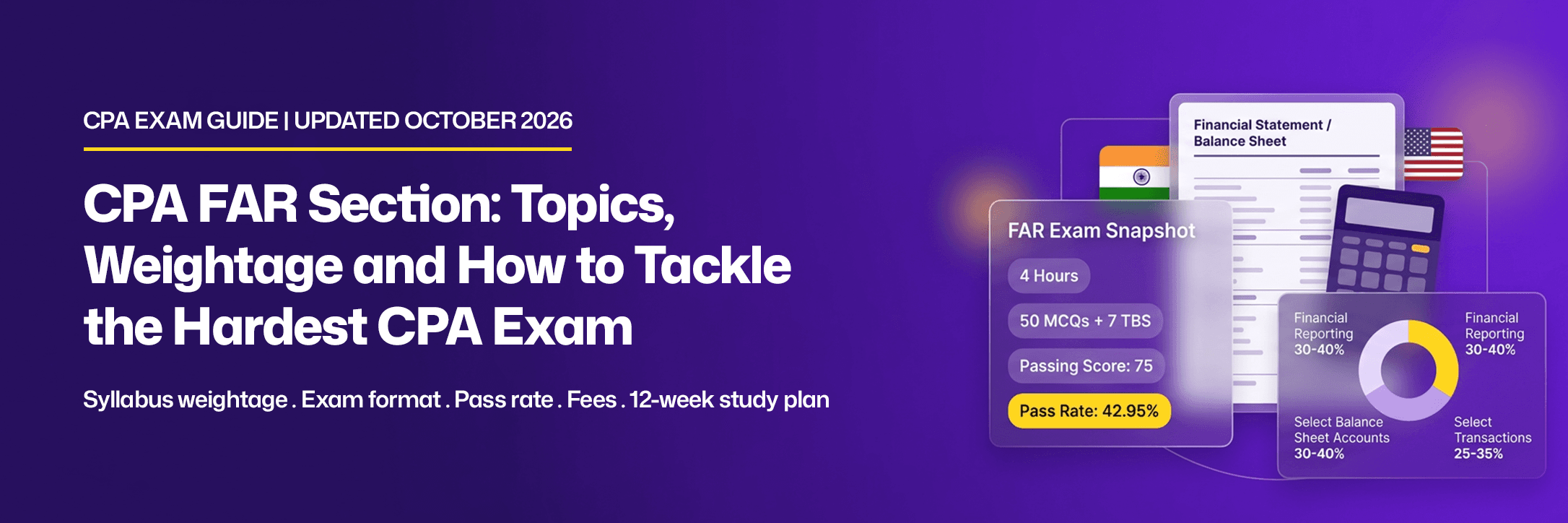
The 2026 AICPA blueprint divides FAR into three content areas. Financial Reporting carries 30-40% of the section. Select Balance Sheet Accounts carries another 30-40%. Select Transactions carries 25-35%.
The section is heavily focused on application and analysis. Memorizing accounting rules is not enough. You need to apply those rules to transactions, adjustments, financial statements, and simulations.
For an Indian candidate, the biggest challenge is often the gap between familiar accounting concepts and US GAAP treatment. Your CA, CMA, ACCA, B.Com, M.Com, or audit experience can help. You still need to learn the US reporting framework tested on FAR.
This CPA FAR section India study guide explains what you need to study. It also shows how you should allocate preparation time. You will learn which topics deserve priority and how to build a practical 12-week plan.
FAR stands for Financial Accounting and Reporting. It is one of the three Core sections of the Uniform CPA Examination. You must pass FAR along with AUD and REG. You must also pass one Discipline section. Your Discipline options are BAR, ISC, and TCP.
FAR tests whether you can apply financial accounting and reporting concepts. The section includes multiple-choice questions and task-based simulations.
You receive four hours for FAR. You answer 50 MCQs and seven TBSs. The two MCQ testlets contain 25 questions each. The three TBS testlets contain two, three, and two simulations.
Your FAR score uses a 50% MCQ and 50% TBS weighting. You need a scaled score of at least 75 to pass. A score of 75 does not mean you answered 75% of questions correctly. The AICPA uses scaled scoring and considers item difficulty.
For Indian candidates, the exam can be taken in India through the international administration system. NASBA lists India among the available international testing locations.
The 2026 CPA FAR blueprint gives you three major content areas. You should use these ranges to guide your study time.
Financial Reporting covers the broad reporting framework. You need to understand financial statements and reporting requirements.
You should study general-purpose reporting for for-profit entities. You should also understand nongovernmental not-for-profit reporting.
The area includes public company reporting topics. It also includes special purpose frameworks and state and local government concepts. Financial statement ratios and performance metrics are also included. You should know what common ratios measure and how reporting changes affect interpretation.
Do not treat this area as pure theory. You should practice preparing and correcting financial statements.
Area II is equally important. It focuses on selected balance sheet accounts and related accounting treatment. You should learn the recognition, measurement, presentation, and adjustment of major accounts.
This area can become calculation-heavy. You need to know the accounting logic behind each calculation.
For example, inventory questions may test measurement and valuation. Receivable questions may require allowance calculations. Debt questions may require amortization and journal entries.
Your study method should follow a fixed sequence. First learn the rule. Then solve a basic example. Next solve a mixed question. Finally solve a TBS that requires multiple steps.
Area III covers accounting transactions that require deeper application. It is smaller than the first two areas by blueprint range. It can still produce difficult questions.
You should focus on decision-making rather than memorization. Many questions ask you to identify the correct accounting treatment first. Revenue recognition is a good example. You need to identify the relevant arrangement and determine when revenue is recognized.
Income tax accounting can also create difficulty. You need to separate financial reporting from tax rules. Lease accounting requires careful attention to classification, measurement, and journal entries. Subsequent events require you to distinguish adjusting events from disclosure matters.
The blueprint gives you ranges rather than exact question counts for individual topics. You should not assume that one topic always receives a fixed number of questions.
| FAR Content Area | 2026 Blueprint Weight | Suggested Share of Study Time |
|---|---|---|
| Financial Reporting | 30–40% | 30–35% |
| Select Balance Sheet Accounts | 30–40% | 30–35% |
| Select Transactions | 25–35% | 25–30% |
| Mixed Revision and TBS Practice | Not separately weighted | 10–15% |
Your exact study allocation should reflect your background. A CA with strong financial reporting experience may need less time for basic accounting. You may need more time for US GAAP differences. A B.Com graduate may need more time for core accounting concepts. Do not build your plan around perceived topic popularity. Build it around the official blueprint and your practice performance.
FAR has a reputation for difficulty because you must cover broad content. You also need to apply accounting rules accurately. The current pass rate supports the need for serious preparation. AICPA reported a 42.95% cumulative FAR pass rate for Q1 and Q2 of 2026.
That figure is not an India-specific pass rate. The AICPA publishes section pass rates for the CPA Exam overall. You should therefore avoid claims about a separate CPA FAR pass rate India unless a reliable official source provides one.
FAR is also demanding because of its skill weighting. The 2026 blueprint assigns 45-55% to application. It assigns another 35-45% to analysis. Together, those ranges show that most of the section tests more than basic recall.
US GAAP Is Different From Indian Accounting Practice
You may already understand accounting principles. You still need to learn how those principles operate under US GAAP. Indian candidates often have experience with Ind AS or older Indian GAAP. CA candidates may also have strong financial reporting knowledge.
That background gives you an advantage. It does not remove the need to learn US-specific accounting treatment. You should create a comparison notebook for concepts that repeatedly cause confusion. Focus on recognition, measurement, presentation, and disclosure.
FAR Requires Strong Journal Entry Skills
Many FAR problems become easier when you understand the journal entry. Do not rely only on formulas. Write the entry and identify which accounts change. This approach helps with inventory, leases, debt, revenue, income taxes, and error corrections. You should practice entries until the underlying logic becomes automatic.
TBSs Require You to Combine Multiple Concepts
A TBS can present information from several documents. You may need to calculate amounts and adjust financial statement balances. You therefore need more than MCQ speed. You need a process for reading exhibits and identifying relevant information. Start by reading the requirement. Then identify the accounts involved. Next determine the accounting rule. Finally calculate and verify your answer.
You Need to Manage Four Hours Carefully
FAR gives you four hours. You need to balance MCQs and TBSs without spending too long on one problem. A practical approach is to keep your MCQ pace controlled. You should also reserve meaningful time for the simulations. Do not aim to finish MCQs as quickly as possible. Aim to finish them with enough time for TBSs. Your practice exams should replicate the real time pressure. Use a timer and avoid checking answers during the test.
There is no official AICPA study-hour requirement for FAR. Your required study time depends on your accounting background and preparation quality.
For planning purposes, many working candidates can use a range of 120 to 180 focused hours for FAR. Treat this as a planning estimate, not an official requirement.
If you have a CA background, you may need fewer hours for basic accounting topics. You may still need substantial time for US GAAP-specific areas. If your accounting foundation is weak, you may need more than 180 hours.
A working professional studying 12 hours each week can reach 144 hours in 12 weeks. A 15-hour weekly schedule gives you 180 hours. You should measure progress by practice performance rather than hours alone. If your scores remain weak, add targeted practice.
Start With the Blueprint
Download the current AICPA blueprint before starting your study plan. Mark every FAR content group you need to cover.
Use the blueprint as your syllabus control document. Do not let your study provider's chapter order become your only structure.
The AICPA states that its blueprints organize content by area, group, and topic. They also provide score weighting and sample task statements.
The AICPA has also published the 2027 blueprint, effective January 1, 2027. If you plan to test from that date onward, review the latest applicable blueprint before finalizing your plan.
Build Concept Maps
Create one-page maps for major FAR topics. Put the accounting rule in the center. Add recognition, measurement, journal entry, presentation, and disclosure around it. This method is useful when you revisit a topic after several weeks.
Use MCQs to Learn and TBSs to Prove Understanding
You should not treat MCQs as the final stage of preparation. Early in your study cycle, use MCQs to identify gaps. Review every incorrect answer and every lucky guess. Later, increase TBS practice. You need to become comfortable with exhibits and multi-step calculations.
AICPA also provides a retired FAR TBS. You can use it to understand the type of simulation work you may encounter.
Keep an Error Log
Your error log should record the topic, mistake, correct rule, and prevention method. Do not write long explanations. Keep each entry short enough to review quickly. For example, record the trigger that caused your error. Then record the accounting treatment you should have applied. Review the log twice each week. This turns repeated mistakes into targeted revision.
The following plan assumes about 12 to 15 study hours each week. You can increase the pace if you have more available time.
| Week | Primary Focus | Practice Target |
|---|---|---|
| 1 | FAR orientation and financial reporting basics | 100 MCQs |
| 2 | Financial statements and reporting | 120 MCQs |
| 3 | NFP, special purpose frameworks, government concepts | 120 MCQs |
| 4 | Cash, receivables, and inventory | 140 MCQs |
| 5 | PP&E and intangible assets | 140 MCQs |
| 6 | Investments, pensions, debt, and liabilities | 140 MCQs |
| 7 | Equity, accounting changes, and error corrections | 140 MCQs |
| 8 | Revenue recognition and contingencies | 140 MCQs |
| 9 | Income taxes, fair value, and leases | 150 MCQs plus TBSs |
| 10 | Subsequent events and mixed topics | 150 MCQs plus TBSs |
| 11 | Full mixed revision | 2 simulated exams |
| 12 | Final review and exam conditioning | 2 full simulations |
Your weekly schedule should include at least one dedicated TBS session from the middle of your preparation. You should increase TBS volume during Weeks 9 through 12. Your final two weeks should focus on mixed practice rather than new chapters. If you work in audit or financial reporting, use your job exposure as reinforcement. Do not assume practical experience replaces exam practice.
If you are an Indian CA, FAR can feel familiar at first. That can become a strength or a trap. Your accounting foundation may reduce the time needed for basic concepts. You may already understand financial statements, consolidation, accounting estimates, and audit-related evidence.
However, you need to identify US GAAP differences early. You should also learn the FAR terminology used in the CPA exam. Do not study FAR as if it were another Indian accounting paper. Your objective is to apply US accounting and reporting rules. If you are an ICAI student or qualified CA, create a separate US GAAP notes section. Add only concepts that differ from your existing knowledge.
You can also use your CA experience to speed through familiar fundamentals. Then redirect that time toward unfamiliar US-specific areas.
NASBA currently lists an international administration fee of US$460 for FAR in India. At an illustrative rate of ₹97 per US$1, that is approximately ₹44,600.
This is only the international administration fee. Your total CPA cost can also include application, examination, evaluation, and jurisdiction-specific fees.
Currency rates change. Your actual rupee amount will depend on the rate and payment charges when you pay. You should check the latest NASBA fee information before making a payment.
Indian candidates often search for a separate FAR pass rate for India. You should be careful with this metric. The AICPA publishes CPA Exam pass rates by section. Its current 2026 data shows a 42.95% cumulative FAR pass rate through Q2.
AICPA does not present that figure as an India-only FAR pass rate. You should therefore use the global section rate when discussing current FAR performance.
The number is useful for setting expectations. It is not a prediction of your individual result. Your own practice scores are more useful. If you consistently perform well across mixed MCQs and TBSs, your preparation is progressing.
You should not schedule FAR solely because you completed every chapter. Use several readiness checks.
First, you should explain the accounting rule without looking at your notes. Second, you should solve mixed questions without knowing the topic in advance. Third, you should complete TBSs under time pressure. Fourth, you should review mistakes without repeating the same error. You should also take full simulated exams. Use them to identify timing problems and weak content areas. If one topic remains weak, do not restart the entire syllabus. Use your error log to target that topic.
Studying Only High-Weight Topics
Weightage should guide your preparation. It should not become a reason to ignore smaller topics. The blueprint gives ranges. Individual exam forms can test topics differently. You should cover the full blueprint before the exam.
Memorizing Without Understanding
FAR questions often require application and analysis. Memorization alone will not prepare you for those skills. Always ask why an accounting treatment works. Then practice applying it to a changed fact pattern.
Avoiding TBSs Until the End
TBSs represent half of the FAR score. You should not leave them for the final week. Start simulation practice once you understand the core concepts. Increase the volume as the exam approaches.
Using Outdated Study Material
Accounting standards and exam blueprints change. Your study material must match the current exam date. The AICPA publishes updated blueprints and policies for new pronouncements. You should check your materials against the applicable blueprint.
Ignoring Your Work Schedule
If you work in an Indian GCC, Big 4 firm, shared services center, or accounting team, your workload can change quickly. Avoid scheduling FAR preparation around your busiest reporting periods when possible. Use mornings for focused study if your evenings are unpredictable. Protect longer weekend sessions for TBS practice.
FAR is one of the hardest CPA sections for many candidates. Its broad syllabus and strong application focus explain much of that difficulty. However, you should not assume that FAR is automatically your hardest section. Your background matters. An Indian CA with financial reporting experience may find FAR more familiar than REG. A tax professional may find REG more comfortable. An accounting graduate with limited tax exposure may experience the opposite. The best strategy is to identify your own gap between familiarity and exam requirements.
If you want structured preparation for the US CPA in India, Board360's US CPA program gives you a dedicated preparation path for professional candidates.
You can use the structure to keep FAR preparation aligned with the current exam format. You can also review Board360's India-focused guide to recent CPA exam changes. It explains the Core and Discipline model and the major changes you need to understand.
Your FAR preparation should start with the official blueprint. It should then move into structured learning, question practice, TBS practice, and timed simulations. The right program can make that process easier to manage alongside work.
FAR rewards disciplined preparation more than last-minute memorization. You need to understand the three content areas and allocate your study time accordingly. You also need strong application skills because FAR tests more than basic recall.
For 2026, Financial Reporting and Select Balance Sheet Accounts each carry 30-40%. Select Transactions carries 25-35%. Your exam includes 50 MCQs and seven TBSs. Each component contributes 50% to your score.
The current cumulative FAR pass rate through Q2 2026 is 42.95%. Use that figure to set realistic expectations, not to predict your result. If you study consistently for 12 weeks, practice the full blueprint, and build strong TBS skills, FAR becomes more manageable. Your accounting background can help you. Your preparation must still be built around US GAAP and the current CPA exam blueprint.