

Menu
✕
Published: October 9, 2026>Board360
If you are preparing for the US CPA in India, REG may be your first close encounter with the U.S. federal tax system. You need to learn its rules, forms, deadlines, and business law concepts. Your Indian accounting background can help, but it will not replace U.S. tax knowledge.
The 2026 CPA REG blueprint divides the section into five content areas. Federal taxation of individuals and entities carry the largest weight ranges. Ethics, procedures, property transactions, and business law remain important too.
The exam also tests how you apply rules to client situations. You may need to calculate taxable income, identify a filing issue, or analyze supporting documents. For that reason, your preparation needs concepts, calculations, question practice, and tax simulations.
This CPA REG section India study guide explains what to study and how to organize your preparation. It also covers the tax-law changes relevant to candidates sitting in 2026.
REG stands for Regulation. It is one of the three Core sections of the Uniform CPA Examination. You must pass REG, AUD, and FAR, plus one selected Discipline section.
REG focuses on U.S. federal taxation, professional responsibilities in tax practice, and business law. The federal tax portion includes individuals, business entities, and property transactions. Business law tests legal concepts that affect commercial relationships and transactions.
You do not need to live in the United States to sit for the exam. NASBA lists India as an international testing location. You must first qualify through a participating U.S. jurisdiction and receive your Notice to Schedule.
Read the current NASBA international administration guidance carefully before you pay fees or choose your appointment. Eligibility rules and licensing requirements vary by jurisdiction.
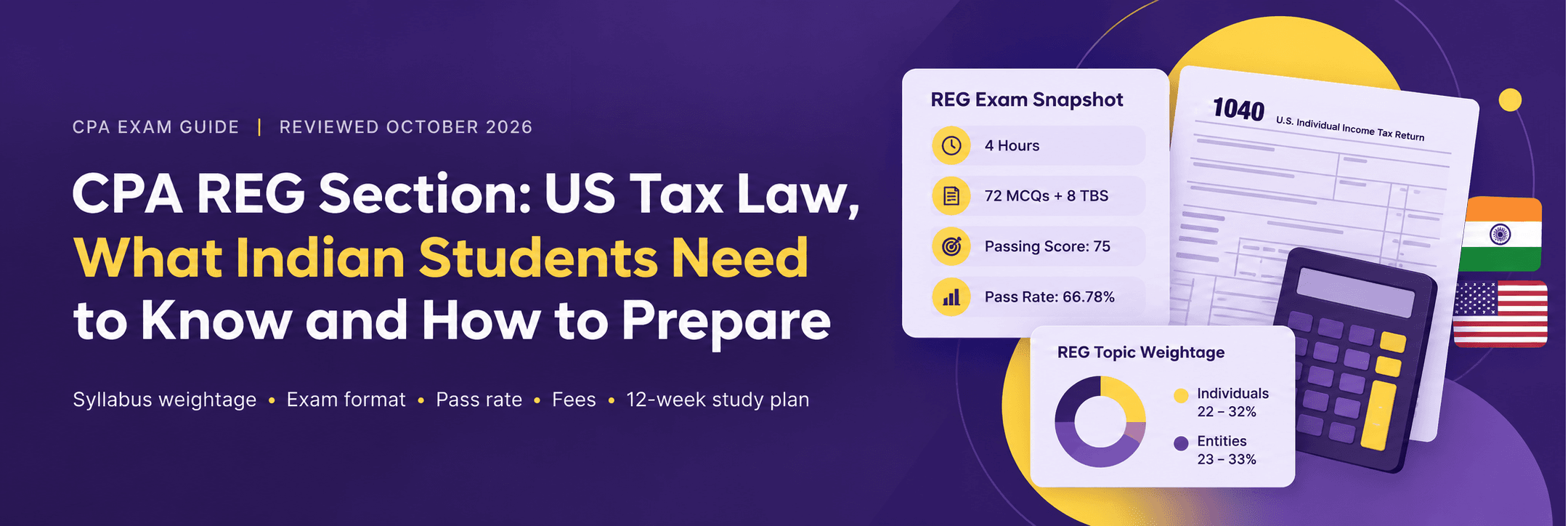
REG gives you four hours to complete 72 multiple-choice questions and eight task-based simulations. The MCQs appear in two testlets of 36 questions each. The TBSs appear in three testlets containing two, three, and three simulations.
Your score combines MCQ and TBS performance, with each component weighted at 50%. You need a scaled score of 75 to pass. A score of 75 does not mean you answered 75% of the questions correctly.
The AICPA uses scaled scoring to account for question characteristics and difficulty. Review the official CPA Exam scoring explanation so you understand how the result is reported.
Do not study only for speed or memorization. You need to explain why a tax treatment applies, calculate the outcome, and interpret supporting facts. Simulations can test several connected steps in one question.
Use the 2026 AICPA CPA Exam Blueprint as your syllabus control document. It provides tested content, content-area weights, skill allocations, and representative task statements. The percentages below are ranges, not fixed question counts.
| REG Content Area | 2026 Blueprint Weight | Preparation Priority |
|---|---|---|
| I. Ethics, Professional Responsibilities and Federal Tax Procedures | 10–20% | Understand professional duties, IRS practice rules, penalties, disclosure, and audit processes. |
| II. Business Law | 15–25% | Learn contracts, agency, debtor-creditor topics, business structures, and federal legal rules. |
| III. Federal Taxation of Property Transactions | 5–15% | Practice basis, depreciation, gains and losses, and nonrecognition rules. |
| IV. Federal Taxation of Individuals | 22–32% | Prioritize income, deductions, filing status, credits, and individual tax calculations. |
| V. Federal Taxation of Entities, including Tax Preparation | 23–33% | Prioritize C corporations, S corporations, partnerships, book-tax differences, and entity returns. |
Areas IV and V are the largest individual ranges in the blueprint. Do not ignore the other three areas because they can still account for a meaningful portion of your exam.
This area tests what you may do as a tax practitioner and how federal tax procedures operate. You should learn the rules governing practice before the IRS. You should also understand tax return preparer responsibilities and potential penalties.
Indian audit experience can help you think critically about documentation and professional responsibility. The terminology and enforcement framework are different, however. Study the U.S. rules directly instead of translating Indian tax procedures word for word.
Business Law covers legal principles that influence contracts and business operations. You need to recognize the legal consequences of a scenario. Many questions are easier when you identify the parties, duties, and remedy involved.
Do not spend all your Business Law time reading notes. Convert definitions into short scenarios. Then identify the rule that decides the outcome.
Property questions test the tax consequences of owning, using, and disposing of assets. You should be comfortable calculating basis and identifying realized gains or losses. You also need to recognize when a tax rule delays recognition.
Build a consistent calculation template. Record adjusted basis, amount realized, selling costs, and the resulting gain or loss. Then check whether a special rule changes the result.
Use the IRS's individual federal income tax guide as a reference for the structure and language of individual tax rules. It is not a substitute for your exam course or the current blueprint.
Your target is not to become an expert in every possible taxpayer situation. It is to master the routine and recurring transactions described by the blueprint. Practice calculations until you can identify the relevant rule quickly.
Entity taxation is another high-weight REG area. You need to compare how corporations and pass-through entities report income. You should understand how book income differs from taxable income.
CA candidates may already understand financial statements and business entity structures. You still need U.S. federal tax rules, U.S. return terminology, and the specific treatment tested in REG. Practise using simplified trial balances and supporting documents. Identify each item as book-only, tax-only, permanent, or temporary where relevant. Then calculate the return impact instead of only memorizing the definition.
You may be familiar with Indian income tax, GST, TDS, tax audits, or company law. REG uses different statutes, agencies, forms, and concepts. You need a planned transition into U.S. federal tax rather than a direct translation from Indian law.
Learn the U.S. tax vocabulary
Start with terms such as gross income, adjusted gross income, taxable income, deduction, credit, basis, amount realized, and filing status. These terms appear repeatedly in tax calculations. Keep a glossary with a definition and one worked example for each term.
Understand tax returns as connected documents
REG questions may ask you to prepare, review, or analyze return information. You should know the purpose of Form 1040 for individuals. You should also recognize the general roles of Forms 1120, 1120-S, and 1065.
You do not need to memorize every form line without context. Instead, learn how a transaction affects taxable income and where that effect flows. Use official IRS small-business tax resources to build a map of business filing topics.
Separate U.S. tax rules from Indian tax assumptions
Do not assume that an Indian deduction or exemption has a U.S. equivalent. The rules may differ even when the underlying transaction looks familiar. Write down the U.S. rule before comparing it with your Indian knowledge.
If you are a qualified CA, use your existing skills in research, audit evidence, and financial analysis. Spend more time on U.S. tax vocabulary, calculations, and federal law. If you are a B.Com or M.Com graduate, first strengthen basic accounting and business concepts.
Tax law can change after study materials are published. The One Big Beautiful Bill Act, also known as H.R. 1 or OBBBA, introduced multiple federal tax changes. The AICPA states that provisions with 2024 and 2025 effective dates became eligible for REG and TCP testing from July 1, 2026.
Read the AICPA's explanation of how the CPA Exam incorporates new tax law and check your exam provider's update notes. Use only material that matches your planned exam date. A course built for an earlier testing window may not include every current rule.
The IRS has published current guidance on individual tax changes under the law. You should use the official guidance to confirm a rule when your course identifies a specific provision. Avoid studying every tax news story without checking its relevance to the REG blueprint.
For exam preparation, focus on what is testable rather than broad policy debate. Know the relevant effective dates, calculation changes, and rules included in your updated study materials. Do not assume every new provision is immediately tested.
The AICPA publishes CPA Exam pass rates by section and quarter. Its latest published figures for the first two quarters of 2026 show a cumulative REG pass rate of 66.78%. This is an overall section rate, not an India-only pass rate.
You should not treat that percentage as the probability that you will pass. Candidates have different levels of preparation and professional experience. Your mock exam results and ability to handle unfamiliar questions provide more useful personal feedback.
| Period | Official Overall REG Pass Rate | How to Interpret It |
|---|---|---|
| Q1 2026 | 66.65% | Quarter-specific result reported by AICPA. |
| Q2 2026 | 66.87% | Quarter-specific result reported by AICPA. |
| Cumulative Q1–Q2 2026 | 66.78% | Latest cumulative figure in the published table used for this guide. |
| Full-Year 2025 | 63.12% | Prior-year comparison, not a prediction of your own outcome. |
Link to the AICPA pass-rate table whenever you publish or refresh this statistic. Check for newer quarterly data before republishing. Do not describe the overall pass rate as a specific pass rate for candidates from India.
Your study material should match the current AICPA blueprint and the law applicable to your exam date. It should explain concepts and provide enough MCQs, simulations, and mixed reviews. A large video library alone does not guarantee exam readiness.
Check the blueprint mapping
Confirm that every content area is covered. Your materials should include tax procedures, business law, property transactions, individual taxation, and entity taxation. Use the official blueprint as your checklist.
Check the tax update policy
Ask how the provider updates content after tax legislation changes. Look for dated update notes and clear coverage of effective dates. This is especially important for exams scheduled during a major tax-law transition.
Check simulations and explanations
Choose a question bank that explains why the correct option is correct. It should also explain why the other options are wrong. For simulations, practise working from exhibits and reconciling numbers to a requested output.
Build an error log
Record the topic, the rule you missed, and the reason for your mistake. Classify each error as a knowledge gap, calculation error, misread fact, or timing problem. Review the log at least twice each week.
The AICPA does not mandate a fixed number of preparation hours. As a planning estimate, you can begin with 120 to 180 focused study hours. Your actual needs depend on your tax background, familiarity with business law, and practice performance.
At 10 to 15 hours each week, a 12-week plan gives you 120 to 180 hours. If you have no U.S. tax background, allocate extra time to foundational concepts and worked examples. If you already work in U.S. tax compliance, you may move faster through familiar topics.
Do not treat time spent watching videos as proof of mastery. Track practice accuracy, retention, speed, and the ability to complete simulations. If you are repeatedly missing a concept, revisit it before moving to mixed practice.
This plan assumes 10 to 15 focused hours each week. Adjust the order if your diagnostic test reveals major weaknesses. Keep one lighter review session each week to revisit older topics.
| Week | Primary Focus | Practice and Review Target |
|---|---|---|
| 1 | Exam orientation, tax vocabulary, and federal tax procedures | Read the blueprint, begin a glossary, and complete 60–80 MCQs. |
| 2 | Ethics, professional responsibilities, and tax procedures | Practice IRS practice rules, penalties, disclosure, and audit procedures. |
| 3 | Business Law fundamentals | Work through contracts, agency, and business structures; complete 80–100 MCQs. |
| 4 | Business Law application and review | Use scenarios covering breach, remedies, creditor rights, and applicable laws. |
| 5 | Property basis and cost recovery | Solve basis, depreciation, holding-period, and gain or loss calculations. |
| 6 | Individual taxation: gross income and adjustments | Practice income inclusions, exclusions, adjustments, and taxable income. |
| 7 | Individual deductions, credits, filing status, and returns | Solve mixed individual tax questions and review current tax updates. |
| 8 | Entity taxation: C corporations | Practice taxable income, credits, limitations, and book-tax differences. |
| 9 | S corporations, partnerships, and pass-throughs | Compare ordinary income, separately stated items, and entity reporting. |
| 10 | Mixed MCQs and task-based simulations | Complete timed sets and review every error. |
| 11 | Full blueprint review and current-law check | Take one timed mock; revisit weak topics and updated tax provisions. |
| 12 | Exam conditioning and final revision | Take another mock, revise your error log, and reduce new content. |
The question counts are practice suggestions rather than official AICPA requirements. Add more questions when your accuracy is low. Shift extra time toward simulations once you understand the core rules.
Use a repeatable MCQ method
Read the final requirement before calculating. Identify the taxpayer or entity, tax year, transaction, and requested amount. Then select the rule and eliminate answers that contradict it. After each question, explain the rule in your own words. Review correct answers when you guessed or used an unreliable shortcut. Keep notes short enough to review during the final week.
Use an exhibit-first approach for simulations
For a TBS, scan the requirement and identify the output first. Then inspect the exhibits for facts that affect the calculation. Ignore irrelevant details unless they help resolve an ambiguity. Write intermediate calculations clearly and check signs, basis, and totals. If a simulation includes several parts, complete the sections you understand before returning to harder requirements. Practise under time limits before exam day.
Balance accuracy with timing
Do not spend several minutes trying to rescue one confusing MCQ. Make the best choice you can, mark it for review when the platform permits, and move forward. Reserve enough time for the simulations.
Your background determines where you start, but everyone must learn the REG syllabus. A qualified Indian CA may recognize financial reporting and professional conduct concepts. A tax professional may understand return review and documentation discipline.
If you work in Indian tax, be especially careful with differences between Indian income tax rules and U.S. federal rules. Similar words do not always mean similar treatment. Use separate notes for U.S. definitions and calculations.
If you are from a B.Com or M.Com background, use simple accounting examples before advanced tax questions. Build comfort with percentages, deductions, taxable income, and entity types. Short daily sessions can help you retain unfamiliar terminology.
If you are a working professional in a Big 4 firm, GCC, shared services team, or tax outsourcing company, plan around busy periods. Reserve a predictable study block on weekdays and longer practice sessions on weekends. Protect your revision time near the exam date.
NASBA lists an international administration fee of US$460 for each CPA Exam section taken in India. At an indicative rate of ₹96.82 per US$1 on October 9, 2026, the fee is approximately ₹44,500. The conversion is illustrative and may change with exchange rates or payment charges.
This international fee is separate from domestic examination fees, application charges, evaluation fees, and jurisdiction-specific costs. Review the official NASBA international exam fees and process before budgeting. International fees are listed as non-refundable by NASBA.
Using old study material
An older course may not reflect current blueprint details or tax-law updates. Confirm the effective date of the material and check whether it includes the current testable provisions.
Memorizing tax tables without understanding the flow
You need to know how amounts flow from gross income to taxable income and tax liability. Learn the purpose of each adjustment before memorizing a formula or threshold.
Ignoring Business Law
Business Law has a 15-25% blueprint range. It is not a minor topic. Schedule regular practice instead of leaving it for the final days.
Practising MCQs but not TBSs
TBSs make up half of the REG score weighting. Practise exhibits, calculations, and response formats throughout preparation. Do not wait until the final week to begin simulations.
Treating overall pass rates as personal odds
The pass rate reflects a broad candidate group. It does not measure your individual readiness. Use mock scores and error patterns to decide what needs improvement.
You need a preparation routine that connects current exam requirements with consistent question practice. Board360's US CPA program can provide a structured learning path for candidates preparing alongside work or college.
Before you begin, review the published program structure and confirm that the content schedule aligns with your planned exam window. Pair your course with the official blueprint and current AICPA updates.
For the tax-law transition, read Board360's guide to OBBBA changes affecting REG and TCP from July 1, 2026. Use it alongside official AICPA and IRS materials, rather than as a replacement for them.
Your core routine should include concept learning, MCQs, TBSs, error-log reviews, and timed practice. Make current tax-law verification a scheduled step, not a last-minute task.