

Menu
✕
Published: October 26, 2026>Board360
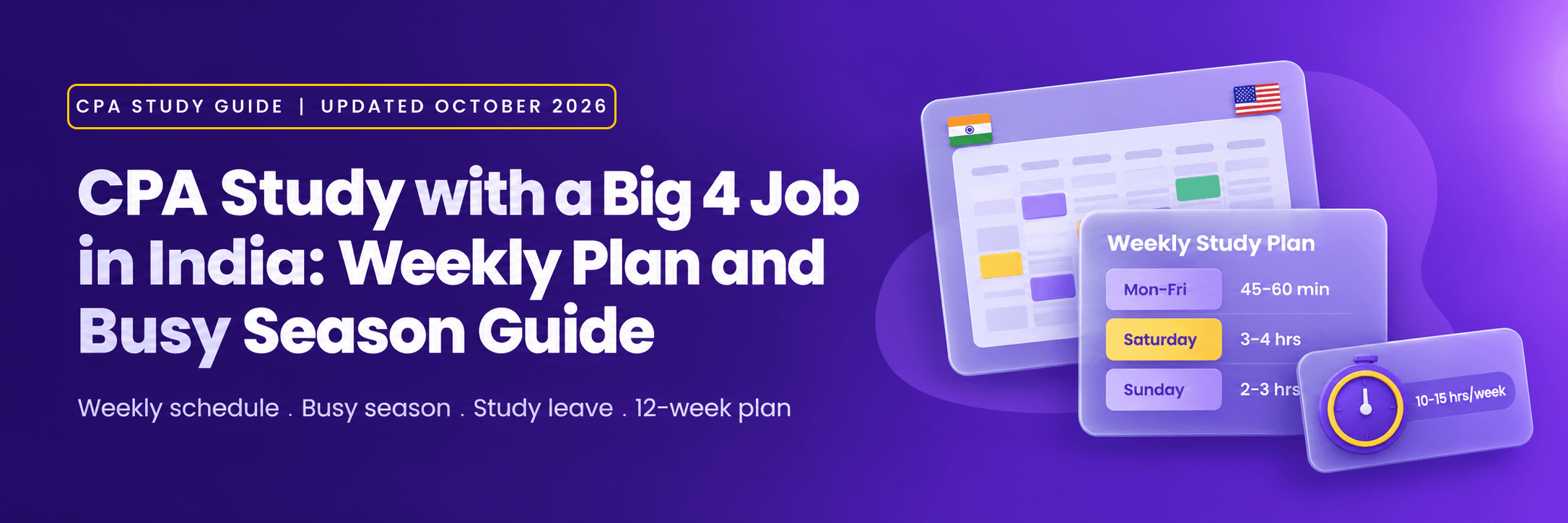
Your Big 4 job can make CPA preparation more relevant and more difficult at the same time. You may work with financial statements, controls, tax files, or US GAAP reporting. Those tasks can reinforce exam concepts, but they cannot replace structured practice.
Your real challenge is protecting study time during deadlines, client calls, review notes, and peak season. The solution is not to study every evening for three hours. You need a flexible routine that survives busy weeks and uses quieter weeks well.
This guide gives you a practical framework for studying alongside a demanding role. It describes habits that can work for Board360 learners and other Indian professionals. It is not a claim that every student follows an identical schedule.
A fixed student timetable assumes predictable evenings and weekends. Your Big 4 calendar rarely behaves that way. A client escalation, inventory count, tax deadline, or late review can disrupt your original plan.
You should therefore build your plan around minimum, normal, and stretch commitments. Your minimum protects consistency during peak workloads. Your normal target moves the syllabus forward. Your stretch target helps you revise before an exam.
Board360’s guide for working CPA professionals in India uses the same principle: consistency matters more than a short burst of unsustainable effort. Treat your timetable as a system you can repeat, not a perfect calendar you must obey.
Start with a weekly target of 10 to 15 focused hours. This is a planning recommendation, not an official AICPA or NASBA requirement. Your weekly total should reflect your current section, prior accounting knowledge, and work intensity.
If you work in audit or US GAAP reporting, some FAR and AUD concepts may feel familiar. You still need exam-specific practice because the CPA tests knowledge through multiple-choice questions and task-based simulations. If you work in tax, parts of REG may connect to your experience. US federal tax rules can still be unfamiliar if your work mainly covers Indian tax compliance. If you work in technology risk, ISC may connect with controls and systems work.
Use these ranges to decide what your calendar can support:
| Workload Pattern | Weekly Study Target | Best Use |
|---|---|---|
| Peak client or audit week | 5 to 8 hours | Short MCQ sets, flashcards, and error-log review |
| Normal delivery week | 10 to 15 hours | New topics, MCQs, and one simulation block |
| Lighter workload or leave week | 15 to 20 hours | Mock exam, difficult topics, and structured revision |
| Final exam week | Plan around the exam and recovery | Light review, logistics, sleep, and travel planning |
Do not assume a stretch week will continue for months. A timetable that requires late nights every day becomes fragile during a long engagement.
Choose study blocks before the week starts. Put them in your calendar as appointments and decide what each block will achieve. Your goal is to reduce the daily friction of deciding when and what to study.
Morning sessions often work well before meetings begin. If your commute is long, use audio review or flashcards only when it is safe and practical. Save detailed calculations and simulation work for a desk and a focused block.
| Day | Suggested Duration | What to Do |
|---|---|---|
| Monday | 45 to 60 minutes | Review the previous topic and complete a short MCQ set |
| Tuesday | 60 minutes | Learn one topic and write a concise rule summary |
| Wednesday | 45 to 60 minutes | Practice MCQs and classify each error |
| Thursday | 45 to 60 minutes | Revisit weak areas and explain the rule aloud |
| Friday | 20 to 30 minutes | Light recall, flashcards, or an error-log review |
| Saturday | 3 to 4 hours | Study new material and complete a TBS practice block |
| Sunday | 2 to 3 hours | Mixed practice, weekly review, and next-week planning |
This schedule gives you a target of roughly 9 to 12 hours, depending on the block lengths. Add a short weekday session when your week is lighter. Do not sacrifice sleep to hit an arbitrary number. Your weekday work should focus on retrieval and practice. Use weekends for difficult new content and longer simulations. This division helps you make progress without requiring every evening to feel like another workday.
If You Work in Audit or Assurance
Your client work may help you understand audit evidence, internal controls, assertions, and risk assessment. It may also give you context for some financial reporting concepts. However, firm methodology and client procedures are not identical to CPA exam requirements.
Use work exposure to build intuition, then confirm the tested rule in your study material. Do not treat a familiar client process as proof that you know the exam topic. Practise MCQs and TBSs using the current AICPA CPA Exam Blueprints.
If You Work in Tax
Your tax calendar may become intense around Indian filing deadlines and US tax deadlines. Plan lower-volume study weeks during predictable peaks. Use quieter periods for REG topics that require uninterrupted concentration.
Indian tax experience can improve your comfort with tax documentation and client communication. It does not automatically prepare you for US federal tax rules or US business law. Keep a separate list of concepts that are new to your work background.
If You Work in Advisory, Consulting, or Deals
Your schedule may change with proposals, workshops, and transaction deadlines. Choose flexible blocks that can move within the same week. For technical topics, protect one longer weekend session rather than depending on scattered late-night study.
If You Work in a GCC or US-Facing Accounting Team
You may encounter US GAAP, reconciliations, close procedures, controls, or reporting packages. This can support FAR and AUD study. You must still study topics outside your role and practice under exam timing.
Busy season should change your study target, not automatically cancel your preparation. Set a minimum weekly commitment that you can maintain during difficult weeks. For example, you might complete two short MCQ sessions and one weekend review.
Before a predictable peak, try to finish the main content for your current topic. Then use the busy period for maintenance. During a quieter period, return to simulations and mixed practice. Avoid booking an exam date based only on your hoped-for workload.
You should not measure success by uninterrupted streaks. Measure it by how well you return to the plan after a difficult work period. A sustainable routine accounts for predictable disruptions instead of pretending they will not happen.
Do not assume that every firm, office, service line, or manager offers the same study leave. Policies can vary by country, business unit, employment level, and exam stage. Confirm the current policy with HR or your internal learning team.
Ask about exam fee reimbursement, approved study resources, leave days, eligibility after probation, required documentation, and repayment conditions. Get the terms in writing before building your exam timeline around them. A useful discussion can be direct and specific. Explain which section you plan to sit, when you expect to test, and how you will maintain client delivery. Ask what formal support is available rather than requesting an informal exception first.
If leave is not available, plan annual leave or personal time carefully. Reserve days for your final revision only after checking the leave approval process. Do not rely on an unconfirmed promise when you pay exam fees or book travel. Keep the plan professional and confidential where needed. Your exam preparation should not involve sharing client information in notes or practice examples. Use only permitted material, and follow your firm’s independence and confidentiality policies.
Your job provides context, not guaranteed exam marks. CPA questions may test a concept from a different angle than your work does. A reviewer note from a real engagement is not a substitute for knowing the underlying accounting rule. After a relevant workday, write down the exam concept in general terms. Do not copy client names, balances, workpapers, screenshots, or confidential details. Later, solve a practice question that tests the same principle.
Separate on-the-job learning from exam mastery. Your work may help you understand why a control matters. Your study material must still teach you how the exam expects you to identify, evaluate, and apply that control concept. For every major topic, check whether you can do three things: explain the rule, answer mixed MCQs, and complete a relevant simulation. If you cannot do all three, keep it in your revision plan.
When You Have 20 Minutes
Complete a short set of MCQs or revisit recent mistakes. Write one sentence explaining why each incorrect answer was wrong. This is enough to preserve momentum during a late client day.
When You Have 45 to 60 Minutes
Study one narrow topic, then test yourself immediately. Avoid watching a long lecture passively. Pause to solve questions and capture the concepts you repeatedly miss.
When You Have 90 Minutes
Use the first half for a concept or mixed question set. Use the second half to review explanations and update your error log. Finish by choosing the first task for your next session.
When You Have a Weekend Block
Start with a clear goal, such as completing one TBS set or finishing a difficult topic. Keep your phone away and use timed sessions. End with a short summary that you can review during a busy weekday.
A simple tracker can prevent wasted time. Record the topic, date studied, MCQ accuracy, simulation status, and next action. Use your results to decide what needs review rather than relying on how familiar the lecture felt.
| Tracker Field | What You Record | How It Helps |
|---|---|---|
| Topic | Section and blueprint topic | Shows syllabus coverage |
| Practice Result | Questions attempted and accuracy | Identifies weak or unstable areas |
| Error Category | Knowledge gap, misread, calculation, or timing | Shows why you lost marks |
| TBS Status | Completed, reviewed, or repeated | Prevents simulation practice from being postponed |
| Next Action | Exact exercise for the next session | Removes uncertainty when time is short |
Keep your tracker small enough to maintain. A complicated dashboard can become a distraction. Your next study action should be obvious within a few seconds.
The AICPA 2026 CPA Exam Blueprints should anchor your content plan. Use them to check the topics and skill expectations for your chosen section. Do not assume your workplace covers the entire blueprint.
Use the official CPA Exam sample test to learn the software interface before exam day. It helps you become comfortable with the test environment and spreadsheet tools. It is not a substitute for section-specific question practice.
Read the NASBA 2026 Candidate Guide for application instructions, scheduling, international testing, and test-day rules. Your own jurisdiction controls important eligibility requirements, so check the relevant state board before committing to a timeline. If you plan to test in India, review NASBA’s international exam information and confirm your jurisdiction participates. Keep exam administration tasks separate from study tasks. This prevents deadlines and documentation from disrupting your revision window.
Use this plan for one section, not all four. It assumes a 10 to 15-hour weekly average and allows for client demands. Adjust each week based on the section blueprint and your practice results.
| Week | Main Focus | Practice Target |
|---|---|---|
| 1 | Review blueprint, baseline test, and topic map | Diagnostic set and error log |
| 2 | Cover first major topic group | Focused MCQs after each lesson |
| 3 | Continue core content and journal-entry or rule practice | Mixed MCQs from Weeks 2 and 3 |
| 4 | Cover next topic group | One review session and timed question set |
| 5 | Study weaker and calculation-heavy topics | MCQs plus worked examples |
| 6 | Complete remaining first-pass content | Topic quiz and error review |
| 7 | Revisit topics with low practice accuracy | Targeted MCQs, no passive rereading |
| 8 | Begin regular task-based simulations | Two or more TBS practice blocks |
| 9 | Mix questions across completed topics | Timed mixed MCQs and TBSs |
| 10 | Take a simulated exam or long timed set | Record timing and content gaps |
| 11 | Repair weak areas based on results | Repeat selected questions and simulations |
| 12 | Final review and exam readiness check | Light review, exam logistics, and rest |
Do not treat the question counts in a commercial course as your only success measure. The quality of review matters as much as the number completed. You should be able to explain your errors and avoid repeating them. If your work schedule collapses during one week, preserve a small maintenance routine and shift the missed content forward. Do not compress two full weeks into a single exhausting weekend. Move your target date if the remaining plan no longer fits.
You need to manage four sections while remaining realistic about busy season. Start by mapping your likely peak months, planned leave, and client transitions. Then set one section milestone at a time rather than committing to an aggressive all-year schedule.
| Planning Phase | What You Do | Decision Gate |
|---|---|---|
| Before Starting | Confirm jurisdiction requirements and choose study resources | You know exam eligibility and application steps |
| Section Preparation | Follow a 10 to 15-hour weekly target and track weak areas | Practice results show progress across the blueprint |
| Final Preparation | Use timed mixed practice and simulations | You can finish within time and explain major mistakes |
| Between Sections | Review the result and plan the next section | Your work calendar supports the next target |
| During Peak Season | Switch to maintenance study and adjust milestones | You preserve knowledge without chronic sleep loss |
There is no single correct section order for every Big 4 employee. Your accounting background, role, and current workload should shape your sequence. Your chosen discipline should also align with the work you understand and the content you can prepare for responsibly.
For broader timeline planning, use Board360’s CPA preparation guide for working professionals. It can help you compare weekly commitments with the full exam journey. Keep enough buffer for retakes, score releases, and work changes.
Mistake 1: Planning for Your Best Week
A schedule built around a quiet week may fail as soon as client work expands. Plan around your normal workload and create a smaller version for peak periods. Add extra hours only when your calendar allows them.
Mistake 2: Watching Lectures Without Retrieval Practice
Watching lessons feels productive, but it does not show whether you can retrieve and apply the rule. Add MCQs and short explanations after every topic. Keep a record of wrong answers and lucky guesses.
Mistake 3: Waiting for Study Leave
You may not receive formal leave, or approval may arrive late. Build a study routine that works before your leave starts. Use approved leave as a final review period rather than the foundation of your entire preparation.
Mistake 4: Studying After Midnight Every Day
Late-night sessions can cut into sleep and reduce focus the next day. Move your hardest work to a fresh part of the day when possible. Use short evening sessions for review, then protect a consistent sleep schedule.
Mistake 5: Assuming Client Experience Covers the Syllabus
Your engagement may expose you to a narrow range of transactions or control types. The CPA blueprint covers a broader body of knowledge. Use workplace context as reinforcement, then complete the missing syllabus topics.
Mistake 6: Hiding Your Plan Until You Need Help
Discuss relevant workload constraints early with your manager, mentor, or people lead. You do not need to share personal details beyond what is useful. Clear communication can help you plan leave and avoid preventable conflicts.
Your study system should combine structured content, deliberate practice, progress tracking, and review. If you prefer guided preparation alongside a full-time job, explore the Board360 US CPA program. Review the program structure and confirm that its current delivery format matches your working hours.
Before enrolling in any preparation program, compare the learning schedule, practice bank, simulation coverage, mentor access, and support terms. Ask how you can study when client calls interrupt a session. Check whether recorded content and short practice blocks fit your week.
Use the program to create consistency, not to outsource your responsibility for exam practice. You still need to follow the official blueprint, answer questions, review mistakes, and protect exam-focused time. A flexible system is useful only when you use it regularly. The best plan is the one that fits your real work calendar. It should help you keep moving during busy periods and deepen practice during quieter weeks. That approach makes CPA preparation easier to sustain alongside demanding client work.
You can study for the CPA while working at a Big 4 in India, but your plan must respect the job you already have. Build your week around short weekday sessions and longer weekend blocks. Set a minimum target for busy season and a stronger target for normal weeks.
Use your work exposure to understand concepts, but confirm every rule against your study material and the current blueprint. Ask about study leave and reimbursement early, and verify each policy with your firm. Keep your preparation measurable through practice results and an error log. You do not need a perfect week to make progress. You need a repeatable system, an honest workload assessment, and enough buffer to recover from disruptions. That is how you make a demanding professional qualification fit alongside a demanding job.